 Indietro
Guidance for Identifying Eukaryotic Cell Structures and Their Functions
Guida di studio - Note intelligenti
 Appunti personalizzati basati sui tuoi materiali, ampliati con definizioni chiave, esempi e contesto.
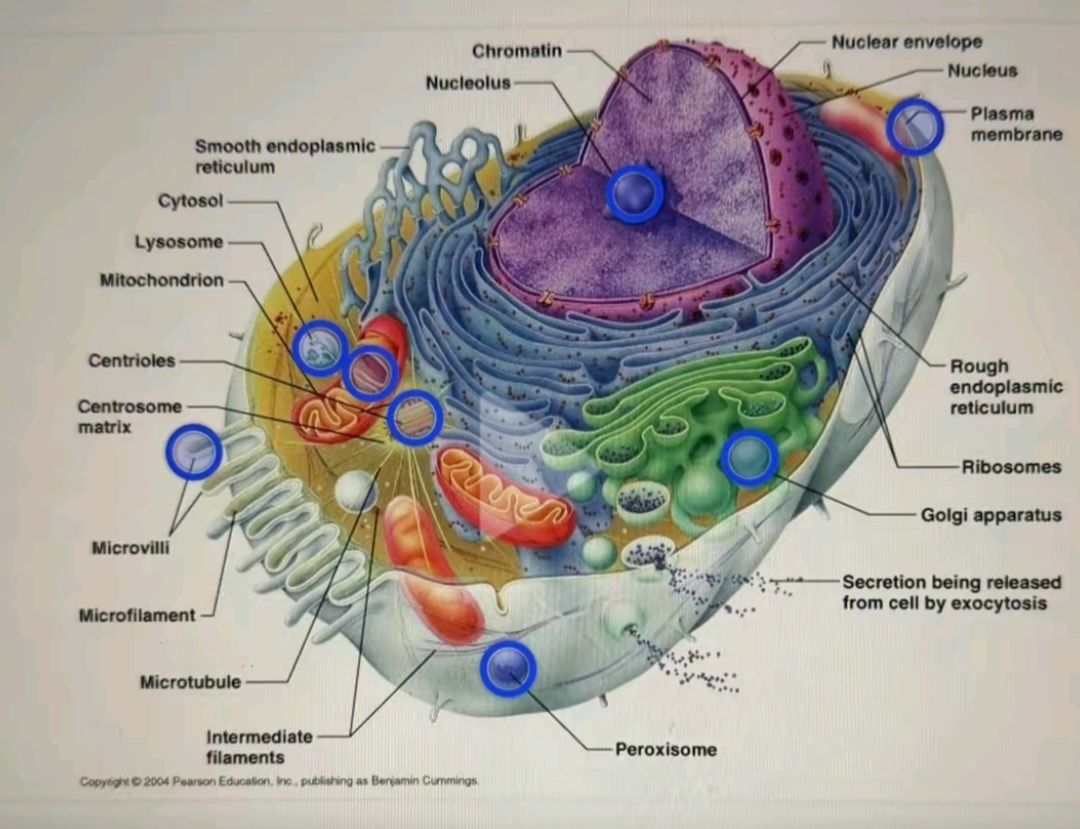
Q1. Identify the cell structures circled in blue and describe their functions.
Background
Topic: Eukaryotic Cell Structure and Function
This question tests your knowledge of the major organelles and structures found in a typical animal cell, as well as your understanding of their roles in cellular processes.
Key Terms:
Nucleus: The organelle that contains the cell's genetic material (DNA) and controls cellular activities.
Plasma Membrane: The boundary of the cell that regulates what enters and exits.
Mitochondrion: The site of cellular respiration and energy (ATP) production.
Centrioles: Structures involved in cell division and organization of microtubules.
Rough Endoplasmic Reticulum (RER): Organelle studded with ribosomes, involved in protein synthesis and processing.
Golgi Apparatus: Organelle responsible for modifying, sorting, and packaging proteins and lipids for secretion or delivery to other organelles.
Step-by-Step Guidance
Examine the diagram and locate each blue circle. Each circle highlights a specific organelle or cell structure.
Use the labels provided in the diagram to match each circled structure to its name. For example, one circle is around the nucleus, another around the mitochondrion, etc.
Recall the function of each organelle. For instance, the nucleus stores genetic information, the mitochondrion produces ATP, and the Golgi apparatus processes and packages proteins.
Write a brief description of the function for each identified structure. Make sure to use precise biological terminology.
For the last two circled structures, review their location and context in the cell to determine their identity and function, but do not write the final answer yet.
Try solving on your own before revealing the answer!
Final Answer:
Nucleus: Contains DNA and controls cell activities.
Plasma Membrane: Regulates entry and exit of substances.
Mitochondrion: Produces ATP through cellular respiration.
Centrioles: Organize microtubules during cell division.
Rough Endoplasmic Reticulum: Synthesizes and processes proteins.
Golgi Apparatus: Modifies, sorts, and packages proteins and lipids.
Each circled structure is a key organelle in the eukaryotic cell, and knowing their functions is essential for understanding cell biology.
