 Indietro
Guided Study for Chapter 1: Biology—Exploring Life
Guida di studio - Note intelligenti
 Appunti personalizzati basati sui tuoi materiali, ampliati con definizioni chiave, esempi e contesto.
Q1. A smart phone is not alive. List three characteristics of life that the phone does not exhibit.
Background
Topic: Characteristics of Life
This question tests your understanding of what defines living organisms, such as reproduction, response to environment, and homeostasis.
Key Terms:
Reproduction: The ability to produce offspring.
Response to environment: Reacting to stimuli in surroundings.
Homeostasis: Maintaining internal stability.
Step-by-Step Guidance
Recall the main characteristics that define life (such as reproduction, response to stimuli, growth, energy use, homeostasis, cellular organization).
Consider whether a smartphone can reproduce or make copies of itself without external help.
Think about whether a smartphone can respond to its environment in a biological sense (not just programmed responses).
Evaluate if a smartphone maintains internal conditions (like temperature or pH) automatically to stay alive.
Try solving on your own before revealing the answer!
Final Answer:
A smartphone does not reproduce, respond to its environment biologically, or maintain homeostasis. These are three essential characteristics of life that it lacks.
Q2. Does a motor vehicle fulfill any of the characteristics of life? If so, which one(s)?
Background
Topic: Characteristics of Life
This question asks you to compare non-living objects to living organisms based on their ability to exhibit life characteristics.
Key Terms:
Energy Utilization: The process of using energy to perform work.
Step-by-Step Guidance
List the characteristics of life (such as energy use, reproduction, growth, response to environment, homeostasis).
Think about how a motor vehicle uses energy (e.g., gasoline or electricity).
Compare this energy use to how living organisms use energy for cellular processes.
Consider whether the vehicle exhibits any other life characteristics, such as reproduction or response to stimuli.
Try solving on your own before revealing the answer!
Final Answer:
A motor vehicle utilizes energy, which is one characteristic of life, but it does not exhibit other characteristics such as reproduction or homeostasis.
Q3. Which of the following is the highest level of taxonomic organization?
Background
Topic: Taxonomy and Classification
This question tests your knowledge of the hierarchy of biological classification.
Key Terms:
Taxonomic Levels: Domain, Kingdom, Phylum, Species, etc.
Step-by-Step Guidance
Recall the order of taxonomic classification from broadest to most specific: Domain, Kingdom, Phylum, Class, Order, Family, Genus, Species.
Identify which option is the broadest category among the choices.
Compare the definitions of each term to determine which is highest.
Try solving on your own before revealing the answer!
Final Answer:
The highest level of taxonomic organization listed is Domain.
Q4. Complete the following table that compares the four kingdoms of the domain Eukarya.
Background
Topic: Classification of Eukaryotes
This question tests your understanding of the characteristics of Plantae, Animalia, Fungi, and Protista.
Key Terms:
Producers: Organisms that make their own food (e.g., plants).
Consumers: Organisms that eat other organisms (e.g., animals).
Decomposers: Organisms that break down dead material (e.g., fungi).
Protists: Diverse group, often unicellular.
Step-by-Step Guidance
Recall the main characteristics of each kingdom: Plantae (photosynthesis), Animalia (consumption), Fungi (decomposition), Protista (diversity).
Fill in the table with the defining features for each group.
Think about examples for each kingdom to help clarify their roles.
Try solving on your own before revealing the answer!
Final Answer:
Plantae: Producers, make food using sunlight. Animalia: Consumers, must feed for energy. Fungi: Specialized consumers, decompose dead matter. Protista: Not easily classified, many are unicellular.
Q5. What will all members of the domains Archaea and Bacteria have in common?
Background
Topic: Domains of Life
This question tests your understanding of prokaryotic and eukaryotic cell types.
Key Terms:
Prokaryotic: Cells without a nucleus.
Eukaryotic: Cells with a nucleus.
Step-by-Step Guidance
Recall the main differences between prokaryotes and eukaryotes.
Identify which domains are prokaryotic.
Review the characteristics shared by Archaea and Bacteria.
Try solving on your own before revealing the answer!
Final Answer:
All members of Archaea and Bacteria are prokaryotic, meaning they lack a nucleus.
Q6. Which of the following would be considered a population?
Background
Topic: Levels of Biological Organization
This question tests your understanding of what constitutes a population in biology.
Key Terms:
Population: A group of individuals of the same species living in a specific area.
Step-by-Step Guidance
Review the definition of a population in biology.
Analyze each option to see which fits the definition (same species, same location).
Eliminate options that refer to single organisms or mixed groups.
Try solving on your own before revealing the answer!
Final Answer:
A school of fish in a lake is considered a population because it is a group of the same species in one area.
Q7. The fact that new characteristics emerge as you go higher in biological levels is referred to as emergent properties.
Background
Topic: Emergent Properties
This question tests your understanding of how complexity increases at higher levels of biological organization.
Key Terms:
Emergent Properties: New characteristics that arise at higher levels of organization.
Step-by-Step Guidance
Recall examples of emergent properties (e.g., cells forming tissues, tissues forming organs).
Think about how individual parts combine to create new functions or properties.
Try solving on your own before revealing the answer!
Final Answer:
Emergent properties are new characteristics that arise as you move to higher levels of biological organization.
Q8. Science is an approach for understanding the natural world and its phenomena.
Background
Topic: The Process of Science
This question tests your understanding of what science is and how it is used to study the natural world.
Key Terms:
Science: Systematic study of the natural world through observation and experimentation.
Step-by-Step Guidance
Recall the definition of science and its main goals.
Think about how science uses evidence and reasoning to understand phenomena.
Try solving on your own before revealing the answer!
Final Answer:
Science is an approach for understanding the natural world and its phenomena.
Q9. Complete the table that compares qualitative data with quantitative data.
Background
Topic: Types of Scientific Data
This question tests your ability to distinguish between descriptive and numerical data.
Key Terms:
Qualitative Data: Descriptive, non-numerical information.
Quantitative Data: Numerical, measurable information.
Step-by-Step Guidance
Recall the definitions of qualitative and quantitative data.
Think of examples for each type (e.g., color, shape vs. weight, length).
Fill in the table with descriptions and examples for each type.
Try solving on your own before revealing the answer!
Final Answer:
Qualitative: Descriptive, e.g., mating habits. Quantitative: Numerical, e.g., weight measurements.
Q10. Which of the following is best described as a tentative explanation to an observation or set of observations?
Background
Topic: Scientific Method
This question tests your understanding of the terms used in scientific inquiry.
Key Terms:
Hypothesis: A tentative explanation for an observation.
Theory: A well-supported explanation.
Prediction: What you expect to happen.
Step-by-Step Guidance
Recall the definitions of hypothesis, theory, prediction, and results.
Identify which term refers to a tentative explanation.
Compare the options to see which fits best.
Try solving on your own before revealing the answer!
Final Answer:
A hypothesis is best described as a tentative explanation to an observation or set of observations.
Q11. Briefly explain what you would say to a student who believes a hypothesis and a theory are essentially the same.
Background
Topic: Scientific Method—Hypothesis vs. Theory
This question tests your ability to distinguish between a hypothesis and a theory.
Key Terms:
Hypothesis: Tentative explanation, not well supported.
Theory: Broad explanation, supported by evidence.
Step-by-Step Guidance
Recall the definitions and differences between hypothesis and theory.
Think about the level of evidence required for each.
Explain why a theory is more widely accepted and supported than a hypothesis.
Try solving on your own before revealing the answer!
Final Answer:
A theory is supported by a large body of evidence and is generally accepted, while a hypothesis is a tentative answer lacking substantial evidence.
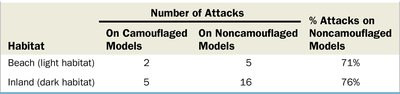
Q12. Were the observed number of attacks on noncamouflaged models greater than camouflaged models in the inland habitat? Use Table 1.5 on page 7 of your textbook.
Background
Topic: Experimental Data Interpretation
This question tests your ability to interpret data from an experiment about camouflage and predation.
Key Terms:
Camouflage: Adaptation that helps organisms blend in.
Predation: Interaction where one organism eats another.
Step-by-Step Guidance
Examine the table for the number of attacks in the inland habitat.
Compare the number of attacks on camouflaged vs. noncamouflaged models.
Calculate the difference between the two numbers.
Try solving on your own before revealing the answer!
Final Answer:
Yes, the observed number of attacks on noncamouflaged models was greater than on camouflaged models in the inland habitat.
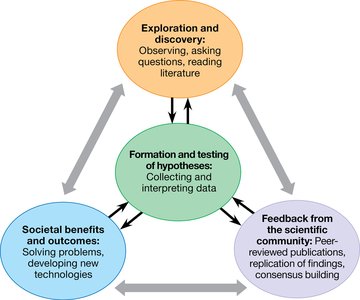
Q13. Does feedback from the scientific community influence the formation and testing of hypotheses? Use Figure 1.7 from page 9 of your textbook.
Background
Topic: Scientific Process—Peer Review
This question tests your understanding of how scientific ideas are shaped by community feedback.
Key Terms:
Peer Review: Evaluation by other scientists.
Hypothesis Formation: Developing testable explanations.
Step-by-Step Guidance
Recall the steps of the scientific method and the role of peer review.
Examine Figure 1.7 to see how feedback is integrated into the process.
Think about how replication and consensus building affect hypothesis testing.
Try solving on your own before revealing the answer!
Final Answer:
Yes, feedback from the scientific community is an integral component of forming and testing hypotheses.
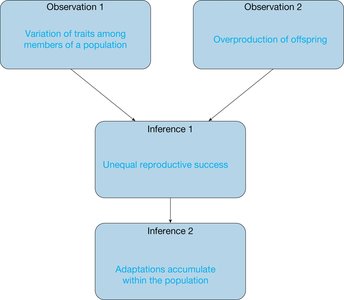
Q14. Fill in the following illustration regarding Darwin’s theory of evolution by natural selection.
Background
Topic: Evolution by Natural Selection
This question tests your understanding of Darwin's observations and inferences about evolution.
Key Terms:
Variation: Differences among individuals.
Overproduction: Producing more offspring than can survive.
Unequal Reproductive Success: Some individuals reproduce more than others.
Adaptation: Traits that increase survival and reproduction.
Step-by-Step Guidance
Review Darwin's two main observations: variation among individuals and overproduction of offspring.
Understand how these lead to unequal reproductive success.
Recognize that adaptations accumulate in the population over time.
Try solving on your own before revealing the answer!
Final Answer:
Observation 1: Variation among members of a population. Observation 2: Overproduction of offspring. Inference 1: Unequal reproductive success. Inference 2: Adaptations accumulate within the population.
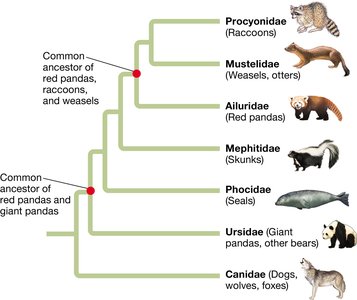
Q15. What do red pandas, weasels, and raccoons have in common? Use Figure 1.9C from page 11 of your textbook.
Background
Topic: Evolutionary Relationships
This question tests your ability to interpret evolutionary trees and common ancestry.
Key Terms:
Common Ancestor: An ancestral species shared by multiple groups.
Phylogenetic Tree: Diagram showing evolutionary relationships.
Step-by-Step Guidance
Examine Figure 1.9C to identify the evolutionary relationships among red pandas, weasels, and raccoons.
Look for the point where their lineages converge on the tree.
Determine what this convergence indicates about their ancestry.
Try solving on your own before revealing the answer!
Final Answer:
Red pandas, weasels, and raccoons share a common ancestor according to the evolutionary tree.
