 Indietro
Guided Study for Plant Life Cycles and Structures (Chapter 29)
Guida di studio - Note intelligenti
 Appunti personalizzati basati sui tuoi materiali, ampliati con definizioni chiave, esempi e contesto.
Q1. Compare the following pairs: sporophyte vs. gametophyte; gametangium vs. sporangium; gametes vs. spores; microphyll, megaphyll, and sporophyll; sporopollenin vs. lignin; xylem vs. phloem.
Background
Topic: Plant Life Cycles and Structures
This question tests your understanding of key terms and concepts related to plant biology, especially the alternation of generations and plant anatomy.
Key Terms:
Sporophyte: Diploid generation that produces spores by meiosis.
Gametophyte: Haploid generation that produces gametes by mitosis.
Gametangium: Structure where gametes are formed.
Sporangium: Structure where spores are formed.
Microphyll: Small leaf with a single vein.
Megaphyll: Larger leaf with multiple veins.
Sporophyll: Leaf that bears sporangia.
Sporopollenin: Durable polymer in spore/pollen walls.
Lignin: Structural polymer in cell walls, especially xylem.
Xylem: Tissue for water/mineral transport.
Phloem: Tissue for nutrient transport.
Step-by-Step Guidance
Start by identifying which generation (sporophyte or gametophyte) is diploid and which is haploid.
Compare the functions of gametangium and sporangium, focusing on what each produces and their roles in the life cycle.
Distinguish between gametes and spores in terms of ploidy and function.
Describe the differences among microphyll, megaphyll, and sporophyll based on structure and function.
Explain the roles of sporopollenin and lignin in plant adaptation and survival.
Contrast xylem and phloem in terms of what they transport and their importance in plant physiology.
Try solving on your own before revealing the answer!
Final Answer:
Sporophyte: Diploid, produces spores; Gametophyte: Haploid, produces gametes.
Gametangium: Produces gametes; Sporangium: Produces spores.
Gametes: Haploid, fuse to form zygote; Spores: Haploid, grow into gametophyte.
Microphyll: Single vein; Megaphyll: Multiple veins; Sporophyll: Leaf with sporangia.
Sporopollenin: Protects spores/pollen; Lignin: Strengthens cell walls.
Xylem: Water/mineral transport; Phloem: Nutrient transport.
These comparisons highlight the alternation of generations and structural adaptations in plants.
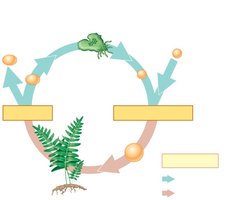
Q2. Label the diagram with sporophyte, gametophyte, meiosis, mitosis, fertilization, gamete, zygote, and spore. Which structures are haploid? Which are diploid? Is the organism a vascular or nonvascular plant? Use Figure 29.11 to explain why this plant is a homosporous vascular plant but not a heterosporous vascular plant.
Background
Topic: Alternation of Generations and Plant Life Cycles
This question tests your ability to identify stages and structures in the plant life cycle, and to distinguish between homosporous and heterosporous plants.
Key Terms:
Meiosis: Cell division producing haploid spores.
Mitosis: Cell division for growth and gamete production.
Fertilization: Fusion of gametes to form zygote.
Homosporous: Produces one type of spore.
Heterosporous: Produces two types of spores (microspores and megaspores).
Step-by-Step Guidance
Identify the main stages in the diagram: sporophyte, gametophyte, spore, gamete, zygote.
Label where meiosis and mitosis occur in the cycle.
Determine which structures are haploid (n) and which are diploid (2n).
Assess whether the plant is vascular or nonvascular based on the diagram and Figure 29.11.
Explain why the plant is homosporous (produces one type of spore) and not heterosporous.
Try solving on your own before revealing the answer!
Final Answer:
Sporophyte (2n), gametophyte (n), meiosis (produces spores), mitosis (growth/gamete production), fertilization (forms zygote), gamete (n), zygote (2n), spore (n).
Haploid: gametophyte, gamete, spore; Diploid: sporophyte, zygote.
The organism is a vascular plant (fern), and is homosporous because it produces only one type of spore.
It is not heterosporous because it does not produce both microspores and megaspores.
This diagram illustrates the alternation of generations and the distinction between homosporous and heterosporous plants.
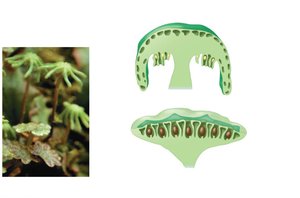
Q3. Label the gametophyte, archegonium, antheridia, and egg in the diagram of a nonvascular plant.
Background
Topic: Nonvascular Plant Anatomy
This question tests your ability to identify reproductive structures in nonvascular plants, such as mosses and liverworts.
Key Terms:
Gametophyte: Dominant generation in nonvascular plants.
Archegonium: Female gametangium, produces eggs.
Antheridia: Male gametangium, produces sperm.
Egg: Female gamete.
Step-by-Step Guidance
Locate the main body of the plant (gametophyte) in the diagram.
Identify the structures that produce eggs (archegonium) and sperm (antheridia).
Find the egg within the archegonium.
Label each structure accordingly.
Try solving on your own before revealing the answer!
Final Answer:
Gametophyte: main green structure.
Archegonium: flask-shaped structure containing the egg.
Antheridia: round structure producing sperm.
Egg: located inside the archegonium.
These labels help you understand the reproductive anatomy of nonvascular plants.
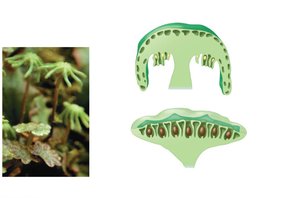
Q4. Label the diagram with sporophyte, gametophyte, meiosis, mitosis, fertilization, sperm, egg, zygote, embryo, peristome, sporangium, spore, archegonium, antheridium.
Background
Topic: Moss Life Cycle and Reproductive Structures
This question tests your ability to identify and label the stages and structures in the moss life cycle.
Key Terms:
Sporophyte: Diploid generation, produces spores.
Gametophyte: Haploid generation, produces gametes.
Meiosis: Produces spores.
Mitosis: Produces gametes.
Fertilization: Forms zygote.
Peristome: Structure that releases spores.
Sporangium: Capsule where spores are produced.
Archegonium: Female gametangium.
Antheridium: Male gametangium.
Step-by-Step Guidance
Identify the main stages: sporophyte, gametophyte, zygote, embryo.
Label where meiosis and mitosis occur in the cycle.
Find and label the reproductive structures: sperm, egg, archegonium, antheridium.
Locate the peristome and sporangium in the diagram.
Label the spore and indicate its origin.
Try solving on your own before revealing the answer!
Final Answer:
Sporophyte: stalk and capsule; Gametophyte: leafy green structure.
Meiosis: in sporangium; Mitosis: in gametophyte.
Fertilization: sperm swims to egg in archegonium.
Zygote/embryo: inside archegonium.
Peristome: teeth-like structure in capsule; Sporangium: capsule.
Spore: released from sporangium.
Archegonium: female structure; Antheridium: male structure.
These labels clarify the moss life cycle and reproductive anatomy.
