 Indietro
Homeostasis and the Endocrine System: Regulation, Hormones, and Pituitary Function
Guida di studio - Note intelligenti
 Appunti personalizzati basati sui tuoi materiali, ampliati con definizioni chiave, esempi e contesto.
Homeostasis in Multicellular Organisms
Definition and Importance
Homeostasis refers to the maintenance of a relatively constant internal environment in multicellular organisms. The interstitial fluid surrounding cells acts as the external environment for cells, providing nutrients and removing waste. Proper regulation of this environment is vital for cell function and survival.
Interstitial fluid: The clear fluid surrounding cells, crucial for nutrient delivery and waste removal.
Homeostasis: The process by which organisms regulate internal conditions within normal limits.
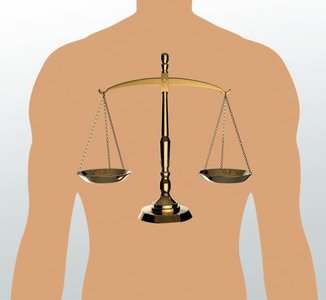
Negative Feedback Mechanisms
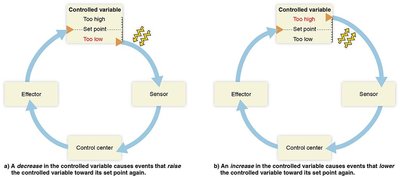
Negative feedback is a fundamental mechanism for maintaining homeostasis. It involves detecting deviations from a set point and triggering responses to counteract those changes.
Controlled variable: The parameter being regulated (e.g., blood pressure).
Sensor/Receptor: Monitors the controlled variable and detects changes.
Control centre: Receives input, compares to set point, and sends signals to effectors.
Effector: Organ or pathway that acts to correct imbalance.
Set point: Internally set value at which a variable stabilizes (e.g., body temperature).
Example: Regulation of Body Temperature
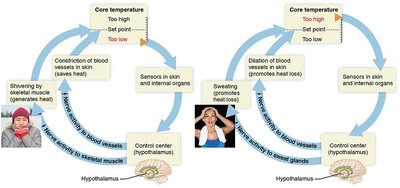
Core body temperature is regulated by negative feedback involving sensors in the skin, the hypothalamus as the control centre, and effectors such as blood vessels and sweat glands.
Cold response: Blood vessels constrict, shivering generates heat.
Hot response: Blood vessels dilate, sweating promotes heat loss.
Multiple sensors and effectors may be activated simultaneously across organ systems.
The Endocrine System
Structure and Function
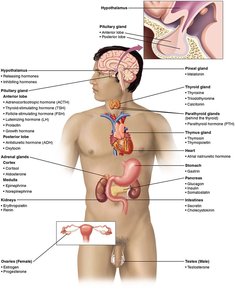
The endocrine system consists of specialized cells, tissues, and glands that produce and secrete hormones. These hormones are chemical messengers that regulate various physiological processes.
Endocrine glands: Ductless organs releasing hormones into interstitial fluid, lymph, and blood (e.g., pituitary gland).
Exocrine glands: Secrete products into ducts (e.g., sweat, digestive fluids).
Hormones: Bloodborne messengers acting on target cells with specific receptors.
Hormones interact with the nervous system and act slower than neural signals.
Hormone Classification: Steroid vs. Non-Steroid
Steroid Hormones
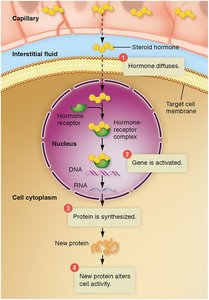
Steroid hormones are structurally related to cholesterol and are lipid-soluble, allowing them to cross cell membranes and directly affect gene expression.
Lipid soluble: Can diffuse across cell and nuclear membranes.
Intracellular receptors: Bind inside the cell, forming hormone-receptor complexes.
Gene activation: Complex attaches to DNA, activates genes, and initiates protein synthesis.
Amplification: Small amounts of hormone can produce large effects by activating gene expression.
Non-Steroid Hormones
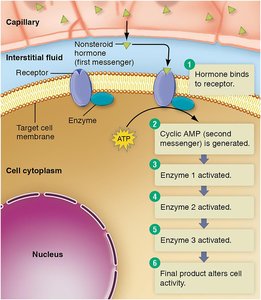
Non-steroid hormones are structurally related to proteins and are lipid-insoluble. They act by binding to cell membrane receptors and triggering intracellular signaling cascades.
Lipid insoluble: Cannot cross cell membrane; bind to surface receptors.
Second messenger: Binding activates molecules like cAMP, which trigger enzyme cascades.
Amplification: Each step in the cascade amplifies the hormone's effect.
Hormones and Negative Feedback
Role in Homeostasis
Many hormones are regulated by negative feedback loops to maintain homeostasis. The endocrine gland acts as the control centre, the hormone is the pathway, and the effector is the target cell.
Feedback loops are initiated by changes in controlled variables.
Hormones help restore balance by acting on target organs.
The Hypothalamus and Pituitary Gland
Body's Control Centre
The hypothalamus is a small brain region serving as a homeostatic control centre, linking the nervous and endocrine systems. It receives neural input and produces hormones in response. The pituitary gland, located below the hypothalamus, secretes eight hormones that regulate other endocrine glands.
Hypothalamus: Monitors internal conditions and produces hormones.
Pituitary gland: Consists of anterior and posterior lobes, each with distinct functions.
Posterior Pituitary Gland
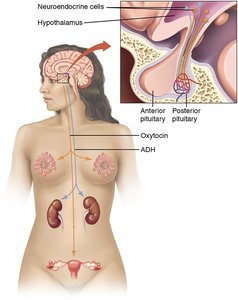
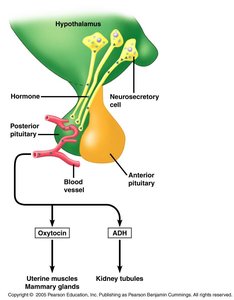
The posterior pituitary gland is composed of neuroendocrine cells that function as both nerve and endocrine cells. These cells generate impulses and secrete peptide hormones directly into the bloodstream.
Neuroendocrine cells: Release hormones such as ADH and oxytocin.
Hormones are transported to target organs via the bloodstream.
Anterior Pituitary Gland
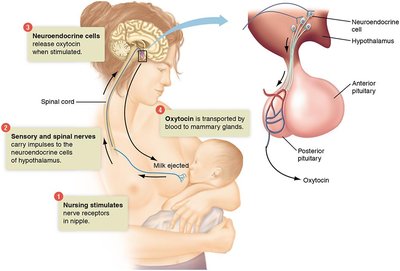
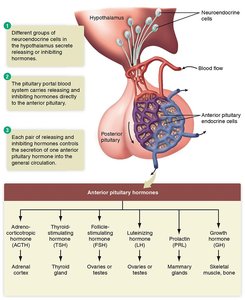
The connection between the hypothalamus and the anterior pituitary gland is endocrine, not neural. Neuroendocrine cells in the hypothalamus secrete releasing or inhibiting hormones into a special blood supply (pituitary portal system) that stimulates the release of specific anterior pituitary hormones.
Releasing/inhibiting hormones: Control the secretion of anterior pituitary hormones.
Pituitary portal system: Direct blood flow from hypothalamus to anterior pituitary.
Pituitary Gland Hormones
The pituitary gland produces several hormones, each with specific targets and actions. The anterior and posterior lobes secrete different hormones.
Anterior pituitary hormones: ACTH, TSH, FSH, LH, PRL, GH
Posterior pituitary hormones: ADH, Oxytocin
Hormone | Abbreviation | Main Targets | Primary Actions |
|---|---|---|---|
Adrenocorticotropic hormone | ACTH | Adrenal cortex | Stimulates adrenal cortex to release glucocorticoids |
Thyroid-stimulating hormone | TSH | Thyroid gland | Stimulates synthesis & secretion of thyroid hormones |
Follicle-stimulating hormone | FSH | Ovaries, Testes | Stimulates egg maturation & estrogen secretion in females; sperm formation in males |
Luteinizing hormone | LH | Ovaries | Stimulates ovulation & progesterone secretion in females |
Prolactin | PRL | Mammary glands | Stimulates development of mammary glands & milk production |
Growth hormone | GH | Most cells | Stimulates growth, cell division, protein synthesis & metabolism |
Antidiuretic hormone | ADH | Kidneys | Reduces water loss in urine |
Oxytocin | Oxytocin | Uterus, Mammary glands | Induces uterine contractions & milk ejection |

Pituitary Disorders
Types and Examples
Pituitary disorders can result from hypersecretion (excess hormone) or hyposecretion (insufficient hormone). These conditions may be inherited or caused by disruption of endocrine feedback loops.
Diabetes insipidus: Hyposecretion of ADH causes water loss in kidneys.
Pituitary dwarfism: Hyposecretion of GH during childhood.
Gigantism: Hypersecretion of GH during childhood.

Summary
Hormones are essential chemical messengers that regulate homeostasis and coordinate complex physiological processes. The endocrine system, especially the hypothalamus and pituitary gland, plays a central role in this regulation.
Additional info: The notes above expand on the original lecture content by providing definitions, examples, and structured explanations suitable for General Biology students.
