 Indietro
Human Evolution: Evidence, Phylogenies, and Primate Relationships
Guida di studio - Note intelligenti
 Appunti personalizzati basati sui tuoi materiali, ampliati con definizioni chiave, esempi e contesto.
Human Evolution: We Are Africans
Key Evidence for African Origin
Modern humans, Homo sapiens, originated in Africa, as supported by multiple lines of evidence including DNA sequences, fossil discoveries, and the distribution of our closest ape relatives. Understanding these lines of evidence is crucial for interpreting human evolutionary history.
DNA Sequences: Genetic studies show that the common ancestor of all living humans lived in Africa approximately 200,000 years ago.
Fossil Hominids: Key fossils such as Ardipithecus ramidus ("Ardi") and Australopithecus afarensis ("Lucy") were discovered in Africa, indicating early upright walking and other human-like traits.
Closest Ape Relatives: Our closest living relatives, chimpanzees and gorillas, are native to Africa.
Mitochondrial DNA (mtDNA): Studies (e.g., Vigilant et al. 1991) show greater mtDNA diversity in African populations, supporting the "Mitochondrial Eve" hypothesis.
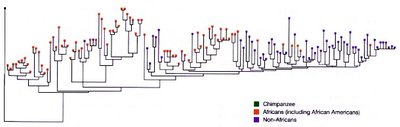
Example: The phylogenetic tree above demonstrates that African populations have the highest genetic diversity, indicating ancestral lineages.
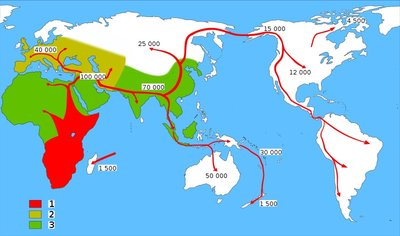
Example: The migration map shows estimated dates of arrival for Homo sapiens in various regions, illustrating the spread from Africa to the rest of the world.
Phylogenetic Trees and Ancestral States
Phylogenetic trees are used to define evolutionary groups and reconstruct ancestral traits. The principle of parsimony (Occam's Razor) is applied to infer the simplest evolutionary pathway, requiring the fewest changes.
Monophyletic Groups: Groups that include a common ancestor and all its descendants.
Ancestral Traits: Traits present at the deepest nodes of a tree (oldest traits).
Derived Traits: Traits found at shallow nodes or only in extant species (most recent traits).
Parsimony: The most likely evolutionary scenario is the one with the fewest changes.
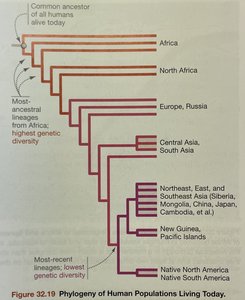
Example: The phylogeny above shows that the most ancestral lineages are from Africa, with the highest genetic diversity, while the most recent lineages are found in Native North and South America.
Interpreting mtDNA Trees
mtDNA trees can be used to infer the geographic origin of human populations. The most parsimonious tree is the one that requires only one migration event out of Africa.
Paraphyletic African Populations: African populations are paraphyletic with respect to the rest of the world, supporting African ancestry as the most parsimonious scenario.
Lowest Genetic Diversity: Non-African populations have the lowest genetic diversity due to founder effects and bottlenecks during migration.
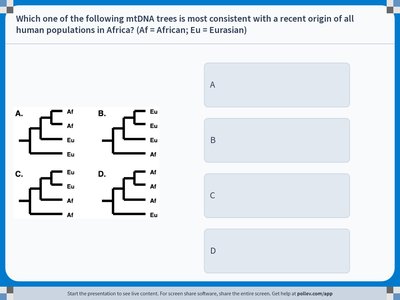
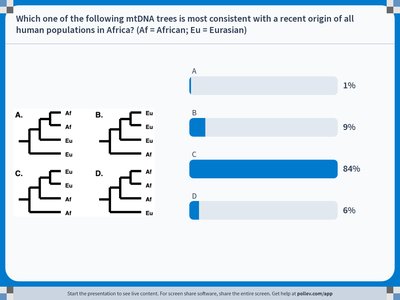
Example: The tree labeled 'C' is most consistent with a recent origin of all human populations in Africa, as it requires only one change (migration) from Africa to Eurasia.
Key Fossil Hominids from Africa
Ardipithecus ramidus ("Ardi")
Ardi lived approximately 4.5 million years ago and provides evidence that the human-chimp common ancestor was not chimp-like. Ardi had an opposable big toe and was already adapted for upright walking with small male canines.
Significance: Indicates early bipedalism and challenges the misconception that humans evolved directly from chimpanzees.
Australopithecus afarensis ("Lucy")
Lucy lived about 3.5 million years ago and exhibited specialized adaptations for bipedalism, such as a straight big toe, knee, and hip.
Significance: Further evidence for upright walking in early hominids.
Recently Extinct Homo Species
Flores Man ("Hobbit")
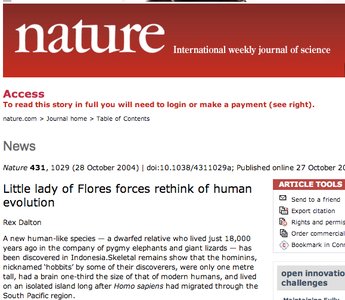
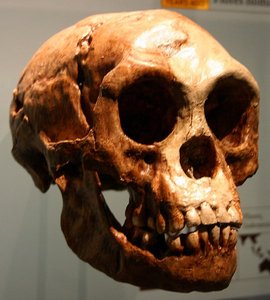
Homo floresiensis lived in Indonesia and went extinct about 10,000 years ago. This species was only about 3 feet tall and had a much reduced brain size.
Denisovans
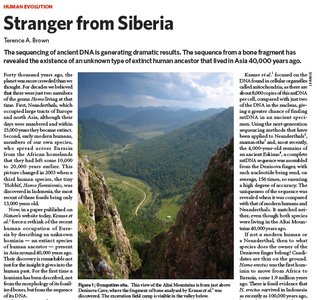
Denisovans are known from DNA extracted from bones found in Siberia. They went extinct about 40,000 years ago, but their DNA persists in modern Asian and Native American populations.
Neanderthals
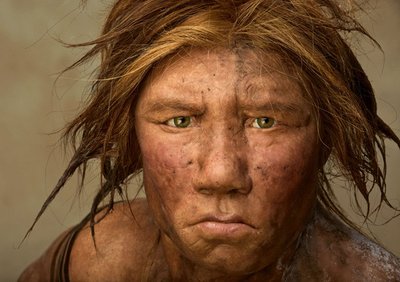
Neanderthals lived throughout Eurasia and went extinct about 40,000 years ago. Genome sequencing has shown that non-African Homo sapiens interbred with Neanderthals, and many people today carry Neanderthal genes.
Phylogenies and Misconceptions
Reading Phylogenetic Trees
Phylogenies do not indicate that extant species are "primitive" or "less evolved." Instead, they show relationships and the timing of divergence between lineages. Extant African lineages are not ancestral; ancestral lineages existed in the past, near the root of the tree.
Primate Evolution and Adaptations
Adaptations for Life in the Trees
Primates evolved several adaptations for arboreal life, which are still present in humans and other primates.
Binocular Vision: Eyes positioned for overlapping fields of view, enhancing depth perception.
Opposable Thumb: Allows for grasping and manipulating objects.
Rotating Shoulder Joint: Enables a wide range of arm movement, useful for climbing.
Major Lineages of Primates
Primates are divided into several major groups, including apes, Old World monkeys, New World monkeys, and lemurs.
Apes: Includes humans, chimpanzees, bonobos, gorillas, orangutans, and gibbons.
Old World Monkeys: Found in Africa and Asia; examples include baboons, macaques, and colobus monkeys.
New World Monkeys: Found in Central and South America; examples include spider monkeys, howler monkeys, and capuchins.
Lemurs: Native to Madagascar; example is the ring-tailed lemur.
Loss of Tails in Primates
The loss of tails is a derived trait in the primate lineage, occurring in the common ancestor of apes and gibbons.
Group | Tail Present? |
|---|---|
Old World Monkeys | Yes |
New World Monkeys | Yes |
Apes (including humans) | No |
Gibbons | No |
Lemurs | Yes |
Example: The most parsimonious explanation is a single loss of tail in the ancestor of apes and gibbons.
Summary Table: Evidence for African Origin of Humans
Evidence Type | Description | Key Findings |
|---|---|---|
DNA Sequences | mtDNA, Y chromosome, whole genome | Common ancestor in Africa, highest diversity in Africa |
Fossil Hominids | Ardi, Lucy, other key fossils | Early upright walking, non-chimp-like ancestors |
Ape Relatives | Chimpanzees, gorillas | Native to Africa, closest living relatives |
Additional info:
Extinct species can be more ancestral or older, but extant lineages are not ancestral.
Hybridization occurred between Homo sapiens and Neanderthals/Denisovans, as shown by genomic evidence.
Conservation and medical implications: Primates face threats from deforestation and hunting; diseases can be transmitted between humans and our closest relatives.
