 Indietro
Human Tissues, Body Systems, and Homeostasis: Structure and Function
Guida di studio - Note intelligenti
 Appunti personalizzati basati sui tuoi materiali, ampliati con definizioni chiave, esempi e contesto.
Human Tissues, Body Systems, and Homeostasis
Overview of Human Tissue Groups
Human tissues are organized groups of cells with similar structure and function. The four primary tissue types are epithelial, connective, muscle, and nervous tissue. Each plays a critical role in maintaining the structure and function of organs and organ systems.
Epithelial Tissue: Covers body surfaces and lines organs.
Connective Tissue: Supports, binds, and protects other tissues and organs.
Adipose Tissue: Specialized connective tissue for fat storage.
Muscle Tissue: Responsible for movement.
Epithelial Tissue
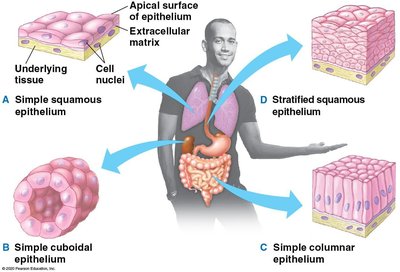
Epithelial tissue forms the covering of both external and internal body surfaces and lines organs. Its main functions include protection, secretion, absorption, and filtration. Some epithelial cells possess cilia to move substances across their surfaces.
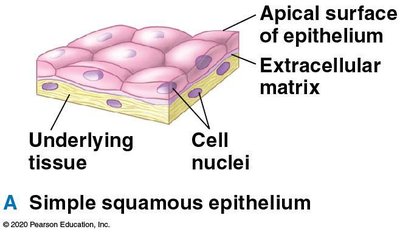
Simple Squamous Epithelium: Thin, flat cells; found lining blood vessels and body cavities, facilitating diffusion and filtration.
Simple Cuboidal Epithelium: Cube-shaped cells; found in glands and kidney tubules, specialized for secretion and absorption.
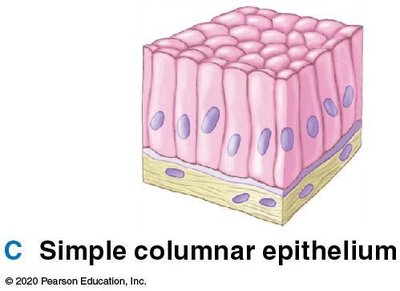
Simple Columnar Epithelium: Tall, column-like cells; lines the stomach, intestines, and bronchioles, specialized for absorption and secretion.
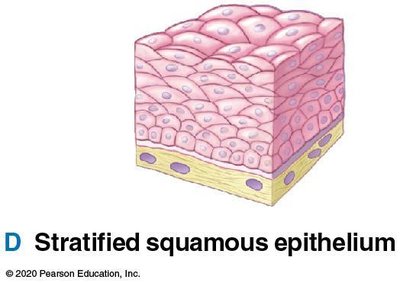
Stratified Squamous Epithelium: Multiple layers of flat cells; found in the outer skin, mouth, and esophagus, providing protection against abrasion.
Connective Tissue
Connective tissue consists of a sparse population of cells scattered throughout a non-living matrix, which may be liquid, jelly-like, or solid. The matrix is produced and secreted by the cells and contains fibers such as collagen and elastin. Connective tissue supports, binds, and protects other tissues and organs.
Loose Connective Tissue: Most common; holds organs in place and attaches epithelial tissue to underlying tissues.
Fibrous Connective Tissue: Densely packed collagen fibers; forms tendons and ligaments.
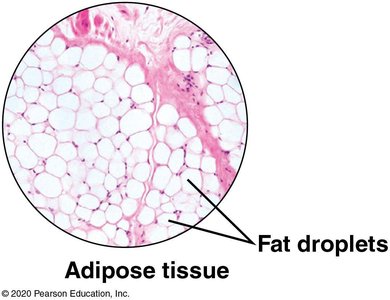
Adipose Tissue: Stores fat for energy, insulation, and cushioning.
Cartilage: Provides flexible support in joints, nose, ear, and respiratory tract.
Bone: Rigid tissue that forms the skeleton; matrix contains collagen and minerals.
Blood: Fluid tissue that transports gases, nutrients, and wastes; considered connective due to its origin and matrix (plasma).




Muscle Tissue
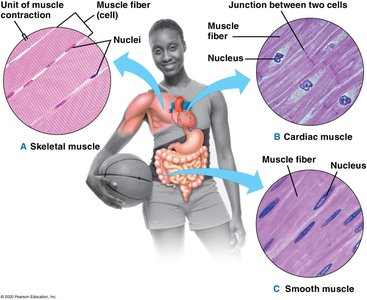
Muscle tissue is specialized for contraction and movement. It is the most abundant tissue in most animals and is classified into three types:
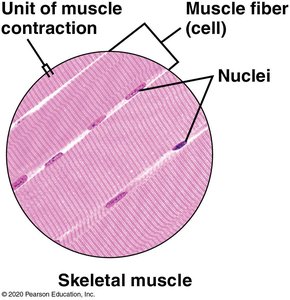
Skeletal Muscle: Voluntary movement; attached to bones by tendons; cells are long and multinucleated.
Cardiac Muscle: Involuntary; found only in the heart; cells are branched and interconnected for synchronized contraction.
Smooth Muscle: Involuntary; found in walls of internal organs such as intestines, uterus, and blood vessels; cells are spindle-shaped.


Nervous Tissue
Nervous tissue forms a communication network throughout the body. It senses stimuli and rapidly transmits information via electrical impulses. The main cell type is the neuron, which carries signals. Other supporting cells insulate axons, nourish neurons, and regulate the fluid environment.
Organs and Organ Systems
Organs are structures composed of multiple tissue types working together to perform specific functions. For example, the small intestine contains epithelial, connective, and muscle tissues, each contributing to digestion and absorption. Organ systems are groups of organs that work together to perform major body functions, such as the digestive, respiratory, and circulatory systems.
Homeostasis and Feedback Mechanisms
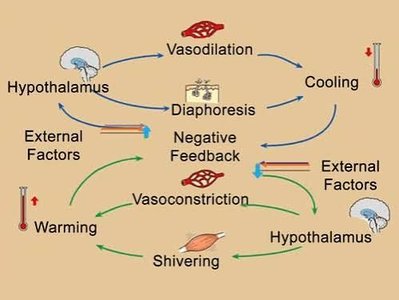
Homeostasis is the body's automatic process of maintaining a stable internal environment despite external changes. This is achieved through feedback loops involving variables, receptors, control centers, and effectors. Communication among these components often occurs via nerves or hormones.
Negative Feedback Loops: Counteract changes in a variable, maintaining stability. Example: Regulation of body temperature and blood glucose.
Positive Feedback Loops: Amplify changes, pushing the system toward an endpoint. Example: Childbirth and blood clotting.
Thermoregulation
Thermoregulation is the process by which animals maintain an internal temperature within an optimal range. Endotherms generate heat metabolically, while ectotherms absorb heat from their environment. Heat exchange occurs via conduction, convection, radiation, and evaporation.
Osmoregulation
Osmoregulation is the control of water and solute concentrations in the body, preventing excessive water gain or loss.
Hormonal Regulation
The endocrine system, including glands such as the thyroid and pancreas, regulates metabolism, development, and homeostasis through hormone secretion. For example, insulin and glucagon from the pancreas maintain blood glucose levels.
Summary Table: Major Tissue Types and Functions
Tissue Type | Main Function | Example Location |
|---|---|---|
Epithelial | Protection, secretion, absorption | Skin, lining of gut |
Connective | Support, binding, transport | Tendons, blood, bone |
Muscle | Movement | Skeletal muscles, heart, digestive tract |
Nervous | Communication, control | Brain, nerves, spinal cord |
Key Equations
Cellular Respiration:
Additional info: This guide integrates foundational concepts from animal form and function, organ systems, and physiological regulation, as covered in General Biology chapters on tissues, homeostasis, and feedback mechanisms.
