 Indietro
Human Tissues, Body Systems, and Homeostasis: Structured Study Notes
Guida di studio - Note intelligenti
 Appunti personalizzati basati sui tuoi materiali, ampliati con definizioni chiave, esempi e contesto.
Human Tissues, Body Systems, and Homeostasis
Overview of Human Tissue Groups
Human tissues are organized into four primary groups, each with distinct functions and structural characteristics. Understanding these tissues is fundamental to comprehending how organs and systems operate within the human body.
Epithelial Tissue: Covers external and internal surfaces, lines organs, and functions in protection, secretion, absorption, and filtration. Some epithelial cells possess cilia for movement of substances.
Connective Tissue: Supports and binds other tissues, consisting of cells scattered in a non-living matrix (fibers in liquid, jelly, or solid).
Adipose Tissue: Specialized connective tissue for fat storage, insulation, and energy reserve.
Muscle Tissue: Responsible for movement via contraction; includes skeletal, cardiac, and smooth muscle types.
Epithelial Tissue
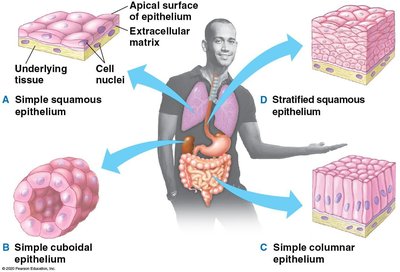
Epithelial tissue forms the covering of both external and internal body surfaces and lines organs. Its functions include protection, secretion, absorption, and filtration. Epithelial cells are tightly packed and may have specialized structures such as cilia.
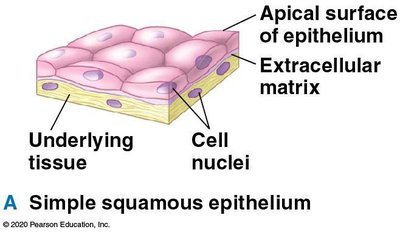
Simple Squamous Epithelium: Thin, flat cells; found lining blood vessels and body cavities, facilitating diffusion and filtration.
Simple Cuboidal Epithelium: Cube-shaped cells; found in organs like the kidneys and glands, involved in secretion and absorption.
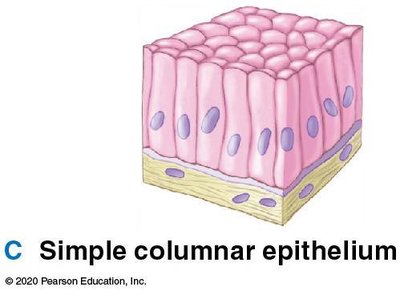
Simple Columnar Epithelium: Tall, column-like cells; lines the stomach, intestines, and bronchioles, specialized for absorption and secretion.
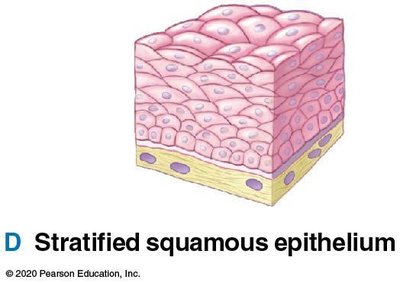
Stratified Squamous Epithelium: Multiple layers of flat cells; provides protection in areas subject to abrasion, such as the skin and mouth.
Connective Tissue
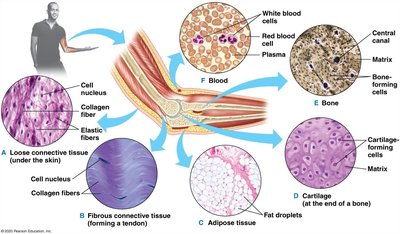
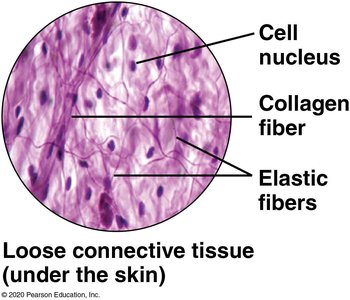
Connective tissue is characterized by a sparse population of cells scattered throughout a matrix produced by the cells. The matrix may be liquid, jelly-like, or solid, and contains fibers that provide structural support.
Loose Connective Tissue: Most common; provides support and elasticity under the skin.
Fibrous Connective Tissue: Densely packed fibers; forms tendons (attach muscle to bone) and ligaments (attach bone to bone).
Adipose Tissue: Stores fat droplets for energy and insulation.
Cartilage: Flexible support; found in joints, nose, ribs, trachea, ear, larynx, intervertebral discs, and menisci.
Bone: Rigid support; matrix contains collagen and minerals, with bone-forming cells.
Blood: Fluid matrix (plasma) with red and white blood cells; transports nutrients, gases, and wastes.



Muscle Tissue
Muscle tissue is the most abundant tissue in most animals and is specialized for contraction, enabling movement. There are three types of vertebrate muscle tissue:
Skeletal Muscle: Voluntary movements; attaches to bones by tendons, striated appearance.
Cardiac Muscle: Involuntary; found in the heart, pumps blood, cells are branched and interconnected.
Smooth Muscle: Involuntary; found in walls of internal organs (intestines, uterus, blood vessels), non-striated.




Nervous Tissue
Nervous tissue forms a communication network throughout the body. It senses stimuli and rapidly transmits information via electrical impulses. The main cell type is the neuron, which carries signals. Other cells insulate axons, nourish neurons, and regulate the fluid environment.
Neurons: Specialized for conducting electrical impulses.
Glial Cells: Support neurons by insulating, nourishing, and regulating their environment.

Organs and Organ Systems
Organs are composed of multiple tissue types, each performing specific functions. Organ systems consist of groups of organs working together to carry out major body functions.
Small Intestine: Lined by columnar epithelium, contains connective tissue with blood vessels, and has smooth muscle layers for food propulsion. Finger-like projections (villi) increase surface area for absorption.
Circulatory System: Delivers oxygen and nutrients, removes carbon dioxide and wastes.
Respiratory System: Exchanges gases with the environment.
Digestive System: Breaks down food, absorbs nutrients, eliminates wastes.
Nervous System: Senses stimuli, coordinates responses.
Muscular System: Moves bones, contracts heart, moves food.
Skeletal System: Supports and protects organs.
Excretory System: Eliminates wastes.
Immune System: Protects from disease.
Reproductive System: Produces gametes, nurtures embryo.
Endocrine System: Maintains homeostasis via hormones.
Integumentary System: Provides a barrier (skin).
Homeostasis and Feedback Mechanisms
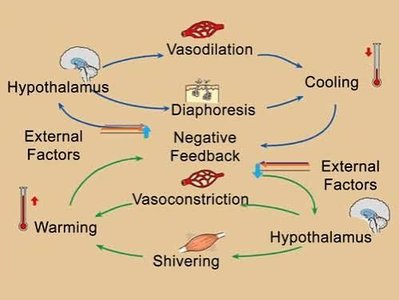
Homeostasis is the body's automatic process of maintaining a stable internal environment despite external changes. This is achieved through feedback loops, which monitor and regulate variables such as temperature, blood sugar, and water levels.
Variables: Parameters monitored and controlled by feedback systems.
Receptors: Detect changes in variables.
Control Centers: Compare variables to set points and signal effectors.
Effectors: Execute changes to adjust variables.
Communication: Occurs via nerves or hormones.
Types of Feedback Loops
Negative Feedback: A change in one direction causes a response in the opposite direction, stabilizing the system. Example: Blood sugar regulation, body temperature.
Positive Feedback: A change in one direction causes further change in the same direction, amplifying the response. Example: Childbirth, blood clotting.
Osmoregulation
Osmoregulation is the process by which animals control the concentrations of solutes in their cells and bodies, preventing excessive uptake or loss of water. This is essential for maintaining cellular function and overall homeostasis.
Endocrine Regulation: Thyroid and Pancreas
The endocrine system regulates metabolism, development, and homeostasis through hormone secretion.
Thyroid Gland: Located in the neck; regulates metabolism, reproduction, and development. Imbalances can cause hyperthyroidism (high blood pressure, weight loss) or hypothyroidism (low blood pressure, weight gain).
Pancreas: Secretes digestive enzymes and hormones (insulin and glucagon) to regulate blood glucose levels. Insulin lowers blood glucose; glucagon raises it. Their balance maintains homeostasis.
Diabetes Mellitus
Diabetes Mellitus: Disorder caused by inability to produce or use insulin, resulting in elevated blood glucose (hyperglycemia).
Hypoglycemia: Excess insulin causes blood glucose to drop below normal.
Summary Table: Types of Human Tissues
Type | Main Function | Location |
|---|---|---|
Epithelial | Protection, secretion, absorption, filtration | Skin, lining of organs |
Connective | Support, binding, transport | Under skin, tendons, bones, blood |
Muscle | Movement by contraction | Skeletal muscles, heart, internal organs |
Nervous | Communication, sensing stimuli | Brain, spinal cord, nerves |
Summary Table: Feedback Mechanisms
Type | Direction of Response | Example |
|---|---|---|
Negative Feedback | Opposite to initial change | Blood sugar regulation, temperature |
Positive Feedback | Same as initial change | Childbirth, blood clotting |
Key Equations
Cellular Respiration:
Examples and Applications
Blood as Connective Tissue: Blood qualifies as connective tissue because it consists of cells suspended in a matrix (plasma) and functions in transport.
Interacting Systems: Digestive and circulatory systems work together to deliver nutrients; respiratory and circulatory systems collaborate to exchange gases.
Additional info:
Some details about tissue types and feedback mechanisms were expanded for clarity and completeness.
