 Indietro
Information Flow: From DNA to Protein, Mutations, and Inheritance
Guida di studio - Note intelligenti
 Appunti personalizzati basati sui tuoi materiali, ampliati con definizioni chiave, esempi e contesto.
Properties of Life and Information Flow
Fundamental Properties of Life
Living organisms share several fundamental properties that distinguish them from non-living matter. These properties are essential for the maintenance, reproduction, and evolution of life.
Self-replication: The ability to reproduce and pass genetic information to offspring.
Information storage and processing: Organisms store genetic instructions in DNA and use these instructions to control cellular functions.
Membrane delimitation: Cells are bounded by membranes that separate internal processes from the external environment.
Energy utilization: Life requires energy, which is stored, transformed, and used to drive cellular processes.
Response to environment: Organisms sense and respond to environmental changes.
Evolution: Populations of organisms change over time through heritable genetic variation.
Central Dogma of Molecular Biology
Information Flow: DNA → RNA → Protein
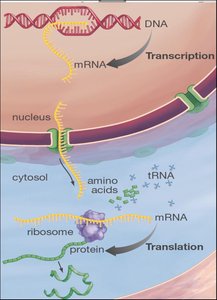
The central dogma describes the flow of genetic information within a biological system. It explains how the instructions in DNA are used to synthesize proteins, which determine an organism's traits.
DNA (Deoxyribonucleic Acid): Stores genetic information in the sequence of nucleotides.
Transcription: The process by which a segment of DNA is copied into messenger RNA (mRNA).
Translation: The process by which the sequence of nucleotides in mRNA is used to assemble a chain of amino acids, forming a protein.
Gene: A segment of DNA that codes for a specific protein.
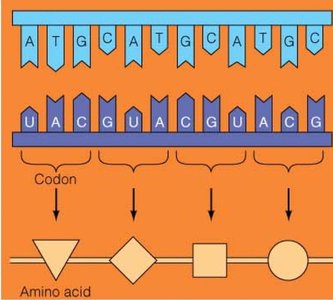
Codon: A sequence of three mRNA nucleotides that specifies a particular amino acid.
Transcription and Translation Example
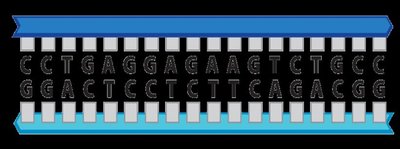
DNA template: CCTGAGGACAAGTCTCAGG
mRNA: CCUGAGGAGAAGUCUCUCC
Protein: PRO GLU GLU LYS SER ALA


Mutations and Their Effects
Types and Consequences of Mutations
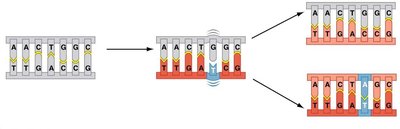
Mutations are changes in the DNA sequence. They can occur spontaneously during DNA replication or be induced by environmental factors. Mutations are the ultimate source of genetic variation.
Point mutations: Change a single nucleotide in the DNA sequence.
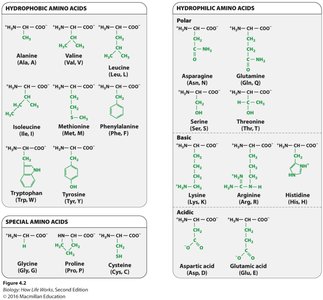
Missense mutations: Change one amino acid in the protein sequence.
Silent mutations: Do not change the amino acid sequence due to redundancy in the genetic code.
Frameshift mutations: Insertions or deletions that shift the reading frame, altering all downstream amino acids.
Nonsense mutations: Change a codon to a stop codon, resulting in a truncated protein.
Mutations can be:
Deleterious: Decrease fitness.
Neutral: No effect on fitness.
Beneficial: Increase fitness.
Most point mutations are neutral, some are deleterious, and a few are beneficial.
Alleles and Genetic Variation
Alleles are alternative forms of a gene that arise by mutation. They can differ by as little as one nucleotide and contribute to genetic diversity within a population.
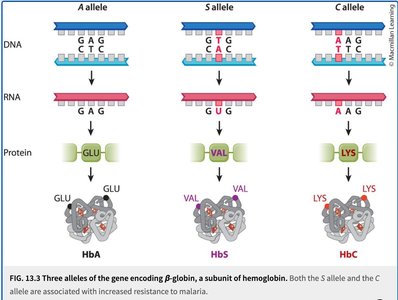
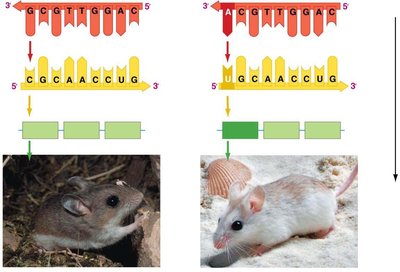
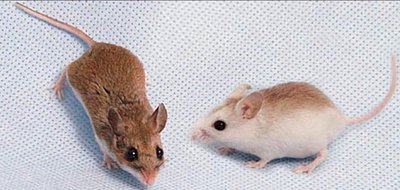
Example: The Mc1r gene in mice has different alleles that affect coat color. A single nucleotide change can result in a different amino acid (missense mutation), altering the protein's function and the organism's phenotype.
Mutation Example: Cystic Fibrosis
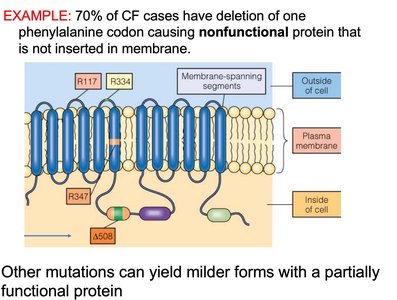
70% of cystic fibrosis (CF) cases are caused by the deletion of a single phenylalanine codon, resulting in a nonfunctional protein that is not inserted into the membrane. Other mutations can cause milder forms of the disease.
Genotype, Phenotype, and Inheritance
Genotype to Phenotype
The genotype is the genetic makeup of an organism, while the phenotype is the observable physical or biochemical traits. The genotype determines which proteins are produced, which in turn influence the phenotype.
Example: In beach and mainland mice, a single nucleotide change in the Mc1r gene leads to a different amino acid in the protein, resulting in different coat colors.
Mendelian Inheritance and Pedigrees
Mendel's laws describe how alleles are inherited from one generation to the next. Dominant alleles mask the effect of recessive alleles. Pedigrees are diagrams that show the inheritance of traits through generations.
Genotypic ratio: The ratio of different allele combinations (e.g., 1:2:1 for MM:M:m:mm in a monohybrid cross).
Phenotypic ratio: The ratio of observable traits (e.g., 3:1 for dominant:recessive in a monohybrid cross).
Using the Genetic Code
Codon Table and Translation
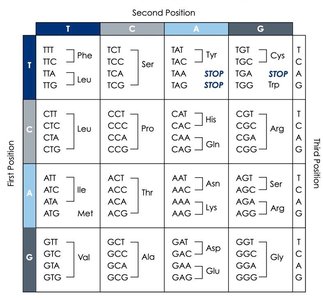
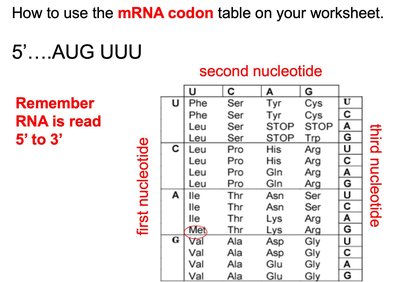
The genetic code is used to translate mRNA codons into amino acids. Each codon specifies one amino acid or a stop signal.
To translate a DNA sequence:
Transcribe the DNA sequence into mRNA (replace T with U).
Divide the mRNA into codons (groups of three nucleotides).
Use the codon table to determine the corresponding amino acids.
Summary Table: Types of Point Mutations
Mutation Type | Description | Effect on Protein |
|---|---|---|
Missense | Single nucleotide change results in a different amino acid | May alter protein function |
Silent | Single nucleotide change does not alter amino acid | No effect on protein |
Nonsense | Single nucleotide change creates a stop codon | Truncated, usually nonfunctional protein |
Frameshift | Insertion or deletion shifts reading frame | Alters all downstream amino acids |
Key Equations and Concepts
Central Dogma:
Genotypic Ratio (Monohybrid Cross): (homozygous dominant : heterozygous : homozygous recessive)
Phenotypic Ratio (Monohybrid Cross): (dominant : recessive)
Additional info: These notes integrate content from lecture slides, worksheets, and textbook-style explanations to provide a comprehensive overview of information flow, mutations, and inheritance in general biology.
