 Indietro
Inside the Cell: Structure and Function of Cellular Components
Guida di studio - Note intelligenti
 Appunti personalizzati basati sui tuoi materiali, ampliati con definizioni chiave, esempi e contesto.
Inside the Cell
Introduction
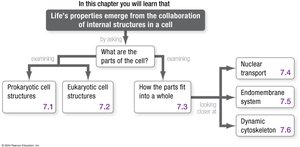
This chapter explores the internal structures of cells, emphasizing how their collaboration gives rise to life’s properties. It covers both prokaryotic and eukaryotic cell structures, their functions, and the dynamic systems that organize and transport cellular materials.
Cell Theory and Basic Cell Components
Cell Theory
Cell theory states that all organisms consist of cells, which are the fundamental units of life. Every cell contains essential biomolecules and structures:
Proteins: Perform most cellular functions.
Nucleic acids: Store, transmit, and process genetic information.
Carbohydrates: Provide energy, carbon, support, and identity.
Plasma membrane: Acts as a selectively permeable barrier.
Cell Types and Domains
Cells are classified based on morphology and evolutionary history:
Eukaryotes: Have a membrane-bound nucleus.
Prokaryotes: Lack a membrane-bound nucleus.
Three domains of life:
Bacteria (prokaryotic)
Archaea (prokaryotic)
Eukarya (eukaryotic)
Prokaryotic Cell Structures and Functions
Overview of Prokaryotic Cells
Prokaryotic cells are more complex than previously thought, as revealed by transmission electron microscopy. They possess distinctive structures and functions:
At least one chromosome
Numerous ribosomes for protein synthesis
Phospholipid membrane composition varies between bacteria and archaea
Cytoplasm: All contents inside the membrane
Chromosome and Nucleoid
The chromosome is the most prominent structure, typically a single, circular DNA molecule associated with proteins. DNA contains genetic information, while proteins provide structural support. Prokaryotes may also have plasmids—small, circular, supercoiled DNA molecules.
Ribosomes
Ribosomes are macromolecular machines composed of RNA and protein, responsible for protein synthesis. Bacterial and archaeal ribosomes are similar in size and function but differ in primary structure.
Cytoskeleton
Long, thin protein filaments form the cytoskeleton, essential for cell division and maintaining cell shape.
Photosynthetic Membranes
Photosynthetic prokaryotes have internal membrane complexes that convert sunlight into chemical energy. These membranes are infoldings of the plasma membrane and contain enzymes and pigments for photosynthesis.
Organelles in Prokaryotes
Some bacteria possess internal, membrane-bound compartments (organelles) for specialized functions, such as storing calcium ions, holding magnetite crystals, or concentrating enzymes.
Cell Wall
The cell wall forms a protective exoskeleton, composed of peptidoglycan in bacteria and glycolipids in some species. It provides shape and rigidity.
External Structures: Flagella and Fimbriae
Prokaryotes interact with their environment using external structures:
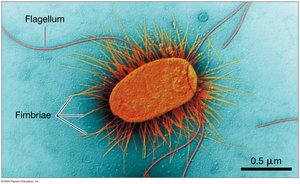
Flagella: Long filaments that rotate to propel the cell.
Fimbriae: Needlelike projections that promote attachment to surfaces.
Eukaryotic Cell Structures and Functions
Overview of Eukaryotic Cells
Eukaryotes include protists, fungi, plants, and animals. They may be unicellular or multicellular and are generally larger than prokaryotic cells.
Benefits of Organelles
Organelles compartmentalize the cell, separating incompatible reactions and increasing efficiency. The cytosol is the fluid portion with a small volume, offsetting the low surface-area-to-volume ratio.
The Nucleus
The nucleus is a large, highly organized compartment surrounded by a double-membrane nuclear envelope with pore-like openings. The nuclear lamina provides structural support, and the nucleolus is the site of ribosomal RNA synthesis and ribosome assembly.
Ribosomes
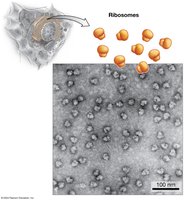
Ribosomes manufacture proteins and lack a membrane. Some are free in the cytosol, while others are attached to the endoplasmic reticulum.
Endoplasmic Reticulum (ER)
The ER is an extensive membrane-enclosed factory, continuous with the nuclear envelope. It has two regions:
Rough ER (RER): Studded with ribosomes, synthesizes proteins for shipment, membrane insertion, or secretion.
Smooth ER (SER): Lacks ribosomes, contains enzymes for lipid synthesis and detoxification, and serves as an ion reservoir.
Golgi Apparatus
The Golgi apparatus processes, sorts, and ships proteins from the RER. It consists of stacked, flat membranous sacs (cisternae) with distinct cis (near nucleus) and trans (toward plasma membrane) faces.
Lysosomes
Lysosomes are recycling centers found only in animal cells, containing about 40 different enzymes (acid hydrolases) that hydrolyze macromolecules. They maintain a low internal pH via proton pumps.
Vacuoles
Vacuoles are prominent in plant and fungal cells, serving as storage centers for water, ions, proteins, pigments, and protective compounds.
Peroxisomes
Peroxisomes are globular organelles that perform reduction–oxidation (redox) reactions. Specialized plant peroxisomes (glyoxysomes) oxidize fats. Catalase detoxifies hydrogen peroxide produced during oxidation.
Mitochondria
Mitochondria supply ATP to cells and have two membranes. The inner membrane is folded into cristae, enclosing the mitochondrial matrix. Mitochondria have their own DNA and ribosomes, and can grow and divide independently.
Chloroplasts
Chloroplasts, found in plants and algae, are the site of photosynthesis. They have three membranes, with thylakoids arranged in grana and surrounded by stroma. Chloroplasts also have their own DNA and ribosomes.
Cytoskeleton
The cytoskeleton is an extensive system of protein fibers that provides shape, stability, and organization, and transports materials within the cell.
Cell Wall and Extracellular Matrix
Fungi, algae, and plants have a stiff cell wall outside the plasma membrane for structural support. Animal cells lack a cell wall but are supported by the extracellular matrix (ECM), a mixture of secreted proteins and polysaccharides.
Summary Table: Eukaryotic Cell Components
Purpose
The following table summarizes the main components of eukaryotic cells and their functions.
Component | Main Function | Key Features |
|---|---|---|
Nucleus | Information storage and processing | Double membrane, nucleolus |
Ribosomes | Protein synthesis | No membrane, free or attached |
Rough ER | Protein synthesis and processing | Studded with ribosomes |
Smooth ER | Lipid synthesis and detoxification | No ribosomes |
Golgi Apparatus | Protein processing, sorting, shipping | Stacked cisternae |
Lysosomes | Macromolecule digestion and recycling | Acid hydrolases, low pH |
Vacuoles | Storage and digestion | Large, prominent in plants |
Peroxisomes | Redox reactions | Catalase, glyoxysomes in plants |
Mitochondria | ATP production | Double membrane, own DNA |
Chloroplasts | Photosynthesis | Three membranes, own DNA |
Cytoskeleton | Structural support, transport | Actin, intermediate, microtubules |
Cell Wall/ECM | Structural support | Cell wall in plants, ECM in animals |
Cell Systems: Integration and Transport
Nuclear Transport
The nucleus is the information center of eukaryotic cells. The nuclear envelope separates the nucleus from the cytosol and is perforated with nuclear pore complexes. Nuclear proteins contain a nuclear localization signal (NLS), a molecular "zip code" that directs them to the nucleus.
The Endomembrane System
The endomembrane system includes the ER, Golgi apparatus, and lysosomes. It produces, processes, and transports proteins, carbohydrates, and lipids. Proteins destined for secretion or specific organelles are synthesized in the RER and processed in the Golgi apparatus.
Pulse–Chase Experiment
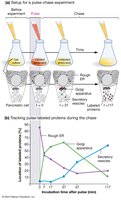
This experiment tracks protein movement through the secretory pathway. Cells are exposed to radiolabeled amino acids (pulse), then normal amino acids (chase). Proteins move from the RER to the Golgi and then to secretory vesicles.
Signal Hypothesis
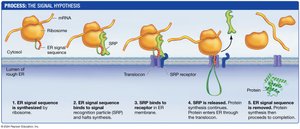
Proteins bound for the endomembrane system have an ER signal sequence, a molecular zip code. The sequence directs the ribosome to the RER, where the protein is synthesized and fed into the ER lumen. Glycosylation occurs, producing glycoproteins for further processing.
Protein Sorting and Vesicle Transport
Proteins are tagged in the Golgi apparatus for delivery to specific destinations. Transport vesicles carry proteins to the plasma membrane for secretion (exocytosis) or to lysosomes for recycling.
Lysosomal Recycling Pathways
Three pathways recycle materials in lysosomes:
Receptor-mediated endocytosis: Particles bind to receptors, are internalized, and delivered to lysosomes.
Phagocytosis: Cell engulfs particles or cells, forming a phagosome that fuses with lysosome.
Autophagy: Damaged organelles are enclosed in a membrane and digested by lysosomes.
The Dynamic Cytoskeleton
Cytoskeletal Elements
The cytoskeleton is a dynamic network of fibers that maintains cell shape, organizes contents, and enables movement. It consists of:
Actin filaments (microfilaments): Smallest, made of actin, involved in movement and cell shape.
Intermediate filaments: Diverse proteins, provide structural support, include keratins and nuclear lamins.
Microtubules: Largest, hollow tubes made of tubulin dimers, involved in chromosome separation and vesicle transport.
Actin Filament Structure and Function
Actin filaments are composed of globular actin subunits, assembled head-to-tail. They have plus and minus ends, with the plus end growing faster. Actin interacts with myosin for cellular movements such as cytokinesis, cytoplasmic streaming, and cell crawling.
Intermediate Filaments
Intermediate filaments provide structural support. Keratins are found in nails and hair, while nuclear lamins stabilize the nuclear envelope and anchor chromosomes.
Microtubules and Centrosomes
Microtubules originate from the microtubule organizing center (MTOC), called the centrosome in animal cells. They are essential for chromosome separation during mitosis and meiosis.
Vesicle Transport and Motor Proteins
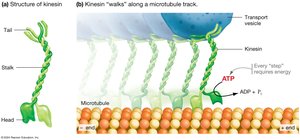
Microtubules serve as tracks for vesicle transport. The motor protein kinesin converts ATP into mechanical energy, "walking" along microtubules to move vesicles.
Flagella and Cilia
Flagella and cilia are projections that move cells. Prokaryotic flagella rotate, while eukaryotic flagella whip back and forth. Cilia are shorter and more numerous. Both have a "9 + 2" microtubule arrangement (axoneme) and are powered by the motor protein dynein, which causes bending and movement.
Conclusion
The structure and function of cellular components are intricately linked, enabling cells to perform specialized tasks, maintain homeostasis, and interact with their environment. Understanding these systems is fundamental to the study of biology.
