 Indietro
Ch.30 pt2 Introduction to Animal Diversity and Body Plans
Guida di studio - Note intelligenti
 Appunti personalizzati basati sui tuoi materiali, ampliati con definizioni chiave, esempi e contesto.
Introduction to Animal Diversity
Overview of Animal Characteristics
Animals are a diverse group of multicellular organisms distinguished by their unique developmental processes, tissue organization, and modes of nutrition. Understanding animal diversity involves examining their cell structure, embryonic development, body plans, and metabolic strategies.
Multicellularity: All animals are multicellular, with specialized cells forming tissues and organs.
Tissue Formation: True tissues evolved early, with cnidarians among the first animals to possess them. More complex tissues and organ systems evolved in bilaterians.
Reproduction and Development: Most animals undergo sexual reproduction, with embryonic development involving cleavage, blastula, and gastrula stages.
Energy and Metabolism: Animals are heterotrophs, obtaining energy through nutrition, gas exchange, and circulation.
Embryonic Development in Animals
Stages of Embryonic Development
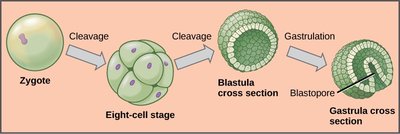
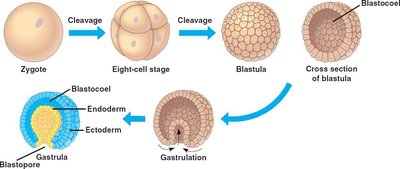
Animal embryonic development is a highly regulated process that transforms a single cell (zygote) into a multicellular organism. The main stages include cleavage, blastula formation, and gastrulation.
Cleavage: Rapid cell division of the zygote produces blastomeres.
Blastula: A hollow ball of cells formed after cleavage.
Gastrulation: Cells move inward, forming the gastrula and establishing embryonic germ layers.
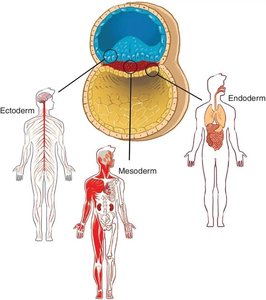
Germ Layers and Organogenesis
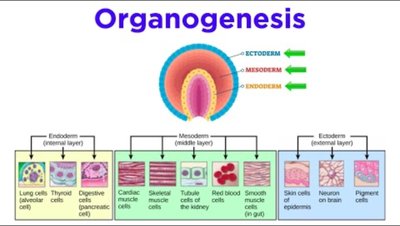
Gastrulation results in the formation of germ layers, which give rise to all tissues and organs in the adult animal. The number and type of germ layers are key features in animal classification.
Ectoderm: Forms skin, nervous system.
Endoderm: Forms interior linings of digestive and respiratory systems.
Mesoderm: Forms muscles, connective tissue, and internal organs (present only in triploblastic animals).
Animal Body Plans
Symmetry
Animal body plans are classified based on symmetry, which influences movement and sensory organization.
Asymmetry: No axis divides the body into mirror-image halves (e.g., sponges).
Radial Symmetry: Body parts arranged around a central axis; allows equal sensing from all sides (e.g., cnidarians).
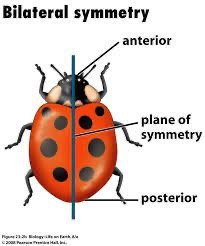
Bilateral Symmetry: Single axis divides the body into mirror-image halves; associated with directional movement and cephalization (e.g., insects, vertebrates).
Relationship Between Symmetry and Nervous System
Symmetry is closely linked to nervous system organization. Radially symmetrical animals have nerve nets, while bilaterians possess more complex nervous systems, often with centralized brains.
Nerve Net: Found in cnidarians and ctenophores.
Central Nervous System (CNS): Found in bilaterians, with neurons organized into nerve cords and ganglia.
Cephalization: Concentration of sensory and neural structures at the anterior end, facilitating environmental interaction.
Body Cavities
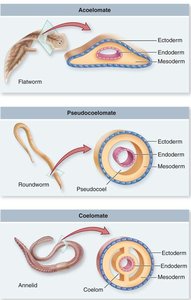
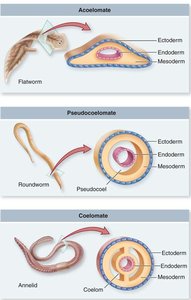
Body cavities are internal spaces that house organs and facilitate physiological functions. The presence and structure of body cavities are important for animal classification.
Acoelomate: No body cavity; organs embedded in solid tissue (e.g., flatworms).
Pseudocoelomate: Body cavity partially lined with mesoderm (e.g., roundworms).
Coelomate: Body cavity completely lined with mesoderm (e.g., annelids).
Phylogeny and Major Animal Lineages
Animal Phylogeny
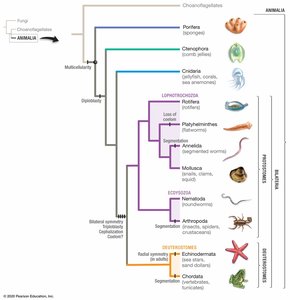
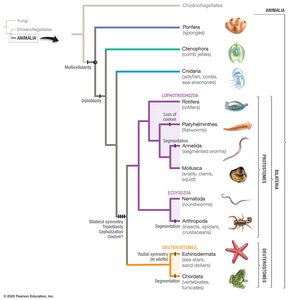
The evolutionary relationships among animal phyla are depicted in phylogenetic trees, which illustrate the origins of multicellularity, tissue development, and body plan diversification.
Sponges (Porifera): Earliest animals, lack true tissues, asymmetrical.
Comb Jellies (Ctenophora): Diploblastic, biradial symmetry.
Cnidarians: Diploblastic, radial symmetry, possess cnidocytes.
Bilaterians: Triploblastic, bilateral symmetry, include protostomes and deuterostomes.
Examples and Applications
Matching Body Structures to Germ Layers
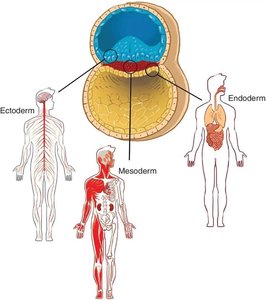
Understanding which body structures arise from each germ layer is fundamental in developmental biology and helps explain the organization of animal bodies.
Ectoderm: Skin, nervous system.
Mesoderm: Muscles, circulatory system, excretory organs.
Endoderm: Digestive tract lining, respiratory system.
Summary Table: Animal Body Plan Features
Feature | Options | Examples |
|---|---|---|
Symmetry | Asymmetrical, Radial, Bilateral | Sponges, Cnidarians, Insects |
Germ Layers | Diploblastic, Triploblastic | Cnidarians, Bilaterians |
Body Cavity | Acoelomate, Pseudocoelomate, Coelomate | Flatworms, Roundworms, Annelids |
Nervous System | Nerve net, CNS | Cnidarians, Vertebrates |
Additional info:
HOX genes are conserved developmental genes that regulate body plan formation in animals.
Animals are heterotrophs, requiring organic nutrients for energy.
Gas exchange and circulation are essential for oxygen delivery and waste removal in animal bodies.
