Indietro
Introduction to Animal Diversity: Structure, Evolution, and Strategies
Guida di studio - Note intelligenti
 Appunti personalizzati basati sui tuoi materiali, ampliati con definizioni chiave, esempi e contesto.
Introduction to Animal Diversity
What Are Animals?
Animals are a monophyletic group of multicellular eukaryotes distinguished by their heterotrophic nutrition, lack of cell walls, and ingestion of prey. Most animals develop tissues from embryonic layers, and recent phylogenetic analyses reveal several major groups: non-bilaterian lineages, two protostome groups (Lophotrochozoa and Ecdysozoa), and deuterostomes.
Monophyletic: All animals share a common ancestor.
Multicellular eukaryotes: Complex cellular organization.
Heterotrophic: Obtain energy by consuming other organisms.
Lack cell wall: Unlike plants and fungi.
Ingest prey: Internal digestion.
Embryonic tissues: Most animals develop specialized tissues.
Origins of Animals
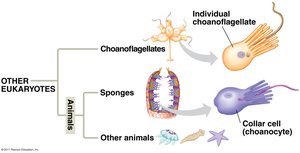
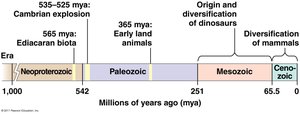
The ancestor of animals likely resembled modern choanoflagellates, which are the closest living eukaryote relatives of animals. Animals arose during the Neoproterozoic era.
Choanoflagellates: Single-celled or colonial eukaryotes with a collar and flagellum.
Neoproterozoic era: Time period when animals first appeared.
History of Animals
Fossil Record and Major Events
The fossil history of animals spans more than half a billion years. The common ancestor of living animals likely lived between 675 and 800 million years ago. The animal kingdom includes a great diversity of living and extinct species.
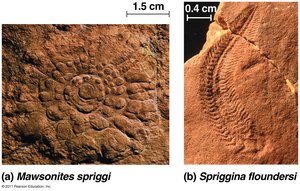
Ediacaran biota: Early soft-bodied animals, 565–544 mya.
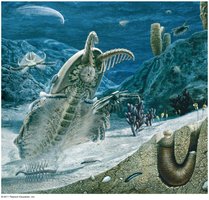
Burgess Shale biota: Earliest fossil appearance of many major animal groups, 535–525 mya.
Cambrian explosion: Period of rapid evolutionary change and diversification.
Cambrian Explosion Hypotheses
Four main hypotheses explain the Cambrian explosion:
Increased oxygen levels enabled efficient aerobic respiration.
Evolution of predation drove morphological divergence and defense strategies.
New ecological niches promoted speciation and diversification.
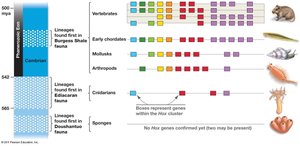
Expansion of Hox genes allowed for larger, more complex bodies.
Animal Body Plans
Fundamental Aspects of Body Plan
Early animal evolution is based on four fundamental aspects:
Number of embryonic tissue layers
Type of body symmetry and degree of cephalization
Presence or absence of a fluid-filled body cavity
How embryonic development proceeds
Embryonic Tissue Layers
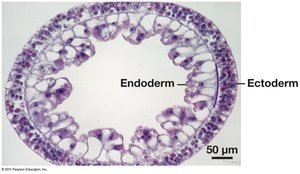
Porifera lack tissues, while other animals exhibit diploblastic or triploblastic organization.
Diploblasts: Two germ layers (ectoderm and endoderm).
Triploblasts: Three germ layers (ectoderm, endoderm, mesoderm).
Mesoderm: Evolution of mesoderm enabled complex muscle tissue and movement.
Body Symmetry
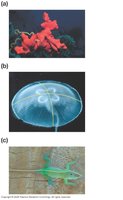
Animals exhibit three types of symmetry:
Asymmetry: No plane of symmetry (e.g., sponges).
Radial symmetry: Multiple planes of symmetry (e.g., jellyfish).
Bilateral symmetry: Single plane of symmetry, leading to cephalization (e.g., lizards).
Nervous System Organization
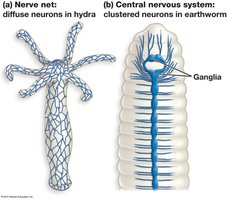
Nervous system complexity correlates with symmetry:
Porifera lack neurons.
Radially symmetrical animals have nerve nets.
Bilateral animals have a central nervous system (CNS), with neurons clustered into tracts, ganglia, and brains.
Body Cavities
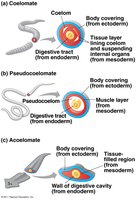
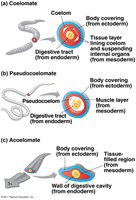
Triploblasts may possess a coelom, a fluid-filled cavity lined by mesoderm.
Coelomates: Coelom completely lined by mesoderm.
Acoelomates: Lack a coelom.
Pseudocoelomates: Body cavity derived from mesoderm and endoderm.
Body cavities allow circulation and hydrostatic skeletons for efficient movement.
Protostome vs. Deuterostome Development
Bilateria are divided into protostomes and deuterostomes based on embryonic development:
Protostomes: Mouth develops from blastopore; spiral and determinate cleavage; coelom forms by schizocoely.
Deuterostomes: Anus develops from blastopore; radial and indeterminate cleavage; coelom forms by enterocoely.
Animal Body Plans: Sac vs. Tube-within-a-Tube
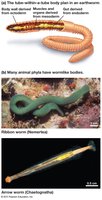
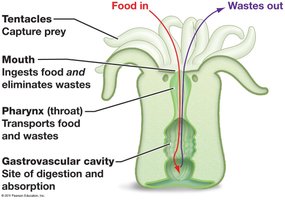
Animals exhibit two basic body plans:
Sac body plan: Mouth leads into an undifferentiated digestive bag (no alimentary system or anus).
Tube-within-a-tube plan: Outer tube forms body wall; inner tube forms gut with specialized compartments.
Animal Phylogeny and Diversity
Animal Phylogeny
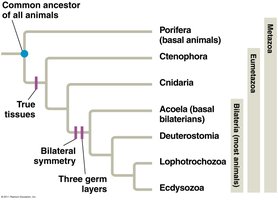
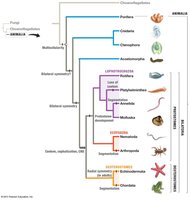
Animal phylogeny is constructed using morphological, molecular, genetic, and fossil data. Key points include monophyly, Porifera as basal animals, Eumetazoa with true tissues, and Bilateria containing most phyla. Three major bilaterian clades are Deuterostomia, Ecdysozoa, and Lophotrochozoa.
Bilaterian Clades
Deuterostomia: Includes chordates and echinoderms.
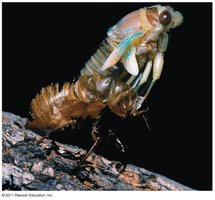
Ecdysozoa: Characterized by molting (ecdysis).
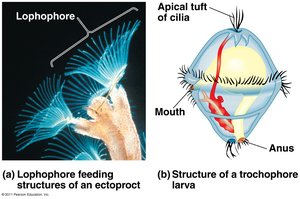
Lophotrochozoa: Defined by lophophore feeding structure and trochophore larva.
Animal Diversity Triggers
Variation Within Lineages
Variation among animal lineages results from innovative sensory modes, feeding structures, and locomotory structures.
Innovative Sensory Modes
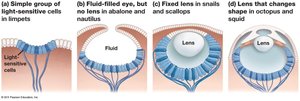
Most animals possess senses for touch, taste, smell, hearing, and light detection. Some have specialized senses such as magnetism, electric fields, and barometric pressure.
Animal Feeding Methods
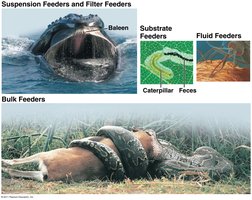
Feeding methods correlate with mouthpart structure:
Suspension feeding: Filtering particles from water.
Substrate feeding: Consuming material in which the animal lives.
Fluid feeding: Sucking nutrient-rich fluids.
Bulk feeding: Eating large pieces of food.
Animal Food Sources
Animals can be classified by their food sources:
Herbivore: Eats plants.
Carnivore: Eats other animals.
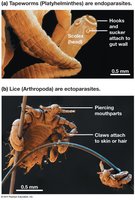
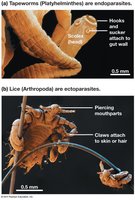
Parasitism: Lives on or in another organism (endoparasitism and ectoparasitism).
Detritivore: Consumes dead organic matter.
Omnivore: Eats both plants and animals.
Animal Locomotion
Movement methods are highly variable, with limbs being a major innovation. Limbs can be unjointed or jointed, and movement serves functions such as finding food, mates, and escaping predation.
Unjointed limbs: Simple, lobe-like structures.
Jointed limbs: Segmented, articulated appendages.
Animal Reproduction
Reproductive Modes
Animals exhibit high variability in reproductive modes:
Asexual reproduction: Offspring arise from a single parent.
Parthenogenesis: Development from unfertilized eggs.
Sexual reproduction: Involves gamete fusion.
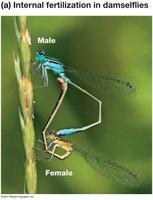
Internal fertilization: Fertilization occurs inside the body.
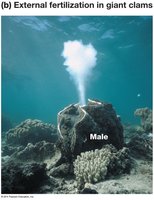
External fertilization: Fertilization occurs outside the body.
Three modes of egg-laying:
Oviparous: Eggs laid outside the body.
Ovoviviparous: Eggs develop inside the body, hatch internally or immediately after laying.
Viviparous: Live birth.