 Indietro
Introduction to Metabolism: Energy, ATP, and Enzymes
Guida di studio - Note intelligenti
 Appunti personalizzati basati sui tuoi materiali, ampliati con definizioni chiave, esempi e contesto.
Introduction to Metabolism
Forms of Energy
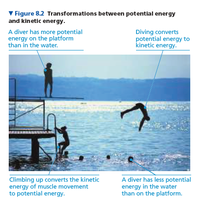
Energy is a fundamental concept in biology, essential for all cellular processes. It exists in various forms, including potential, kinetic, and thermal energy.
Potential Energy: Stored energy due to location or structure, such as in chemical bonds. Chemical energy is a type of potential energy.
Kinetic Energy: Energy associated with motion.
Thermal Energy/Heat: Kinetic energy resulting from the movement of molecules or atoms, often transferred between objects.
Energy Flow in Biological Systems
Energy flows in one direction through biological systems, primarily originating from the sun. Plants capture sunlight via photosynthesis, and energy is not cycled but substances are.
All organisms harvest external energy to power life processes.
Heat is lost to the environment during cellular respiration and cannot be used to do work.
Metabolism and Metabolic Pathways
Definition of Metabolism
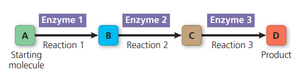
Metabolism encompasses all chemical reactions within cells, including those that consume or generate energy. These reactions are organized into metabolic pathways, where each step is catalyzed by a specific enzyme.
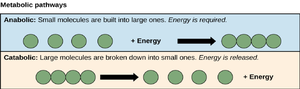
Anabolic Pathways: Build complex molecules from simpler ones; require energy.
Catabolic Pathways: Break down complex molecules into simpler ones; release energy.
Chemical Reactions: Energy In and Out
Anabolic vs. Catabolic Reactions
Chemical reactions in cells can be classified as anabolic (endergonic) or catabolic (exergonic).
Anabolic Reactions: Energy-requiring; build molecules (e.g., photosynthesis).
Catabolic Reactions: Energy-releasing; break down molecules (e.g., cellular respiration).
Laws of Thermodynamics in Biology
First and Second Laws of Thermodynamics
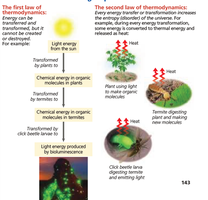
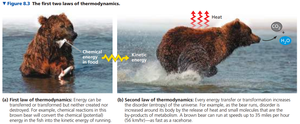
The laws of thermodynamics govern energy transformations in biological systems.
First Law: Energy can be transferred or transformed, but cannot be created or destroyed.
Second Law: Every energy transfer increases the disorder (entropy) of the universe.
Free Energy and Reaction Types
Free Energy (ΔG)
Free energy (ΔG) is the energy available to do work under constant temperature and pressure. Cells use free energy for various tasks, such as building proteins, transporting substances, and muscle contraction.
Exergonic and Endergonic Reactions
Exergonic Reaction: Releases energy; ΔG is negative; spontaneous.
Endergonic Reaction: Absorbs energy; ΔG is positive; non-spontaneous.
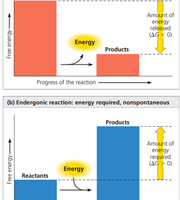
Spontaneous and Nonspontaneous Processes
Spontaneous Process: Thermodynamically favorable; proceeds without continuous energy input (e.g., cellular respiration, diffusion).
Nonspontaneous Process: Requires energy input (e.g., protein synthesis, photosynthesis).
Equilibrium
Equilibrium: State of maximum stability; rates of forward and backward reactions are equal.
At equilibrium, ΔG = 0 and the system can do no work.
Processes moving toward equilibrium are spontaneous; movements away are nonspontaneous and have positive ΔG.
ATP: The Energy Currency of the Cell
ATP and Energy Coupling
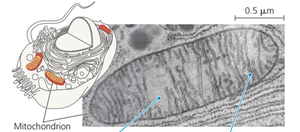
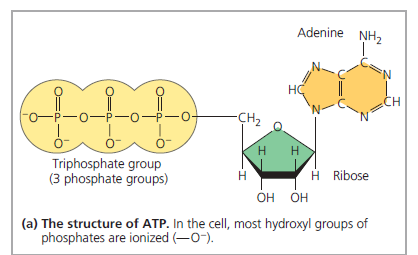
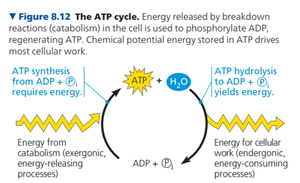
Adenosine triphosphate (ATP) is the main energy carrier in cells, produced largely in mitochondria. ATP couples exergonic and endergonic reactions via phosphorylation, linking catabolic and anabolic pathways.
The ATP Cycle
The ATP cycle is a reversible process involving ATP synthase. Energy from catabolism is used to synthesize ATP, which is then hydrolyzed to power cellular work.
ATP in Cellular Work
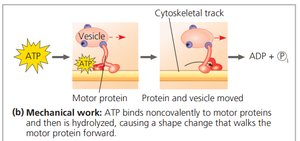
ATP drives transport and mechanical work by transferring phosphate groups to target molecules.
ATP hydrolysis provides energy for motor proteins and vesicle movement.
Enzymes: Biological Catalysts
What are Enzymes?
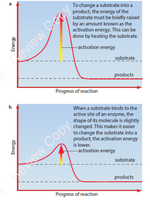
Enzymes are biological catalysts, usually proteins, that speed up reaction rates by lowering activation energy. They remain unchanged after the reaction and are highly specific for their substrates.
Activation Energy (EA): Minimum energy needed to start a reaction.
Each enzyme functions best within a characteristic range of temperature, salt concentration, and pH.
Substrate Specificity
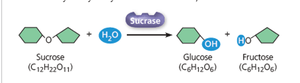
Substrate: The reactant an enzyme acts on.
Enzyme-substrate complex (ES Complex): The intermediate formed when an enzyme binds its substrate.
The catalytic action converts substrate(s) to product(s).


The Activation Energy Barrier
Enzymes lower the activation energy barrier, making reactions proceed faster.
Mode of Action of Enzymes
Lock & Key Model: The enzyme's active site is a small cleft where the substrate fits precisely.
Enzymes lower activation energy by concentrating substrate molecules and orienting them to favor reactions.
The Active Site and Catalytic Cycle
An enzyme can convert one or more reactant molecules to one or more product molecules.
The catalytic cycle involves substrate binding, conversion to product, and release.
Induced Fit Model
Induced Fit: The enzyme or substrate changes shape slightly for a perfect fit, often excluding water from the active site.
Effects of Temperature and pH
Enzymes have optimum conditions for activity.
Some enzymes, such as those in Archaea, are thermophilic (survive at >80°C) or acidophilic (survive in acidic conditions).
Enzyme Inhibition
Competitive Inhibition: Inhibitor competes with substrate for active site; reversible.
Non-competitive Inhibition: Inhibitor binds to allosteric site, changing the active site shape; can be reversible or irreversible.
Irreversible Inhibition: Permanent, often caused by heavy metal ions.
Reversible Inhibition: Includes end-product inhibition.
Feedback Inhibition
End-Product Inhibition: The product of a pathway regulates its own further production, often via noncompetitive reversible inhibition.
Cofactors and Coenzymes
Cofactors: Inorganic helpers (e.g., zinc, iron, copper) for enzyme activity.
Coenzymes: Organic helpers, often vitamins.
Example: Catalase uses iron as a cofactor to convert hydrogen peroxide to water and oxygen.
Metabolic Pathways
Organization of Metabolic Pathways
Cells organize reactions into orderly, enzyme-mediated sequences called metabolic pathways. Examples include respiration and photosynthesis.
Summary Table: Types of Metabolic Pathways
Pathway Type | Description | Energy Requirement | Example |
|---|---|---|---|
Anabolic | Builds complex molecules from simpler ones | Requires energy | Photosynthesis |
Catabolic | Breaks down complex molecules into simpler ones | Releases energy | Cellular Respiration |
Key Equations
Free Energy Change:
ATP Hydrolysis:
Enzyme-Substrate Complex:
Additional info: Academic context was added to clarify the role of energy, ATP, and enzymes in metabolism, and to ensure completeness for exam preparation.
