 Indietro
Introduction to Metabolism: Energy, Enzymes, and Regulation
Guida di studio - Note intelligenti
 Appunti personalizzati basati sui tuoi materiali, ampliati con definizioni chiave, esempi e contesto.
Metabolism, Energy, and Life
Overview of Metabolic Pathways
Metabolism encompasses all chemical reactions occurring within an organism, organized into interconnected metabolic pathways. These pathways are classified as:
Catabolic pathways: Break down molecules, releasing energy.
Anabolic pathways: Build complex molecules, consuming energy.
Enzymes, which are biological catalysts, facilitate these reactions, ensuring efficient energy transformation and molecular rearrangement.
Energy Transformations in Biological Systems
Energy is the capacity to do work and exists in various forms:
Kinetic energy: Energy of motion (e.g., a moving arrow).
Potential energy: Stored energy due to position or structure (e.g., chemical energy in food molecules).
Energy transformations are governed by the laws of thermodynamics:
First Law (Conservation of Energy): Energy cannot be created or destroyed, only transformed.
Second Law: Every energy transfer increases the entropy (disorder) of the universe. Ordered matter can only be maintained by increasing disorder elsewhere.
Example: Pulling back a bowstring stores potential energy, which is converted to kinetic energy when released. Some energy is always lost as heat, a form of kinetic energy due to random molecular motion.
Free Energy and Spontaneous Reactions
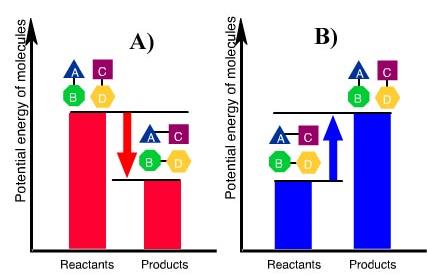
Free energy (G) is the portion of a system's energy available to do work under cellular conditions. The change in free energy is given by:
Exergonic reactions: Release free energy (-ΔG), are spontaneous, and the products have less free energy than the reactants.
Endergonic reactions: Require an input of energy (+ΔG), are non-spontaneous, and the products have more free energy than the reactants.
In cells, exergonic reactions are often coupled to endergonic reactions, allowing energy released from one to drive the other. Metabolism is kept from reaching equilibrium by the continuous input of reactants and removal of products.
ATP: The Energy Currency of the Cell
Adenosine triphosphate (ATP) powers cellular work by coupling exergonic and endergonic reactions. Hydrolysis of ATP releases energy by removing its terminal phosphate group, forming ADP and inorganic phosphate:
ATP drives endergonic reactions by transferring a phosphate group to reactants, making them more reactive.
Catabolic pathways regenerate ATP from ADP and phosphate.
Enzymes
Role and Mechanism of Enzymes
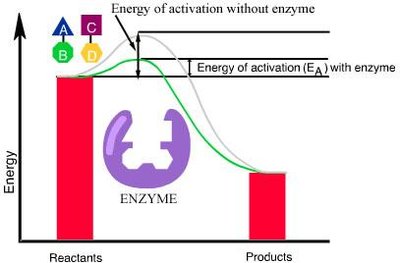
Enzymes are proteins that act as biological catalysts, speeding up metabolic reactions by lowering the activation energy (EA) required for reactions to proceed. This allows reactions to occur at moderate temperatures compatible with life.
Enzyme Specificity and Function
Each enzyme has a unique active site that binds specifically to its substrate (the reactant molecule).
Binding induces a slight change in enzyme shape (induced fit), optimizing the interaction.
The active site lowers activation energy by:
Orienting substrates correctly
Straining substrate bonds
Providing a favorable microenvironment
Factors Affecting Enzyme Activity
Enzymes have optimal temperature and pH ranges for activity.
Cofactors (inorganic ions) and coenzymes (organic molecules) are sometimes required for enzyme function.
Inhibitors can reduce enzyme activity:
Competitive inhibitors bind to the active site, blocking substrate access.
Noncompetitive inhibitors bind elsewhere, altering enzyme shape and function.
The Control of Metabolism
Regulation of Enzyme Activity
Allosteric regulation: Enzymes change shape when regulatory molecules bind to specific sites (allosteric sites), acting as activators or inhibitors.
Feedback inhibition: The end product of a metabolic pathway inhibits an enzyme involved earlier in the pathway, preventing overproduction.
Cooperativity: In multi-subunit enzymes, binding of a substrate to one active site increases activity at other sites.
Spatial Organization of Metabolism
Enzymes may be organized into complexes, embedded in membranes, or compartmentalized within organelles, enhancing metabolic efficiency and regulation.
Emergent Properties in Biological Systems
Higher levels of biological organization result in new properties that emerge from the interactions and organization of simpler components. This principle is fundamental to the chemistry of life and the regulation of metabolism.
