 Indietro
Introduction to Science and the Scientific Method in Biology
Guida di studio - Note intelligenti
 Appunti personalizzati basati sui tuoi materiali, ampliati con definizioni chiave, esempi e contesto.
Introduction to Biology
What is Science?
Science is a systematic, methodical, and objective approach to acquiring knowledge about the natural, social, and formal universe. It relies on observation, experimentation, and logical reasoning to understand and explain phenomena.
Systematic: Follows a structured order and method (the scientific method).
Methodical: Uses planned and replicable procedures to evaluate hypotheses.
Objective: Seeks to minimize personal or cultural biases.
Falsifiable and Provisional: Scientific knowledge is open to revision and correction as new evidence arises.
Main Branches of Science
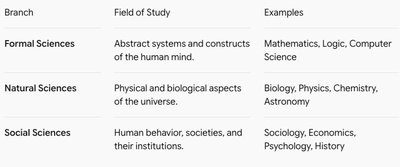
Science is divided into several branches, each with distinct fields of study and examples:
Branch | Field of Study | Examples |
|---|---|---|
Formal Sciences | Abstract systems and constructs of the human mind. | Mathematics, Logic, Computer Science |
Natural Sciences | Physical and biological aspects of the universe. | Biology, Physics, Chemistry, Astronomy |
Social Sciences | Human behavior, societies, and their institutions. | Sociology, Economics, Psychology, History |
Research Methodology
Falsifiability in Science
Falsifiability is a principle proposed by Karl Popper, stating that for a hypothesis or theory to be scientific, it must be possible to conceive an experiment or observation that could prove it false. This principle distinguishes science from pseudoscience and metaphysics.
Corroboration: Theories are not proven true but are supported by surviving attempts at falsification.
Demarcation Criterion: Separates science from pseudoscience; scientific theories must risk being wrong.
Scientific Progress: Science advances by eliminating errors and refining theories.
Rejection of Dogmatism: Scientific knowledge is dynamic and open to correction.
Science, Technology, and Pseudoscience: Key Differences
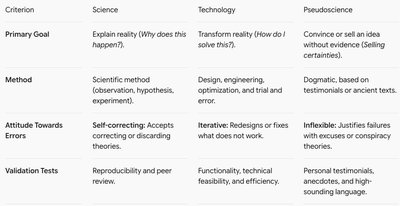
Although science, technology, and pseudoscience all deal with knowledge or the physical world, their goals, methods, and criteria for truth differ fundamentally.
Criterion | Science | Technology | Pseudoscience |
|---|---|---|---|
Primary Goal | Explain reality (Why does this happen?) | Transform reality (How do I solve this?) | Convince or sell an idea without evidence (Selling certainties) |
Method | Scientific method (observation, hypothesis, experiment) | Design, engineering, optimization, and trial and error | Dogmatic, based on testimonials or ancient texts |
Attitude Towards Errors | Self-correcting: Accepts correcting or discarding theories | Iterative: Redesigns or fixes what does not work | Inflexible: Justifies failures with excuses or conspiracy theories |
Validation Tests | Reproducibility and peer review | Functionality, technical feasibility, and efficiency | Personal testimonials, anecdotes, and high-sounding language |
The Scientific Method
Overview of the Scientific Method
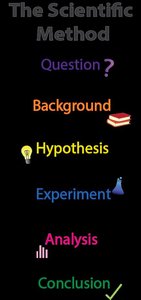
The scientific method is a rigorous and systematic process used to investigate phenomena, acquire new knowledge, or correct and integrate previous knowledge. It is based on empirical evidence, measurement, and reproducibility. The process is cyclical, connecting practical observation with theory.
Observation
Question/Problem Statement
Hypothesis
Experimentation
Data Analysis
Conclusion
Steps of the Scientific Method
Observation: Rigorous identification of a natural phenomenon using senses or instruments. Example: "Bread stored at room temperature developed mold, but bread in the fridge did not."
Question/Problem Statement: Clear formulation of a research question based on observation. Example: "How does temperature affect the rate of mold growth on bread?"
Hypothesis: A tentative, testable explanation that can be evaluated through experimentation. Example: "If white bread is stored at a lower temperature (4 ºC), then mold will take significantly longer to appear and cover less surface area compared to bread stored at room temperature (20 ºC), because colder temperatures slow down the biological metabolic processes of fungal spores."
Experimentation: Designing and executing controlled tests to validate or refute the hypothesis. All variables except the independent variable must be kept constant.
Data Analysis: Processing results (quantitative or qualitative) to support or reject the hypothesis. State clearly whether the hypothesis was supported or rejected, cite key data, and explain the biological or physical reason for the result.
Conclusion: Accepting, modifying, or rejecting the initial hypothesis and communicating the findings.
Variables in Scientific Experiments
Types of Variables
Variables are factors, conditions, or elements in an experiment that can change, be controlled, or be measured. They allow scientists to test hypotheses by isolating cause-and-effect relationships.
Independent Variable: The factor deliberately manipulated by the researcher (cause). Example: The amount of sunlight a plant receives.
Dependent Variable: The measured or observed factor that changes in response (effect). Example: The height of the plant after two weeks.
Controlled Variables: Factors kept constant throughout the experiment. Example: The type of soil, amount of water, pot size, and temperature.
Control Group vs Experimental Group
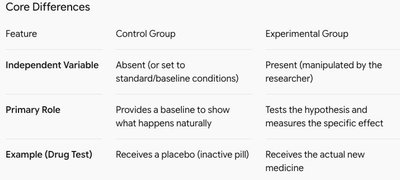
In experiments, the control group and experimental group are parallel setups used to isolate cause-and-effect relationships. Comparing them ensures that any observed effect is due to the independent variable, not outside factors or random chance.
Feature | Control Group | Experimental Group |
|---|---|---|
Independent Variable | Absent (or set to standard/baseline conditions) | Present (manipulated by the researcher) |
Primary Role | Provides a baseline to show what happens naturally | Tests the hypothesis and measures the specific effect |
Example (Drug Test) | Receives a placebo (inactive pill) | Receives the actual new medicine |
Additional info: Understanding the scientific method and experimental design is foundational for all biological research, as it ensures that conclusions are based on reliable, reproducible evidence.
