 Indietro
Invertebrate Diversity: Key Phyla and Their Characteristics
Guida di studio - Note intelligenti
 Appunti personalizzati basati sui tuoi materiali, ampliati con definizioni chiave, esempi e contesto.
Invertebrate Diversity
Overview of Major Invertebrate Phyla
Invertebrates represent the vast majority of animal diversity on Earth. This section explores the key characteristics, representative organisms, and evolutionary relationships of major invertebrate phyla, focusing on sponges, cnidarians, flatworms, nematodes, and molluscs.
Phylum | Key Characteristics | Representative Organisms |
|---|---|---|
Porifera (Sponges) | No true tissues, asymmetrical, filter feeders | Purple tube sponge, Azure vase sponge, Scypha |
Cnidaria | Radial symmetry, two tissue layers, stinging cells (cnidocytes) | Hydra, Sea anemone, Jellyfish |
Platyhelminthes (Flatworms) | Bilateral symmetry, three tissue layers, no body cavity | Planarians, Flukes, Tapeworms |
Nematoda (Roundworms) | Bilateral symmetry, body cavity, complete digestive tract | Free-living nematodes, Parasitic nematodes |
Mollusca | Muscular foot, visceral mass, mantle, often a shell | Snails, Clams, Octopus, Squid |
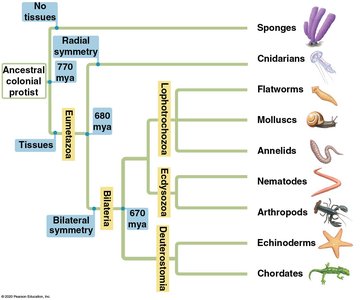
Sponges (Phylum Porifera)
Structure and Function
Sponges are the simplest animals and represent the earliest branch of the animal kingdom. They lack true tissues and organs, and their bodies are porous, allowing water to flow through and facilitate filter feeding.
No true tissues: Composed of loosely associated cells separated by a gelatinous region.
Asymmetrical: Most sponges lack body symmetry.
Choanocytes: Specialized flagellated collar cells that filter food from water.
Amoebocytes: Cells that produce supportive skeletal fibers and aid in digestion.
Sessile adults: Sponges are attached to surfaces and do not move.
Habitat: Mostly marine, some freshwater species.
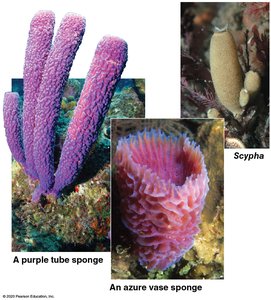
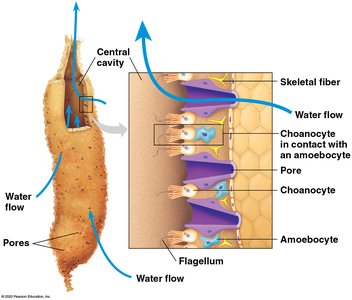
Example: The purple tube sponge and azure vase sponge are common marine sponges. Scypha is a genus often used in laboratory studies.
Cnidarians (Phylum Cnidaria)
Body Structure and Life Forms
Cnidarians are characterized by radial symmetry, two true tissue layers, and specialized stinging cells called cnidocytes. They have a simple body plan with two main forms: polyp and medusa.
Radial symmetry: Body parts arranged around a central axis.
Two tissue layers: Outer epidermis and inner gastrodermis, separated by a jelly-like mesoglea.
Gastrovascular cavity: Central digestive compartment with a single opening.
Polyp form: Sessile, cylindrical body with tentacles (e.g., hydra, sea anemone).
Medusa form: Free-floating, umbrella-shaped body with tentacles (e.g., jellyfish).
Cnidocytes: Specialized cells for defense and prey capture, containing nematocysts (stinging organelles).
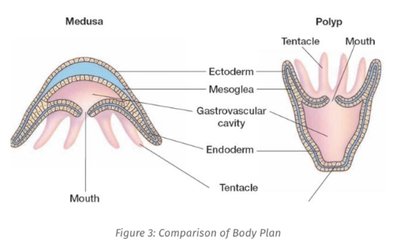
Example: Hydra (polyp), sea anemone (polyp), and marine jelly (medusa) are representative cnidarians.
Gastrovascular Cavity Functions
Digestion of food
Distribution of nutrients
Removal of wastes
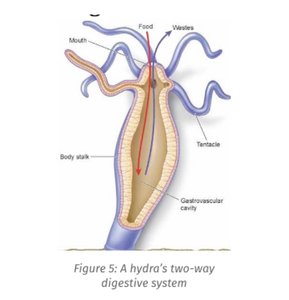
Additional info: The gastrovascular cavity serves as both a digestive and circulatory compartment, as cnidarians lack a separate circulatory system.
Flatworms (Phylum Platyhelminthes)
Structure and Diversity
Flatworms are the simplest animals with bilateral symmetry and three tissue layers. They lack a body cavity (acoelomate) and have a thin, ribbon-like body.
Bilateral symmetry: Body has distinct left and right sides.
Three tissue layers: Ectoderm, mesoderm, and endoderm.
No body cavity: Organs are embedded directly in solid tissue.
Simple nervous system: Includes a simple brain and nerve cords.
Gastrovascular cavity: Single opening for ingestion and egestion.
Light-sensitive eye cups: Aid in detecting light direction.
Major groups: Planarians (free-living), flukes (parasitic), tapeworms (parasitic).
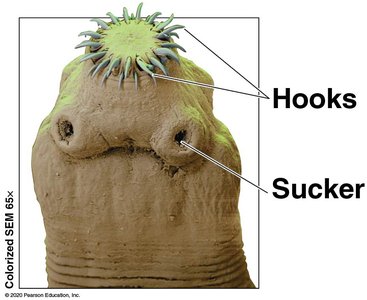
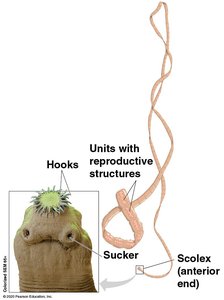
Example: Tapeworms live in the digestive tracts of vertebrates and absorb nutrients across their body surface, using hooks and suckers to attach to the host's intestinal wall.
Nematodes (Phylum Nematoda)
Structure and Function
Nematodes, or roundworms, are bilaterally symmetrical animals with a body cavity and a complete digestive tract. They are covered by a nonliving cuticle that is periodically shed.
Bilateral symmetry
Three tissue layers
Body cavity (pseudocoelom): Provides space for internal organs and fluid transport.
Complete digestive tract: Separate mouth and anus, allowing for continuous food processing.
Cuticle: Protective, nonliving layer that is molted as the animal grows.
Ecological roles: Free-living decomposers, plant parasites, and animal parasites.
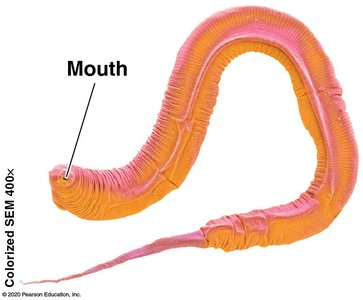
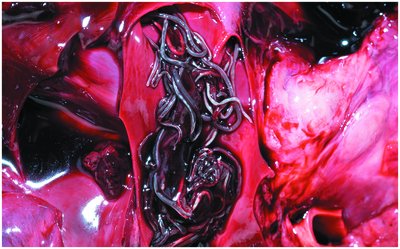
Example: Some nematodes are beneficial decomposers, while others, such as heartworms, are serious animal parasites.
Molluscs (Phylum Mollusca)
General Body Plan
Molluscs are soft-bodied animals, often protected by a hard shell. They have a common body plan consisting of a muscular foot, visceral mass, and mantle. Many possess a radula for feeding and a circulatory system.
Muscular foot: Used for locomotion.
Visceral mass: Contains most internal organs.
Mantle: May secrete a shell that covers the visceral mass.
Radula: Rasping organ for feeding (not present in all groups).
Trochophore larva: Ciliated larval stage in many molluscs.
Separate sexes: Most molluscs have distinct male and female individuals.
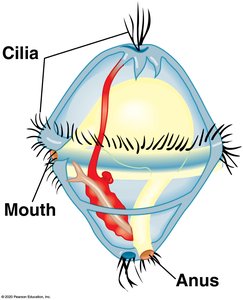
Major Mollusc Groups
Gastropods: Largest group; includes snails and slugs. Most have a single, spiral-shaped shell and a distinct head with eyes. Aquatic species use gills, while terrestrial species use the mantle cavity as a lung.
Bivalves: Includes clams, oysters, mussels, and scallops. Shell divided into two hinged halves. Suspension feeders using gills for feeding and gas exchange. Muscular foot used for digging and anchoring.
Cephalopods: Includes octopus, squid, and nautilus. Fast, agile predators with beak-like jaws and a radula. Some have external shells (nautilus), internal shells (squid), or no shell (octopus). Highly developed brains and sense organs.
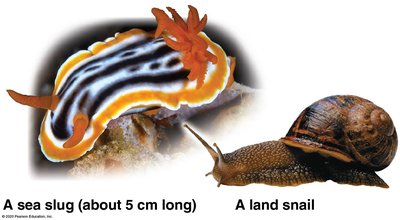
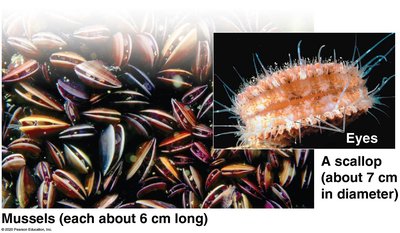
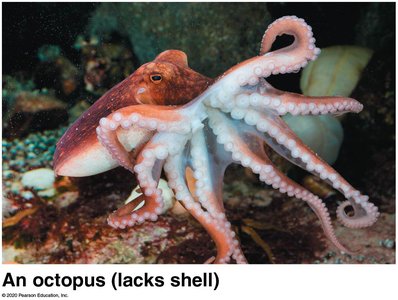
Example: The octopus is a shell-less cephalopod known for its intelligence and complex behaviors. Mussels and scallops are common bivalves found in marine environments.
