 Indietro
Joints (Articulations): Structure, Classification, and Movement
Guida di studio - Note intelligenti
 Appunti personalizzati basati sui tuoi materiali, ampliati con definizioni chiave, esempi e contesto.
Joints (Articulations)
Introduction to Joints
Joints, or articulations, are sites where two or more bones meet. They are essential for skeletal mobility and maintaining the structural integrity of the skeleton.
Articulation: The anatomical term for a joint, where bones connect.
Functions of Joints:
Enable movement of the skeleton
Maintain skeletal structure and stability
Joints are classified based on their structure and the amount of movement they permit.
Classification of Joints
Functional Classification
Functional classification is based on the amount of movement a joint allows:
Synarthroses: Immovable joints (e.g., sutures of the skull)
Amphiarthroses: Slightly movable joints (e.g., intervertebral discs)
Diarthroses: Freely movable joints (e.g., most limb joints)
Structural Classification
Structural classification is based on the material binding the bones and the presence or absence of a joint cavity:
Fibrous Joints: Bones joined by dense connective tissue; no joint cavity; mostly immovable.
Cartilaginous Joints: Bones joined by cartilage; no joint cavity; slightly movable.
Synovial Joints: Bones separated by a fluid-filled joint cavity; freely movable.
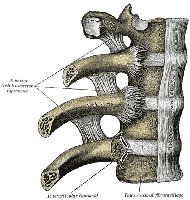
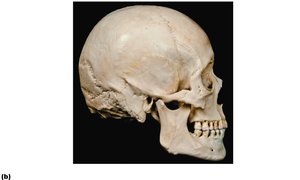
Synovial Joints
Major Structural Components
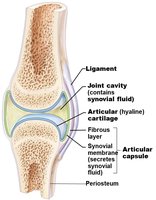
Synovial joints are the most common and movable type of joint in the body. They have several distinguishing features:
Articular (hyaline) cartilage: Covers the ends of bones, reducing friction and absorbing shock.
Joint (synovial) cavity: A small, fluid-filled space between articulating bones.
Articular capsule: Encloses the joint cavity; consists of two layers:
Fibrous layer: Outer, continuous with periosteum of bones.
Synovial membrane: Inner, secretes synovial fluid.
Synovial fluid: Viscous, lubricating fluid that reduces friction and nourishes cartilage.
Ligaments: Reinforce the joint and connect bone to bone.
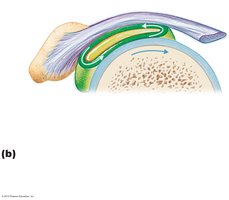
Additional structures: Fatty pads (cushioning) and menisci (improve fit, minimize wear and tear).
Structures Associated with Synovial Joints
Bursae: Flattened sacs lined with synovial membrane, containing synovial fluid; reduce friction where structures rub together.
Tendon Sheaths: Elongated bursae that wrap around tendons subjected to friction.
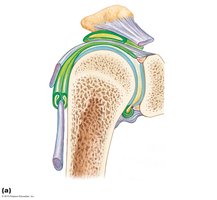
Types of Synovial Joints
Ball and Socket Joints
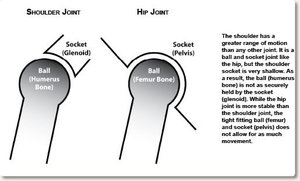
Ball and socket joints allow movement in multiple axes and planes. Examples include the shoulder and hip joints.
Shoulder Joint: Greater range of motion due to shallow socket (glenoid); less stability.
Hip Joint: Deeper socket (acetabulum); more stability, less range of motion.
Hinge Joints
Hinge joints allow movement primarily in one plane (flexion and extension). Examples include the elbow and knee.
Stability and Mobility of Synovial Joints
Synovial joints are the most mobile but also the weakest parts of the skeleton. Their stability is influenced by:
Shape of articular surfaces: Ball and socket joints provide the best fit.
Number of ligaments: More ligaments increase stability but are limited in stretch tolerance.
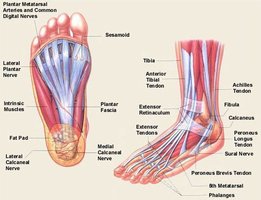
Muscle tone: Tendons connecting muscle to bone are critical for stabilizing joints, especially in the shoulder and foot arch.
Movements at Synovial Joints
Types of Movements
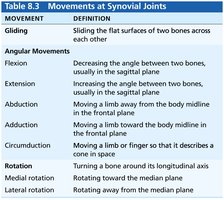
Movements at synovial joints occur along transverse, frontal, or sagittal planes. For movement to occur, a muscle must cross a joint.
Movement | Definition |
|---|---|
Gliding | Sliding the flat surfaces of two bones across each other |
Flexion | Decreasing the angle between two bones, usually in the sagittal plane |
Extension | Increasing the angle between two bones, usually in the sagittal plane |
Abduction | Moving a limb away from the body midline in the frontal plane |
Adduction | Moving a limb toward the body midline in the frontal plane |
Circumduction | Moving a limb or finger so that it describes a cone in space |
Rotation | Turning a bone around its longitudinal axis |
Medial rotation | Rotating toward the median plane |
Lateral rotation | Rotating away from the median plane |
Summary Table: Functional and Structural Classification of Joints
Functional Classification | Movement | Structural Classification | Example |
|---|---|---|---|
Synarthroses | Immovable | Fibrous | Sutures of the skull |
Amphiarthroses | Slightly movable | Cartilaginous | Intervertebral discs |
Diarthroses | Freely movable | Synovial | Shoulder, knee |
Additional info: The notes above integrate textbook-level explanations and examples for each joint type and movement, as well as the anatomical and functional relationships relevant to college-level General Biology.
