 Indietro
Land Plant Evolution, Structure, and Function
Guida di studio - Note intelligenti
 Appunti personalizzati basati sui tuoi materiali, ampliati con definizioni chiave, esempi e contesto.
Land Plant Evolution
Introduction to Land Plants
Land plants (Embryophytes) are a diverse group of organisms that evolved from green algae and have adapted to terrestrial environments. Their evolution marks a significant transition in the history of life, enabling the colonization of land and the development of complex terrestrial ecosystems.
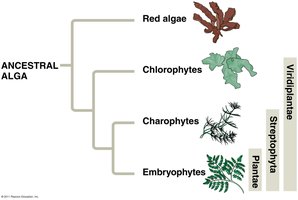
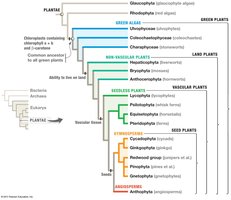
Green plants include both green algae and land plants.
Land plants are primarily terrestrial, while green algae are mostly aquatic.
Charophytes are the closest living relatives of land plants, sharing key features such as chloroplast structure and cell wall composition.
Major Groups of Land Plants
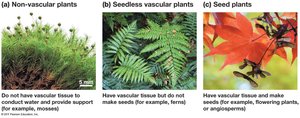
Land plants are classified into three major groups based on morphology and reproductive strategies:
Non-vascular plants (Bryophytes): Lack vascular tissue; include mosses, liverworts, and hornworts.
Seedless vascular plants: Possess vascular tissue but do not produce seeds; include ferns, horsetails, and club mosses.
Seed plants: Have vascular tissue and produce seeds; divided into gymnosperms (naked seeds) and angiosperms (seeds within a carpel).
Evolutionary Timeline
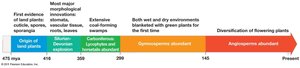
The evolution of land plants is marked by several key innovations and diversification events:
First land plants appeared ~470 million years ago (Ordovician period).
Vascular plants evolved ~425 million years ago (Silurian period).
Seed plants emerged ~360 million years ago (late Devonian period).
Angiosperms diversified and became dominant in the Cretaceous period.
Key Innovations for Terrestrial Life
Adaptations to Land
Land plants evolved several adaptations to survive and thrive in terrestrial environments:
Cuticle: A waxy, watertight layer covering leaves and stems to prevent water loss.
Stomata: Pores surrounded by guard cells that regulate gas exchange and water loss.
Vascular tissues: Specialized tissues (xylem and phloem) for transporting water, minerals, and nutrients throughout the plant body.
Lignin: A complex polymer that provides structural support, allowing plants to grow taller and withstand wind and gravity.
Reproductive Innovations
Key reproductive adaptations allowed plants to reproduce successfully on land:
Alternation of generations: Life cycle alternates between multicellular haploid (gametophyte) and diploid (sporophyte) stages.
Multicellular, dependent embryos: Embryos are retained and nourished by parental tissues.
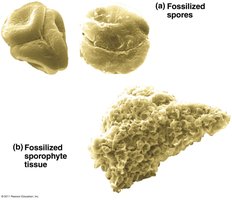
Walled spores: Produced in sporangia, resistant to harsh environments due to sporopollenin coating.
Multicellular gametangia: Structures (archegonia and antheridia) that produce and protect gametes.
Apical meristems: Regions of cell division at the tips of roots and shoots, enabling growth and adaptation to the environment.
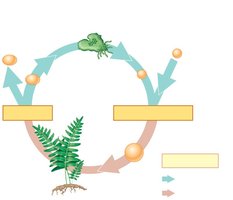
Major Lineages and Life Cycles
Bryophytes (Non-vascular Plants)
Bryophytes are the most ancient group of land plants and are characterized by a dominant gametophyte generation and the absence of vascular tissue.
Examples: Mosses, liverworts, hornworts.
Gametophyte is the dominant, photosynthetic stage; sporophyte is small and dependent on the gametophyte.
Important ecological roles: Soil formation, nitrogen retention, and peat formation.
Seedless Vascular Plants
Seedless vascular plants have vascular tissues but reproduce via spores rather than seeds. They were dominant in the Carboniferous period and contributed to the formation of coal deposits.
Examples: Ferns, horsetails, club mosses.
Sporophyte is the dominant generation; gametophyte is small and often grows underground.
Most are homosporous, but some are heterosporous (produce distinct male and female spores).
Require moist environments for fertilization due to flagellated sperm.
Seed Plants
Seed plants are the most diverse and widespread group of land plants, characterized by the production of seeds and pollen.
Gymnosperms: Produce "naked" seeds not enclosed in a fruit (e.g., pines, firs, cycads, ginkgo).
Angiosperms: Produce seeds enclosed within a fruit (flowering plants).
Reduced gametophytes protected by sporophyte tissues.
Pollen eliminates the need for water in fertilization.
Seeds allow for dispersal and dormancy.
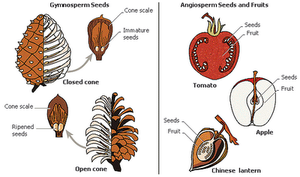
Angiosperm Diversity and Reproduction
Angiosperms (Flowering Plants)
Angiosperms are the most diverse group of land plants, distinguished by flowers and fruits.
Flowers are specialized structures for sexual reproduction, consisting of sepals, petals, stamens, and carpels.
Fruits develop from the ovary and aid in seed dispersal.
Double fertilization: One sperm fertilizes the egg (zygote, 2N), and another fuses with two nuclei to form endosperm (3N), which nourishes the embryo.
Pollination and Diversity
Pollination in angiosperms often involves animals (insects, birds, mammals) or wind. The co-evolution of flowers and pollinators has contributed to the vast diversity of angiosperms.
Flowers use color, shape, and scent to attract pollinators.
Fruits aid in seed dispersal by attracting animals.
Monocots vs. Dicots
Angiosperms are divided into two major groups based on seed, leaf, and floral characteristics:
Feature | Monocots | Dicots (Eudicots) |
|---|---|---|
Cotyledons | One | Two |
Vascular tissue | Scattered | Arranged in a ring |
Leaf veins | Parallel | Branched |
Flower parts | Multiples of 3 | Multiples of 4 or 5 |
Plant Structure and Function
Plant Organs and Tissues
Plants have a hierarchical organization consisting of organ systems, organs, tissues, and cells. The three basic organs are roots, stems, and leaves, organized into root and shoot systems.
Roots: Anchor the plant, absorb water and minerals, and store carbohydrates. Types include taproots, fibrous roots, and specialized roots (prop, storage, pneumatophores, buttress).
Stems: Support leaves and reproductive structures, transport fluids, and store nutrients. Modified stems include rhizomes, bulbs, stolons, and tubers.
Leaves: Main site of photosynthesis; consist of a blade and petiole.
Plant Tissues
Dermal tissue: Protective outer covering (epidermis, cuticle, periderm in woody plants).
Vascular tissue: Conducts water, minerals, and nutrients (xylem and phloem).
Ground tissue: Functions in storage, photosynthesis, and support.
Growth and Development
Plants grow throughout their lives due to meristems—regions of undifferentiated cells capable of division.
Primary growth: Increases length via apical meristems at root and shoot tips.
Secondary growth: Increases thickness via lateral meristems (vascular and cork cambium); common in woody plants.
Apical dominance: Inhibits growth of axillary buds near the shoot tip, promoting vertical growth.
Ecological and Economic Importance of Plants
Produce oxygen via photosynthesis.
Build and stabilize soil, prevent erosion, and retain water.
Provide food, medicines, raw materials, and fossil fuels.
Moderate local climates by providing shade and reducing wind impact.
Review/Key Concepts
Land plants evolved from green algae, specifically charophytes.
Key adaptations for terrestrial life include cuticle, stomata, vascular tissue, and reproductive innovations.
Major groups: Non-vascular plants, seedless vascular plants, seed plants (gymnosperms and angiosperms).
Angiosperm diversity is closely linked to pollination strategies.
Understanding plant anatomy and physiology is essential for appreciating their ecological roles and importance to humans.
