 Indietro
Light-Dependent Reactions of Photosynthesis: Structure and Function
Guida di studio - Note intelligenti
 Appunti personalizzati basati sui tuoi materiali, ampliati con definizioni chiave, esempi e contesto.
Photosynthesis
Overview of Light-Dependent Reactions
The light-dependent reactions are the first stage of photosynthesis, occurring in the thylakoid membranes of chloroplasts. These reactions convert solar energy into chemical energy, producing ATP and NADPH, which are essential for the subsequent Calvin Cycle. The process also generates oxygen as a by-product from the splitting of water.
Location: Thylakoid membrane of the chloroplast
Main products: ATP, NADPH, and O2
Purpose: To capture light energy and convert it into chemical energy
Role of Light and Chlorophyll
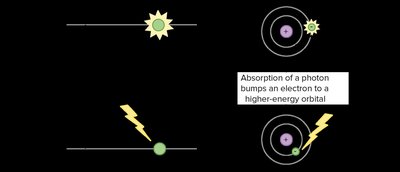
Chlorophyll is the primary pigment involved in capturing light energy. When chlorophyll absorbs a photon, an electron is excited from its ground state to a higher energy level. This excited electron is then transferred through a series of proteins embedded in the thylakoid membrane.
Photon absorption: Light energy excites electrons in chlorophyll molecules.
Electron excitation: The excited electron moves to a higher-energy orbital.
Photosystems and Electron Flow
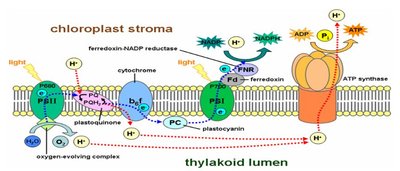
There are two main photosystems involved in the light-dependent reactions: Photosystem II (PSII) and Photosystem I (PSI). Each photosystem contains a reaction center with a special pair of chlorophyll a molecules (P680 in PSII and P700 in PSI) and associated proteins and pigments.
Photosystem II (PSII): Absorbs light at 680 nm (P680). Splits water to provide electrons, protons (H+), and releases O2 as a by-product.
Photosystem I (PSI): Absorbs light at 700 nm (P700). Receives electrons from PSII via the electron transport chain.
Electron transport chain: Electrons move from PSII to PSI, passing through plastoquinone (PQ), cytochrome complex, and plastocyanin (PC).
Generation of ATP and NADPH
The movement of electrons through the electron transport chain creates a proton (H+) gradient across the thylakoid membrane. This gradient is used by ATP synthase to generate ATP from ADP and inorganic phosphate (Pi), a process known as photophosphorylation. Electrons from PSI are ultimately transferred to NADP+ to form NADPH, catalyzed by NADP+ reductase.
ATP formation: Driven by the diffusion of H+ through ATP synthase.
NADPH formation: Electrons and a proton reduce NADP+ to NADPH.
Summary Table: Inputs and Outputs of Light-Dependent Reactions
Input | Output |
|---|---|
Light energy (photons) | ATP |
H2O | NADPH |
NADP+ | O2 |
ADP + Pi | — |
Key Equations
Overall light reaction:
Essential Points to Remember
Light-dependent reactions occur in the thylakoid membrane.
They convert solar energy into chemical energy (ATP and NADPH).
Water is split, providing electrons and protons, and releasing O2.
ATP and NADPH produced are used in the Calvin Cycle (light-independent reactions).
