 Indietro
Light-Dependent Reactions of Photosynthesis: Structure, Function, and Mechanisms
Guida di studio - Note intelligenti
 Appunti personalizzati basati sui tuoi materiali, ampliati con definizioni chiave, esempi e contesto.
Photosynthesis: Light-Dependent Reactions
Introduction to Light-Dependent Reactions
The light-dependent reactions of photosynthesis are essential for converting solar energy into chemical energy. These reactions occur only in the presence of light and take place within specialized membranes in both prokaryotic and eukaryotic cells. The process involves the excitation of electrons, which are transferred through protein and pigment complexes embedded in the membrane, ultimately forming ATP and NADPH.
Chloroplast Structure and Localization of Light Reactions
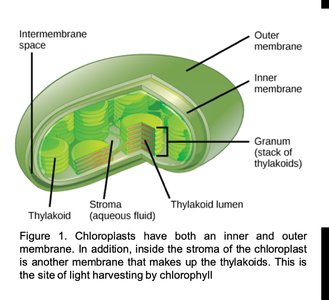
Chloroplasts are the organelles where photosynthesis occurs in eukaryotic cells. They possess both an inner and outer membrane, with the thylakoid membrane located inside the stroma. The thylakoids are stacked into grana, providing a large surface area for light absorption. The pigments responsible for the green color of chloroplasts, such as chlorophyll, are found in the thylakoid membrane, not in the outer or inner membranes.
Thylakoid membrane: Site of light harvesting by chlorophyll.
Stroma: Fluid-filled space where carbon fixation occurs.
Thylakoid lumen: Internal space within thylakoids where proton gradients are established.
Photosystems: Structure and Function
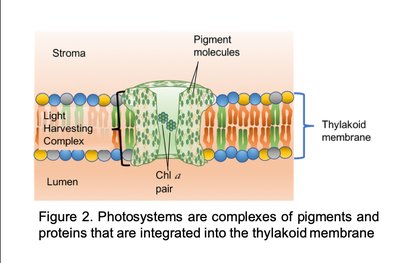
Photosystems are complexes of proteins and pigments integrated into the thylakoid membrane. They absorb light energy, which is transferred to a pair of chlorophyll a molecules in the reaction center. These molecules can become excited and release electrons, harnessing light energy for electron transport.
Photosystem II (PSII): Contains a larger pigment array and initiates electron flow by oxidizing water.
Photosystem I (PSI): Has fewer pigment molecules and reduces NADP+ to NADPH.
Chlorophyll a: Central pigment in both photosystems responsible for electron excitation.
Oxidation-Reduction Reactions and the Electron Transport Chain (ETC)
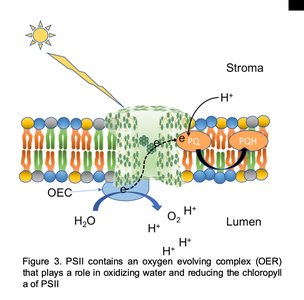
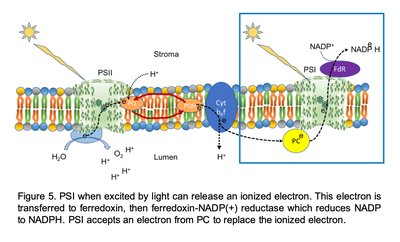
When chlorophyll a in PSII is excited, it releases an electron that is picked up by plastoquinone (PQ), a mobile electron carrier. PQ also picks up a proton (H+) from the stroma, becoming PQH. The oxygen evolving complex (OEC) attached to PSII oxidizes water, providing replacement electrons to PSII and releasing O2 and H+ into the lumen.
Oxygen evolving complex (OEC): Oxidizes water, reduces PSII chlorophyll a, and releases O2.
Plastoquinone (PQ): Transfers electrons and protons within the membrane.
Linear electron flow: Movement of electrons from water to NADP+ via PSII and PSI.
Role of Cytochrome b6f and Mobile Electron Carriers
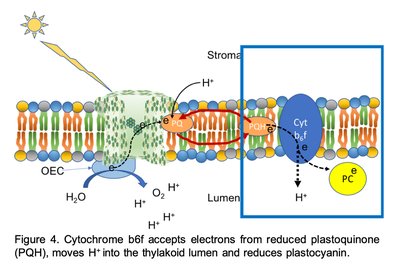
Cytochrome b6f is a protein complex in the thylakoid membrane that accepts electrons from PQH, releases H+ into the lumen, and transfers electrons to plastocyanin (PC), a water-soluble carrier. PC then delivers electrons to PSI, which becomes reduced and can initiate further electron transfer.
Cytochrome b6f: Facilitates electron transfer and proton movement, contributing to the proton gradient.
Plastocyanin (PC): Transfers electrons from cytochrome b6f to PSI.
Formation of NADPH and ATP
PSI, upon excitation, releases an electron that is transferred to ferredoxin (Fd), another mobile carrier. Ferredoxin-NADP(+) reductase (FdR) then reduces NADP+ to NADPH in the stroma. The proton gradient established across the thylakoid membrane drives ATP synthesis via ATP synthase, which uses the energy of H+ flow to phosphorylate ADP.
NADPH: Formed by reduction of NADP+ via ferredoxin and FdR.
ATP: Synthesized by ATP synthase using the electrochemical gradient.
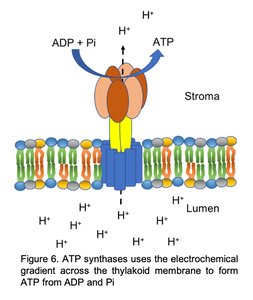
Photophosphorylation: The process of ATP formation driven by light-induced proton gradient.
Equation for ATP synthesis:
Cyclic vs. Linear Electron Flow
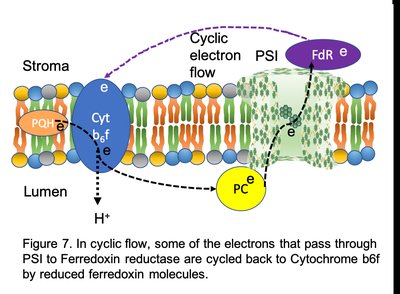
While linear electron flow produces both ATP and NADPH, cyclic electron flow allows PSI to cycle electrons back to cytochrome b6f, increasing ATP production without generating NADPH. This mechanism is used when the chloroplast requires more ATP than NADPH.
Cyclic electron flow: Involves PSI, ferredoxin, cytochrome b6f, and plastocyanin; increases ATP yield.
Linear electron flow: Involves both PSII and PSI; produces ATP and NADPH.
Complexes not involved in cyclic flow: PSII and ferredoxin-NADP(+) reductase.
Summary Table: Key Components of Light-Dependent Reactions
Component | Function | Solubility |
|---|---|---|
Plastoquinone (PQ) | Electron carrier between PSII and cytochrome b6f | Water-insoluble |
Plastocyanin (PC) | Electron carrier between cytochrome b6f and PSI | Water-soluble |
Ferredoxin (Fd) | Electron carrier from PSI to FdR | Water-soluble |
ATP Synthase | Synthesizes ATP using proton gradient | Membrane-bound |
Cytochrome b6f | Transfers electrons and pumps protons | Membrane-bound |
Review Questions
What molecule is reduced by the electrons from PSII chlorophyll a?
PSII oxidizes plastoquinone and PSI is reduced by plastocyanin.
Order of electron flow in linear electron flow:
Hydrogen in water
PSII Chlorophyll a
Plastoquinone
Cytochrome b6f
Plastocyanin
PSI Chlorophyll a
Ferredoxin-NADP(+) reductase
NADP+
Summary
The light-dependent reactions convert solar energy into chemical energy in the form of NADPH and ATP. These reactions involve protein complexes, pigment molecules, and mobile electron carriers working together to produce NADPH and ATP, which fuel the assembly of sugar molecules in the light-independent reactions. The electron transport chain establishes a proton gradient, which is used by ATP synthase to generate ATP. Cyclic and linear electron flows regulate the balance of ATP and NADPH production according to cellular needs.
