 Indietro
Lipids and Carbohydrates: Structure, Function, and Types
Guida di studio - Note intelligenti
 Appunti personalizzati basati sui tuoi materiali, ampliati con definizioni chiave, esempi e contesto.
Lipids
Structure and Function of Lipids
Lipids are a diverse group of hydrophobic molecules essential for various biological functions. They are characterized by their insolubility in water and play critical roles in energy storage, membrane structure, and signaling.
Triglycerides: Serve as long-term energy storage molecules.
Phospholipids: Major components of cell membranes.
Steroids: Function as hormones and signaling molecules.
Main Types of Lipids
Triglycerides: Composed of one glycerol molecule and three fatty acids. Used for energy storage.
Phospholipids: Consist of a glycerol backbone, two fatty acids, and a phosphate group. Form the structural basis of cell membranes.
Steroids: Characterized by a four-ring structure. Examples include cholesterol and hormones such as estrogen and testosterone.
Example: Phospholipids form the lipid bilayer of cell membranes, providing a barrier and structural integrity to cells.
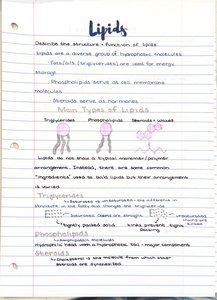
Key Properties of Lipids
Hydrophobic nature due to nonpolar hydrocarbon chains.
Energy-rich molecules, especially triglycerides.
Phospholipids are amphipathic, containing both hydrophobic and hydrophilic regions.
Additional info: Lipids are not true polymers, as they are not formed by repeating monomer units.
Carbohydrates
Structure and Function of Carbohydrates
Carbohydrates are organic molecules that serve as energy sources and structural components in cells. They are composed of carbon, hydrogen, and oxygen, typically in a ratio of 1:2:1.
Monosaccharides: Simple sugars, such as glucose and fructose.
Disaccharides: Formed by joining two monosaccharides (e.g., sucrose).
Polysaccharides: Complex carbohydrates made of many monosaccharide units (e.g., starch, cellulose).
Simple Sugars
Monomers (single molecules) of carbohydrates are called monosaccharides. Glucose and fructose are common examples.
Glucose: C6H12O6, a primary energy source for cells.
Fructose: An isomer of glucose, found in fruits.
Complex Carbohydrates
Polysaccharides are formed by linking monosaccharides through glycosidic bonds. Examples include starch (energy storage in plants) and cellulose (structural component in plant cell walls).
Starch: Composed of glucose monomers; used for energy storage in plants.
Cellulose: Composed of glucose monomers; provides structural support in plant cell walls.
Example: Glycogen is a polysaccharide used for energy storage in animals.
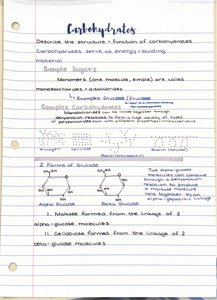
Forms of Glucose
Alpha-glucose: Forms starch through linkage at the 1,4 position.
Beta-glucose: Forms cellulose through linkage at the 1,4 position, but with a different orientation.
Additional info: The difference in linkage between alpha and beta glucose determines the digestibility and function of the polysaccharide.
