 Indietro
Lipids and Cell Membranes: Structure, Function, and Permeability
Guida di studio - Note intelligenti
 Appunti personalizzati basati sui tuoi materiali, ampliati con definizioni chiave, esempi e contesto.
Lipids and Cell Membranes
Cell Membranes and Cell Walls
The plasma membrane is a fundamental structure found in all cells, serving as a selective barrier between the cell's interior and its environment. While all cells possess a plasma membrane, only certain organisms have cell walls. Cell walls are present in bacteria, plants, fungi, and some protists. Animal cells do not have cell walls, relying solely on the plasma membrane for structural integrity and regulation of transport.
Composition of the Plasma Membrane
The plasma membrane is a complex, dynamic structure composed of three main types of biomolecules:
Lipids (phospholipids & cholesterol): ~40% by mass
Proteins: ~50% by mass
Carbohydrates: ~10% by mass
This composition allows the membrane to be both flexible and functional, supporting a variety of cellular processes.
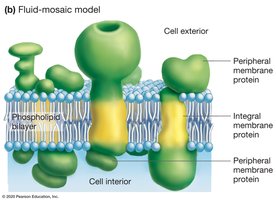
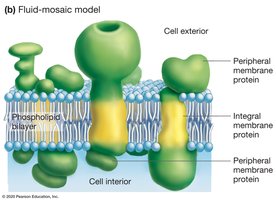
Fluid Mosaic Model
The fluid mosaic model describes the plasma membrane as a flexible, dynamic structure in which lipids and proteins move laterally within the bilayer. The membrane is 'studded' with proteins and carbohydrates, creating a mosaic-like appearance. This model emphasizes the diversity and mobility of membrane components.
Membrane Fluidity
Membrane fluidity is essential for cellular function, allowing for movement of proteins and lipids, fusion of membranes, and proper functioning of transport mechanisms. Fluidity depends on several factors:
Phospholipid type: Saturated fatty acids pack tightly, making membranes more rigid; unsaturated fatty acids have kinks, preventing tight packing and increasing fluidity.
Temperature: Lower temperatures compress molecules, increasing rigidity; higher temperatures increase fluidity.
Cholesterol: Acts as a fluidity buffer, preventing membranes from becoming too rigid in cold or too fluid in heat.
Phospholipid Bilayer Dynamics
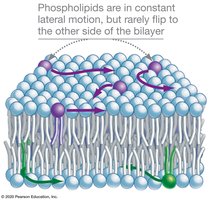
Phospholipids are in constant lateral motion within the bilayer, but rarely flip to the other side. This lateral movement is crucial for membrane fluidity and function.
Membrane Proteins
Proteins constitute about half the mass of the plasma membrane and serve various functions:
Transporters: Facilitate movement of substances across the membrane.
Receptors: Receive and transmit signals.
Enzymes: Catalyze reactions at the membrane surface.
Binding and adhesion: Help cells attach to each other or to extracellular structures.
Membrane proteins are classified as:
Integral proteins (transmembrane): Embedded within the bilayer, often spanning the membrane.
Peripheral proteins: Attached to the membrane surface, either on the interior or exterior.
Integral and Peripheral Proteins
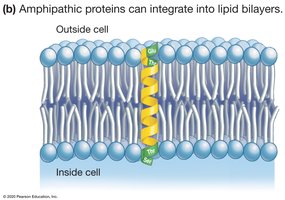
Integrins are integral proteins with both hydrophobic and hydrophilic regions, allowing them to embed within the bilayer. The arrangement of these regions determines their orientation and function.
Peripheral proteins are sometimes cell-specific and play important roles in immunity recognition, helping cells identify and respond to foreign substances.
Carbohydrates in the Membrane
Carbohydrates make up about 10% of the membrane mass and are found only on the exterior surface. They are bound to proteins (forming glycoproteins) or to lipids (forming glycolipids). These structures are essential for cell-cell recognition and attachment.
Selective Permeability of Lipid Bilayers
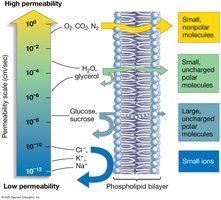
The lipid bilayer exhibits selective permeability, allowing certain molecules to pass while restricting others. Permeability depends on the size, polarity, and charge of molecules:
High permeability: Small, nonpolar molecules (O2, CO2, N2)
Moderate permeability: Small, uncharged polar molecules (H2O, glycerol)
Low permeability: Large, uncharged polar molecules (glucose, sucrose)
Very low permeability: Ions (Cl-, K+, Na+)
Hydrocarbon Saturation and Membrane Permeability
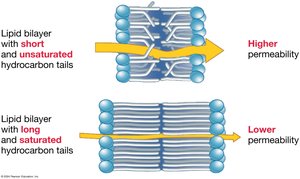
The degree of hydrocarbon saturation in phospholipid tails affects membrane permeability:
Short and unsaturated tails: Increase membrane permeability due to more gaps and looser packing.
Long and saturated tails: Decrease permeability due to tighter packing and fewer gaps.
Cholesterol and Membrane Permeability
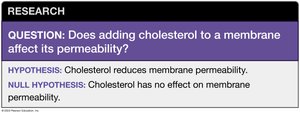
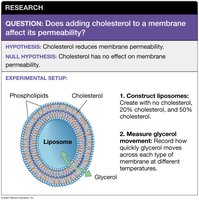
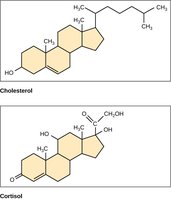
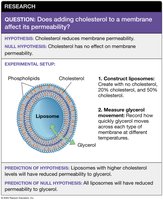
Cholesterol is a steroid lipid that modulates membrane fluidity and permeability. Research questions often focus on whether adding cholesterol to membranes affects their permeability.
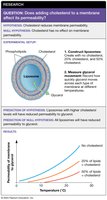
Hypothesis: Cholesterol reduces membrane permeability.
Null hypothesis: Cholesterol has no effect on membrane permeability.
Experimental Setup
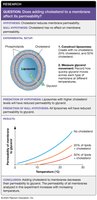
Experiments typically involve constructing liposomes with varying cholesterol content and measuring the movement of glycerol across the membrane at different temperatures.
Results and Predictions
Results show that liposomes with higher cholesterol content have reduced permeability to glycerol, especially at higher temperatures. This supports the hypothesis that cholesterol acts as a fluidity buffer and decreases permeability.
Other Lipids: Waxes and Steroids
Besides phospholipids and cholesterol, membranes may contain other lipids such as waxes and steroids. Steroids, including cholesterol, play key roles in membrane structure and signaling.
Summary Table: Membrane Components and Functions
Component | Location | Function |
|---|---|---|
Phospholipids | Bilayer | Structural barrier, selective permeability |
Cholesterol | Within bilayer | Fluidity buffer, reduces permeability |
Proteins (Integral) | Embedded in bilayer | Transport, signaling, adhesion |
Proteins (Peripheral) | Surface of bilayer | Cell recognition, signaling |
Carbohydrates | Exterior surface | Cell-cell recognition, attachment |
Additional info: Academic context was added to clarify the role of membrane components, the fluid mosaic model, and the experimental approach to studying cholesterol's effect on permeability.
