 Indietro
Lipids and Cell Membranes: Structure, Function, and Permeability
Guida di studio - Note intelligenti
 Appunti personalizzati basati sui tuoi materiali, ampliati con definizioni chiave, esempi e contesto.
Lipids and Cell Membranes
Introduction to Cell Membranes
The plasma membrane, also known as the cellular membrane, is a fundamental structure found in all cells. It serves as a selective barrier, regulating the movement of substances into and out of the cell. While all cells possess a plasma membrane, only certain organisms have an additional cell wall (e.g., bacteria, plants, fungi, and some protists). Animal cells lack cell walls, relying solely on the plasma membrane for structural integrity and communication.
Composition of the Plasma Membrane
The plasma membrane is composed of three major classes of biomolecules:
Lipids (mainly phospholipids and cholesterol): ~40% by mass
Proteins: ~50% by mass
Carbohydrates: ~10% by mass
These components work together to provide the membrane with both structure and function.
Fluid Mosaic Model
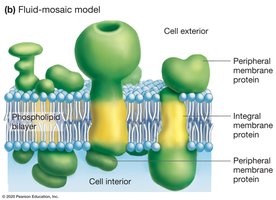
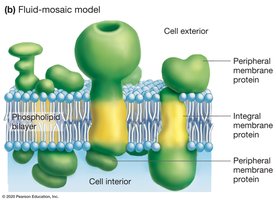
The fluid mosaic model describes the plasma membrane as a flexible, dynamic structure with proteins and other molecules embedded within or attached to a fluid lipid bilayer. This model highlights the diversity and mobility of membrane components.
Membrane Proteins
Membrane proteins are essential for various cellular functions, including transport, signal transduction, enzymatic activity, and cell adhesion. They are classified into two main types:
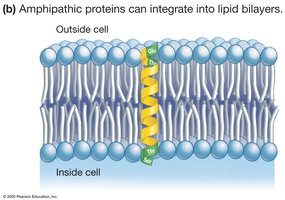
Integral (Transmembrane) Proteins: Span the entire lipid bilayer and have regions that are hydrophobic (interacting with lipid tails) and hydrophilic (interacting with aqueous environments).
Peripheral Proteins: Attached to the membrane surface (either interior or exterior) and often play roles in cell recognition and signaling.
Integrins (Integral Proteins)
Integrins are a type of integral protein with both hydrophobic and hydrophilic regions, allowing them to embed within the bilayer. The arrangement of these regions determines their orientation and function within the membrane.
Peripheral Proteins
Peripheral proteins are sometimes referred to as "cell-specific" proteins and are important for immune recognition and cell signaling. They do not penetrate the hydrophobic core of the bilayer.
Membrane Carbohydrates
Carbohydrates are found exclusively on the exterior surface of the plasma membrane. They are covalently bound to proteins (forming glycoproteins) or lipids (forming glycolipids). Their primary functions include cell-cell recognition and attachment, which are critical for immune response and tissue formation.
Membrane Fluidity
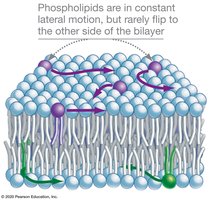
Membrane fluidity refers to the ability of the lipid molecules to move within the layer, allowing the membrane to maintain its structure while remaining flexible. Fluidity is influenced by:
Phospholipid Type: Saturated fatty acids pack tightly, making the membrane more rigid; unsaturated fatty acids have kinks that prevent tight packing, increasing fluidity.
Temperature: Lower temperatures compress membrane molecules, reducing fluidity; higher temperatures increase fluidity.
Cholesterol: Acts as a fluidity buffer, preventing membranes from becoming too rigid in the cold or too fluid in the heat.
Selective Permeability of Membranes
Permeability and the Lipid Bilayer
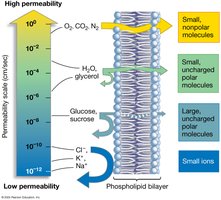
The plasma membrane exhibits selective permeability, allowing certain molecules to cross more easily than others. This property is crucial for maintaining cellular homeostasis.
Small, nonpolar molecules (e.g., O2, CO2, N2) pass through easily.
Small, uncharged polar molecules (e.g., H2O, glycerol) pass through with moderate ease.
Large, uncharged polar molecules (e.g., glucose, sucrose) and ions (e.g., Cl-, K+, Na+) have low permeability.
Factors Affecting Membrane Permeability
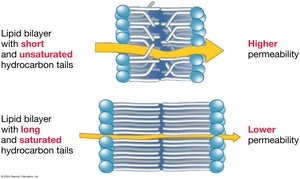
Membrane permeability is influenced by the composition of the lipid bilayer:
Hydrocarbon Tail Length and Saturation: Short and unsaturated hydrocarbon tails increase permeability; long and saturated tails decrease permeability.
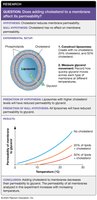
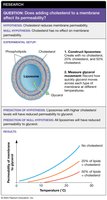
Cholesterol Content: Higher cholesterol reduces permeability by filling spaces between phospholipids.
Experimental Analysis: Cholesterol and Membrane Permeability
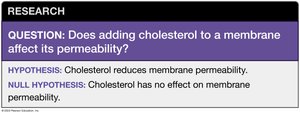
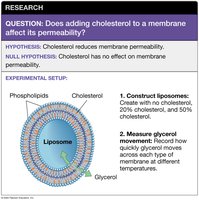
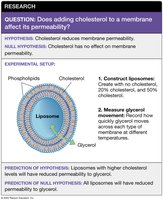
Research has investigated how cholesterol affects membrane permeability. The hypothesis is that cholesterol reduces permeability, while the null hypothesis states it has no effect. Experiments involve constructing liposomes with varying cholesterol content and measuring the movement of glycerol across the membrane at different temperatures.
Other Membrane Lipids
Waxes and Steroids
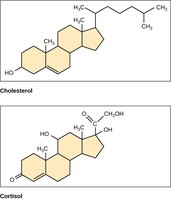
In addition to phospholipids and cholesterol, membranes may contain other lipids such as waxes and steroids. Cholesterol is a key steroid in animal cell membranes, contributing to membrane structure and fluidity. Other steroids, such as cortisol, serve as signaling molecules.
Summary Table: Membrane Components and Functions
Component | Location | Main Function(s) |
|---|---|---|
Phospholipids | Bilayer core | Structural framework, selective barrier |
Cholesterol | Between phospholipids | Modulates fluidity and permeability |
Integral proteins | Span bilayer | Transport, signaling, enzymatic activity |
Peripheral proteins | Membrane surface | Cell recognition, signaling |
Carbohydrates | Exterior surface | Cell-cell recognition, attachment |
Key Equations and Concepts
Fluidity and Permeability Relationship: Membrane fluidity increases with unsaturated fatty acids and higher temperatures; permeability generally increases with fluidity.
Fick's Law of Diffusion: The rate of diffusion across a membrane is proportional to the surface area and concentration gradient, and inversely proportional to membrane thickness.
Additional info: Fick's Law is a general principle for passive diffusion and helps explain why membrane composition affects the rate at which substances cross the bilayer.
