 Indietro
Lipids, Membranes, and Cell Compartments: Structure and Function
Guida di studio - Note intelligenti
 Appunti personalizzati basati sui tuoi materiali, ampliati con definizioni chiave, esempi e contesto.
Lipids: Structure and Types
Fatty Acids
Fatty acids are long hydrocarbon chains with a terminal carboxyl group. They are the building blocks of many lipids and are classified based on the presence or absence of double bonds in their hydrocarbon tails.
Saturated fatty acids: Have no double bonds; all carbons are 'saturated' with hydrogen atoms. They are typically solid at room temperature and found in animal fats (e.g., butter, meat fat).
Unsaturated fatty acids: Contain one or more double bonds, introducing kinks in the hydrocarbon chain. These are usually liquid at room temperature and found in plant oils (e.g., olive oil, corn oil).
Hydrophobic and hydrophilic regions: Fatty acids are amphipathic, with a hydrophilic (water-loving) carboxyl head and a hydrophobic (water-fearing) hydrocarbon tail.
Example: Palmitic acid is a common saturated fatty acid found in animal fats.

Triacylglycerols (Triglycerides)
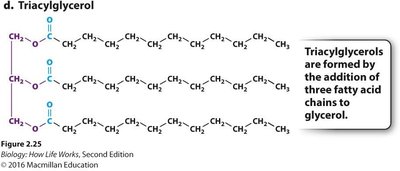
Triacylglycerols are the main form of energy storage in animals and plants. They are composed of one glycerol molecule esterified to three fatty acid chains.
Function: Long-term energy storage, insulation, and protection.
Structure: Glycerol backbone with three fatty acids attached via ester bonds.
Example: Animal fats (e.g., butter) and plant oils (e.g., corn oil).
Phospholipids and Membrane Structure
Phospholipids: Amphipathic Molecules
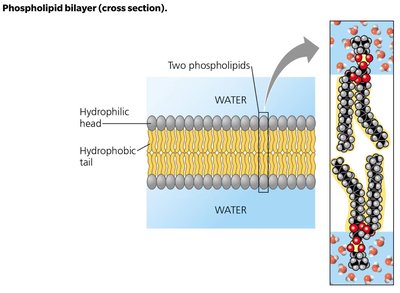
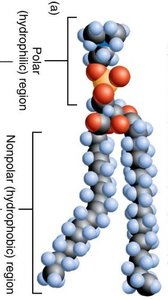
Phospholipids are major components of cell membranes. They consist of a glycerol backbone, two fatty acid tails (hydrophobic), and a phosphate-containing head group (hydrophilic).
Amphipathic nature: The dual hydrophilic and hydrophobic regions allow phospholipids to form bilayers in aqueous environments.
Bilayer formation: In water, phospholipids spontaneously arrange into bilayers with hydrophobic tails facing inward and hydrophilic heads facing outward.
Properties of Lipid Bilayers
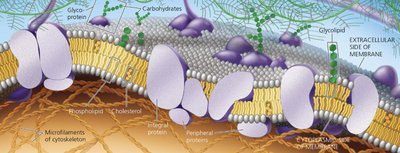
The lipid bilayer is the fundamental structure of biological membranes, providing a barrier and matrix for membrane proteins.
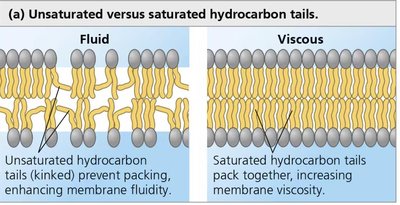
Fluidity: The degree of saturation of fatty acid tails affects membrane fluidity. Unsaturated (kinked) tails increase fluidity, while saturated tails make the membrane more viscous.
Selective permeability: The bilayer allows some molecules (e.g., small nonpolar molecules) to pass freely, while restricting others (e.g., ions, large polar molecules).
Dynamic nature: Lipids and some proteins can move laterally within the bilayer, contributing to membrane fluidity.
Membrane Proteins and Their Functions
Types of Membrane Proteins
Membrane proteins are essential for various cellular functions and are classified based on their association with the lipid bilayer.
Integral (transmembrane) proteins: Span the entire membrane and are involved in transport, signaling, and cell recognition.
Peripheral proteins: Loosely attached to the membrane surface, often involved in signaling or maintaining cell shape.
Amphipathic nature: Many membrane proteins have both hydrophobic and hydrophilic regions, allowing them to interact with both the lipid bilayer and the aqueous environment.
Membrane Functions
Biological membranes perform several critical functions:
Barrier: Separate the cell interior from the external environment.
Compartmentalization: Define intracellular organelles and specialized spaces.
Selective permeability: Regulate the movement of substances into and out of the cell.
Communication: Contain receptors for signal transduction and cell-cell recognition.
Transport: Contain proteins that facilitate the movement of ions and molecules across the membrane.
Transport Across Membranes
Passive Transport: Diffusion and Osmosis
Transport across membranes can occur passively (without energy input) or actively (requiring energy).
Simple diffusion: Movement of molecules from high to low concentration directly through the lipid bilayer (e.g., O2, CO2).
Facilitated diffusion: Movement of molecules down their concentration gradient via specific membrane proteins (channels or carriers).
Osmosis: Diffusion of water across a semipermeable membrane from areas of high to low free water concentration.
Active Transport
Active transport moves substances against their concentration gradients and requires energy, often from ATP.
Primary active transport: Direct use of ATP to transport molecules (e.g., Na+/K+ pump).
Secondary active transport (cotransport): Uses the energy stored in concentration gradients established by primary active transport to move other substances.
Summary Table: Types of Lipids and Their Functions
Lipid Type | Structure | Main Function | Example |
|---|---|---|---|
Fatty Acids | Long hydrocarbon chain with carboxyl group | Building blocks, energy source | Palmitic acid |
Triacylglycerols | Glycerol + 3 fatty acids | Energy storage | Butter, olive oil |
Phospholipids | Glycerol + 2 fatty acids + phosphate group | Membrane structure | Cell membrane |
Key Equations
Surface area of a sphere:
Volume of a sphere:
Additional info:
Membrane fluidity is crucial for cell function, affecting processes such as endocytosis, exocytosis, and membrane protein mobility.
Cholesterol is another important lipid in animal cell membranes, modulating fluidity and stability.
