 Indietro
Lipids, Membranes, and the First Cells: Study Notes for General Biology
Guida di studio - Note intelligenti
 Appunti personalizzati basati sui tuoi materiali, ampliati con definizioni chiave, esempi e contesto.
Chapter 6: Lipids, Membranes, and the First Cells
Plasma Membrane: Structure and Function
The plasma membrane (or cell membrane) is a fundamental structure that separates living cells from their external environment. It acts as a selective barrier, allowing essential materials to enter while keeping harmful substances out, and facilitates the chemical reactions necessary for life by sequestering appropriate chemicals.
Selective permeability: Only certain molecules can pass through the membrane.
Compartmentalization: Enables distinct internal environments for cellular processes.
Facilitation of reactions: Concentrates reactants for efficient biochemical reactions.
6.1 Lipid Structure and Function
Definition and Properties of Lipids
Lipids are carbon-containing compounds that are insoluble in water due to their high proportion of nonpolar bonds. The main structural feature is the hydrocarbon chain, which is hydrophobic and does not interact with water.
Hydrocarbons: Molecules containing only carbon and hydrogen; hydrophobic.
Fatty acids: Hydrocarbon chains bonded to a carboxyl group; can be saturated or unsaturated.
Isoprenoids: Hydrocarbon chains functioning as pigments, scents, vitamins, and hormone precursors.
Bond Saturation and Hydrocarbon Structure
The saturation of hydrocarbon chains affects their physical properties and biological functions.
Saturated fatty acids: Only single bonds between carbons; maximum hydrogen atoms; solid at room temperature.
Unsaturated fatty acids: One or more double bonds; causes "kinks" in the chain; liquid at room temperature.
Polyunsaturated: Multiple double bonds; even more fluid.
Example: Animal fats (saturated) are solid, while plant oils (unsaturated) are liquid at room temperature.
Types of Lipids in Cells
Cells contain three major types of lipids, each with distinct structures and functions:
Steroids: Bulky, four-ring structure; includes hormones (estrogen, testosterone) and cholesterol.
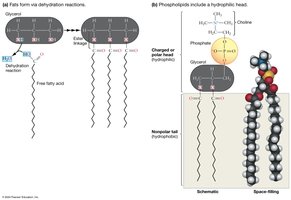
Fats (triacylglycerols): Three fatty acids linked to glycerol; primary role is energy storage.
Phospholipids: Glycerol linked to a phosphate group and two hydrocarbon chains; main component of cell membranes.
Fats form via dehydration reactions between the hydroxyl group of glycerol and the carboxyl group of fatty acids, resulting in an ester linkage. Fatty acids are not polymers.
6.2 Phospholipid Bilayers
Amphipathic Nature of Membrane Lipids
Phospholipids are amphipathic, meaning they have both hydrophilic (water-loving) heads and hydrophobic (water-fearing) tails. This property is crucial for membrane formation.
Hydrophilic head: Contains glycerol, phosphate group, and a charged or polar group.
Hydrophobic tail: Nonpolar hydrocarbon chains.
Amphipathic lipids do not dissolve in water; instead, they form micelles or bilayers.
Phospholipid Bilayer Formation
Phospholipid bilayers form spontaneously in water, creating paired sheets with hydrophilic heads facing outward and hydrophobic tails inward. This structure is the basis of biological membranes.
Micelles: Spherical aggregates formed by free fatty acids.
Lipid bilayers: Paired sheets formed by phospholipids.
Membrane Fluidity
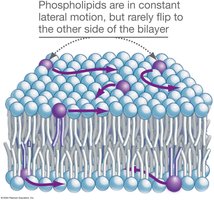
Phospholipids are in constant lateral motion within the bilayer, but rarely flip to the other side. Membrane fluidity is influenced by temperature, tail length, and saturation.
Lower temperature: Decreases fluidity and permeability.
Longer, saturated tails: Decrease permeability.
Cholesterol: Increases packing density, reduces permeability.
6.3 Movement Across Lipid Bilayers: Diffusion and Osmosis
Diffusion
Diffusion is the spontaneous movement of molecules from regions of high concentration to low concentration, driven by thermal energy. It increases entropy and leads to equilibrium.
Passive transport: Diffusion across membranes without energy input.
Selective permeability: Small, nonpolar molecules move quickly; large, polar, or charged molecules move slowly.
Osmosis
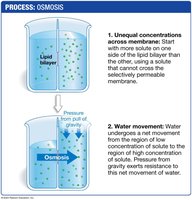
Osmosis is a special case of diffusion involving water movement across a selectively permeable membrane. Water moves from areas of low solute concentration to high solute concentration, equalizing solute levels.
Hypertonic: Higher solute concentration outside; water moves out, cell shrinks.
Hypotonic: Lower solute concentration outside; water moves in, cell swells.
Isotonic: Equal solute concentration; no net water movement.
6.4 Proteins Alter Membrane Structure and Function
Fluid-Mosaic Model of Membrane Structure
The fluid-mosaic model describes membranes as dynamic mosaics of phospholipids and proteins. Proteins can be integral (spanning the membrane) or peripheral (bound to the membrane surface).
Integral (transmembrane) proteins: Span the membrane, with segments facing both interior and exterior.
Peripheral proteins: Bind to membrane lipids without passing through.
Membrane proteins can be isolated using detergents, which are amphipathic molecules forming micelles.
Membrane Transport Proteins
Membrane proteins facilitate the movement of substances across the bilayer:
Channel proteins: Form pores for ions to diffuse down electrochemical gradients.
Carrier proteins: Undergo shape changes to transport specific molecules (e.g., glucose).
Pumps: Use energy (often ATP) to move substances against their concentration gradients (active transport).
Facilitated diffusion is passive transport assisted by proteins, while active transport requires energy input.
Sodium–Potassium Pump
The sodium–potassium pump (Na⁺/K⁺-ATPase) is a membrane protein that uses ATP to transport sodium and potassium ions against their concentration gradients, maintaining cellular electrochemical balance.
Active transport: Moves ions from low to high concentration.
Secondary active transport: Uses electrochemical gradients to power movement of other molecules.
Summary Table: Types of Membrane Transport
Transport Type | Energy Required? | Direction Relative to Gradient | Example |
|---|---|---|---|
Simple Diffusion | No | Down | Oxygen across membrane |
Facilitated Diffusion | No | Down | Glucose via GLUT-1 |
Active Transport | Yes (ATP) | Up | Sodium–Potassium Pump |
Osmosis | No | Down (water gradient) | Water movement in/out of cell |
Membranes and Chemical Evolution
The first lipid bilayers likely provided containers for the earliest replicating molecules, such as RNA. Protocells are simple vesicle-like structures that may have been intermediates in the evolution of cells, allowing nucleic acids to be harbored and protected.
Key Equations
Diffusion rate:
Osmosis:
Sodium–Potassium Pump: per ATP hydrolyzed
Additional info: Academic context was added to clarify the mechanisms of membrane transport, the importance of amphipathic molecules, and the evolutionary significance of lipid bilayers.
