 Indietro
Lipids, Membranes, and the First Cells: Chapter 6 Study Guide
Guida di studio - Note intelligenti
 Appunti personalizzati basati sui tuoi materiali, ampliati con definizioni chiave, esempi e contesto.
Chapter 6: Lipids, Membranes, and the First Cells
Overview
This chapter explores the structure and function of lipids, their role in forming cell membranes, and the mechanisms by which substances move across these membranes. Understanding these concepts is fundamental to cell biology and the study of life.

Functions of Lipids
Lipids are a diverse group of biomolecules with several essential functions in living organisms.
Energy Storage: Fats store chemical energy efficiently due to their high-energy bonds.
Pigments: Some lipids act as pigments, capturing and responding to sunlight.
Cell Signaling: Lipids serve as signals between cells, such as steroid hormones.
Waterproof Coatings: Lipids form waterproof barriers on skin and cells.
Vitamins: Certain lipids function as vitamins in cellular processes.
Roadmap of Chapter 6
The chapter is organized around understanding how the plasma membrane is built from lipids and proteins, and how substances move across it.
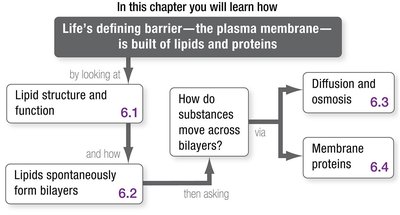
Lipid Structure and Function
Hydrocarbon Chains and Fatty Acids
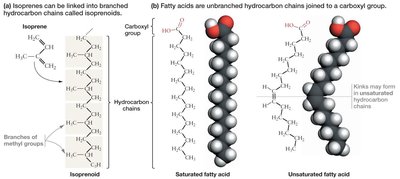
Lipids are primarily composed of hydrocarbon chains, which can be saturated or unsaturated. The structure of these chains affects the physical properties of lipids.
Saturated Fatty Acids: Have no double bonds, resulting in straight chains that pack tightly.
Unsaturated Fatty Acids: Contain one or more double bonds, causing kinks and preventing tight packing.
Isoprenoids: Branched hydrocarbon chains derived from isoprene units.
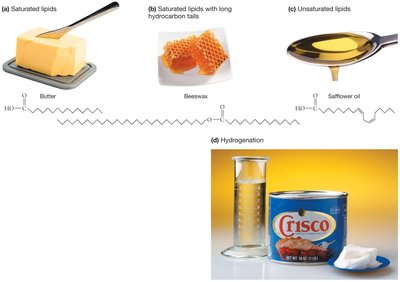
Fluidity of Lipids
The fluidity of lipids depends on the length and saturation of their hydrocarbon chains. Shorter and unsaturated chains increase fluidity, while longer and saturated chains decrease it.
Steroids
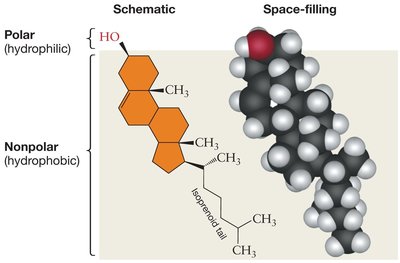
Steroids are a family of lipids characterized by a bulky, four-ring structure. They differ by functional groups attached to the rings.
Examples: Estrogen, testosterone, and cholesterol.
Cholesterol: An important component of plasma membranes, affecting membrane fluidity and permeability.
Fats (Triacylglycerols/Triglycerides)
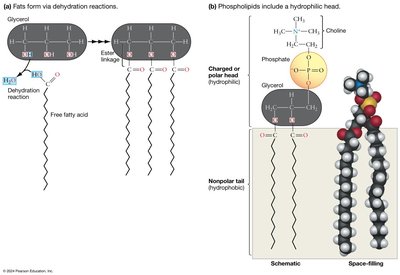
Fats are composed of three fatty acids linked to a glycerol molecule via ester linkages. Their primary role is energy storage.
Formation: Dehydration reactions between the hydroxyl group of glycerol and the carboxyl group of fatty acids.
Not Polymers: Fatty acids are not linked into chains; fats are not polymers.
Phospholipids
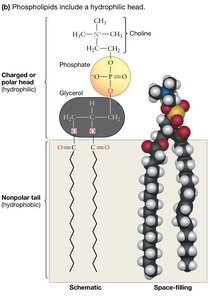
Phospholipids consist of glycerol linked to a phosphate group and two hydrocarbon chains. They are the primary component of cell membranes.
Fatty Acid Tails: Found in Bacteria and Eukarya.
Isoprenoid Tails: Found in Archaea.
Amphipathic: Contain both hydrophilic (head) and hydrophobic (tail) regions.
Lipid Bilayers and Membrane Formation
Amphipathic Nature and Bilayer Formation
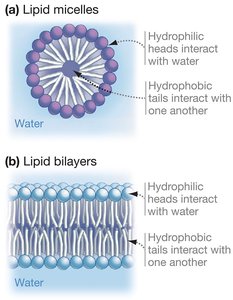
Phospholipids spontaneously form bilayers in aqueous environments due to their amphipathic nature. Hydrophilic heads face water, while hydrophobic tails face inward.
Micelles: Spherical structures with hydrophilic heads outward and tails inward.
Bilayers: Double-layered sheets with tails sandwiched between heads.
Artificial Membranes and Liposomes
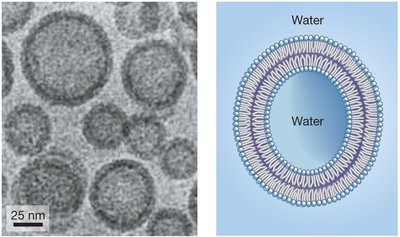
In laboratory settings, phospholipids can form vesicles called liposomes, which are artificial membrane-bound structures used to study membrane properties.
Membrane Permeability
Selective Permeability of Lipid Bilayers
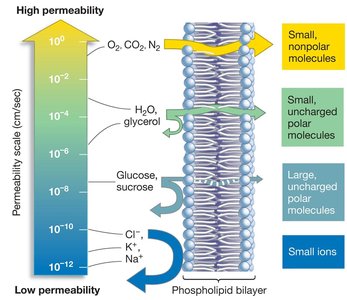
Lipid bilayers are selectively permeable, allowing certain molecules to pass while blocking others. Permeability depends on molecule size, polarity, and charge.
High Permeability: Small, nonpolar molecules (O2, CO2, N2).
Moderate Permeability: Small, uncharged polar molecules (H2O, glycerol).
Low Permeability: Large, uncharged polar molecules (glucose, sucrose).
Very Low Permeability: Ions (Cl-, K+, Na+).
Factors Affecting Membrane Permeability
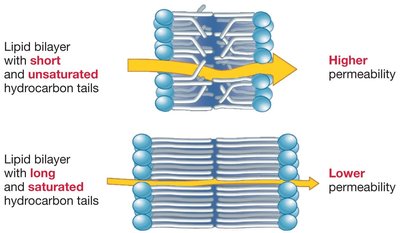
Membrane permeability is influenced by hydrocarbon tail length, saturation, and cholesterol content.
Short, Unsaturated Tails: Increase permeability.
Long, Saturated Tails: Decrease permeability.
Cholesterol: Reduces permeability by increasing packing density.
Temperature Effects
Membrane fluidity and permeability decrease as temperature drops, due to slower movement and tighter packing of phospholipids.
Diffusion and Osmosis Across Membranes
Diffusion
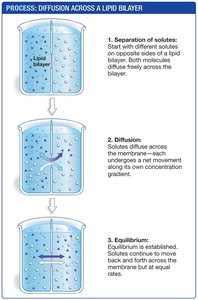
Diffusion is the spontaneous movement of molecules from regions of high concentration to low concentration, driven by thermal energy.
Equilibrium: Achieved when molecules are evenly distributed, with no net movement.
Passive Transport: Diffusion across membranes without energy input.
Osmosis
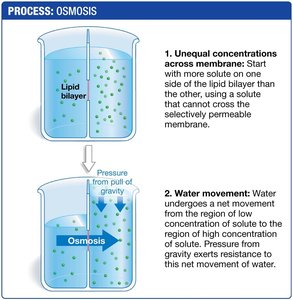
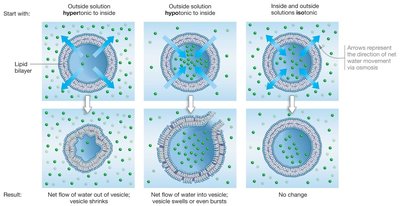
Osmosis is the diffusion of water across a selectively permeable membrane, moving from low solute concentration to high solute concentration.
Effects of Osmosis on Vesicles
Osmosis can cause membrane-bound vesicles to shrink or burst, depending on the relative concentrations of solutes inside and outside the vesicle.
Membrane Proteins and Transport
Role of Proteins in Membranes
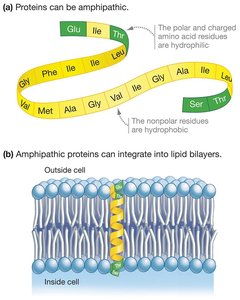
Proteins are integral to membrane structure and function, often equaling phospholipids in abundance. Amphipathic proteins can insert into membranes, forming passageways for substances.
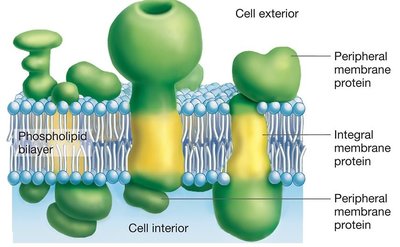
Integral (Transmembrane) Proteins: Span the membrane, with segments facing both interior and exterior.
Peripheral Proteins: Bind to membrane lipids without passing through, found on either side of the membrane.
Fluid-Mosaic Model
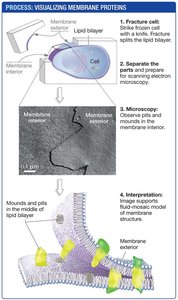
The fluid-mosaic model describes the dynamic arrangement of proteins and lipids in the membrane, replacing the earlier sandwich model. This model was confirmed by electron microscopy studies.
Channel Proteins and Electrochemical Gradients
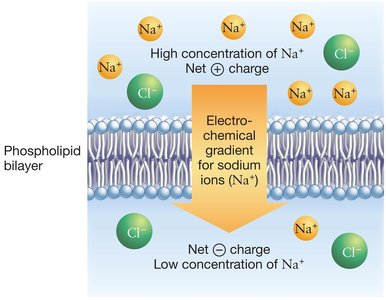
Channel proteins facilitate diffusion by forming pores in the membrane, allowing ions to cross. Electrochemical gradients arise when ions build up on one side, creating both concentration and charge differences.
Ions diffuse down their electrochemical gradients.
Summary Table: Types of Membrane Proteins
Type | Location | Function |
|---|---|---|
Integral (Transmembrane) | Span membrane | Transport, signaling |
Peripheral | Interior or exterior surface | Support, signaling |
Key Concepts and Applications
Cell membranes are essential barriers formed by lipids and proteins.
Lipid structure determines membrane fluidity and permeability.
Diffusion and osmosis are fundamental processes for substance movement across membranes.
Membrane proteins enable selective transport and communication.
Additional info: This guide expands on brief lecture points with academic context, definitions, and examples to ensure completeness and clarity for exam preparation.
