 Indietro
Lipids, Membranes, and the First Cells: Structure, Function, and Transport Mechanisms
Guida di studio - Note intelligenti
 Appunti personalizzati basati sui tuoi materiali, ampliati con definizioni chiave, esempi e contesto.
Chapter 6: Lipids, Membranes, and the First Cells
Overview of the Plasma Membrane
The plasma membrane, also known as the cell membrane, is a fundamental structure that separates living cells from their external environment. It acts as a selective barrier, allowing essential materials to enter, keeping harmful substances out, and facilitating the chemical reactions necessary for life.
Selective permeability: Only certain molecules can cross the membrane freely.
Compartmentalization: Enables distinct internal environments for cellular processes.
Facilitation of reactions: Sequesters chemicals to promote biological reactions.
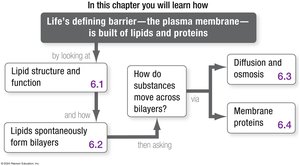
6.1 Lipid Structure and Function
Definition and Properties of Lipids
Lipids are carbon-containing compounds that are insoluble in water due to their high proportion of nonpolar bonds. The main types of lipids include hydrocarbons, fatty acids, isoprenoids, steroids, fats, and phospholipids.
Hydrocarbons: Nonpolar molecules composed only of carbon and hydrogen; hydrophobic.
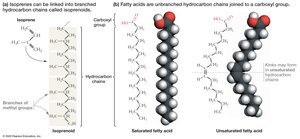
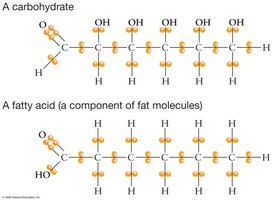
Fatty acids: Hydrocarbon chains bonded to a carboxyl (–COOH) group; can be saturated or unsaturated.
Isoprenoids: Hydrocarbon chains functioning as pigments, scents, vitamins, and hormone precursors.
Saturation and Physical State of Lipids
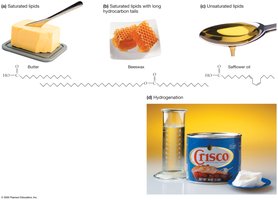
The degree of saturation in hydrocarbon chains affects the physical state and health properties of lipids.
Saturated fatty acids: Only single bonds between carbons; maximum hydrogen atoms; solid at room temperature.
Unsaturated fatty acids: One or more double bonds; causes kinks; liquid at room temperature.
Polyunsaturated: Multiple double bonds; even more fluid.
Major Types of Lipids in Cells
Cells contain three major types of lipids: steroids, fats, and phospholipids. Each type has distinct structures and functions.
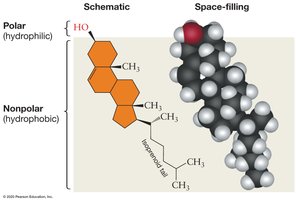
Steroids: Bulky, four-ring structure; includes hormones (estrogen, testosterone) and cholesterol.
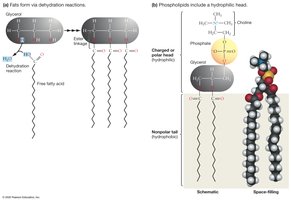
Fats (triglycerides): Three fatty acids linked to glycerol; energy storage; not polymers.
Phospholipids: Glycerol linked to a phosphate group and two hydrocarbon tails; primary component of cell membranes.
6.2 Phospholipid Bilayers
Amphipathic Nature and Membrane Formation
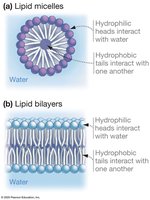
Phospholipids are amphipathic, containing both hydrophilic (water-loving) heads and hydrophobic (water-fearing) tails. This property drives the spontaneous formation of micelles and bilayers in aqueous environments.
Micelles: Spherical aggregates with hydrophilic heads outward, tails inward.
Lipid bilayers: Paired sheets with hydrophilic heads facing water and tails facing each other.
Artificial Membranes and Experimental Systems
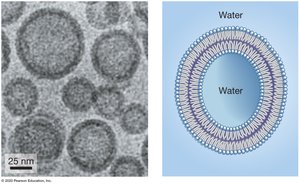
Phospholipids can form vesicles (liposomes) and planar bilayers in laboratory settings, allowing researchers to study membrane permeability and transport.
Liposomes: Artificial vesicles surrounded by phospholipid bilayers.
Planar bilayers: Lipid bilayers constructed across a hole separating two solutions.
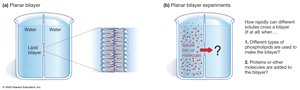
Selective Permeability of Lipid Bilayers
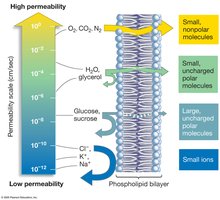
Phospholipid bilayers exhibit selective permeability, allowing small or nonpolar molecules to cross quickly, while large or charged molecules cross slowly or not at all.
Examples: Oxygen (O2) crosses quickly; glucose crosses slowly.
Factors Affecting Membrane Permeability
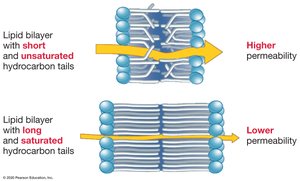
The permeability of membranes is influenced by hydrocarbon tail length, saturation, and cholesterol content.
Short, unsaturated tails: Higher permeability.
Long, saturated tails: Lower permeability.
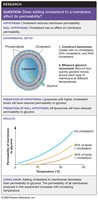
Cholesterol: Increases packing density, reduces permeability.
Temperature Effects on Membrane Fluidity
Membrane fluidity decreases as temperature drops, causing molecules to move more slowly and hydrophobic tails to pack tightly, which reduces permeability.
6.3 Diffusion and Osmosis Across Lipid Bilayers
Diffusion
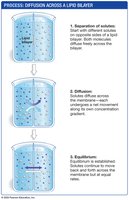
Diffusion is the spontaneous movement of molecules from regions of high concentration to low concentration, driven by thermal energy and resulting in increased entropy.
Equilibrium: Random distribution of molecules; no net movement.
Passive transport: Diffusion across membranes without energy input.
Osmosis
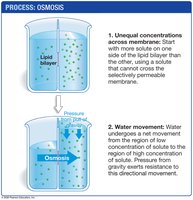
Osmosis is a special case of diffusion involving water movement across selectively permeable membranes, from low solute concentration to high solute concentration.
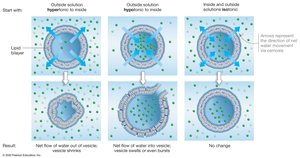
Hypertonic: Higher solute concentration outside; water moves out; cell shrinks.
Hypotonic: Lower solute concentration outside; water moves in; cell swells.
Isotonic: Equal solute concentrations; no net water movement.
Membranes and Chemical Evolution
Protocells and Early Membranes
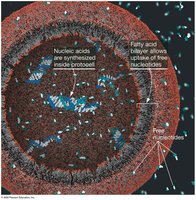
The first lipid bilayers likely provided containers for replicating molecules such as RNA. Protocells are simple vesicle-like structures that may have been intermediates in the evolution of cells.
Protocells: Vesicles harboring nucleic acids; possible evolutionary intermediates.
6.4 Proteins Alter Membrane Structure and Function
Role of Membrane Proteins
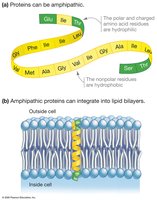
Membrane proteins are as abundant as phospholipids in plasma membranes. They can insert into membranes due to their amphipathic nature, forming passageways for substances to cross the lipid bilayer.
Amphipathic proteins: Contain both hydrophilic and hydrophobic regions; can anchor into bilayers.
Fluid-Mosaic Model of Membrane Structure
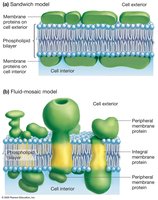
The fluid-mosaic model describes membranes as dynamic mosaics of phospholipids and proteins, with some proteins spanning the membrane and others attached to its surfaces.
Integral (transmembrane) proteins: Span the membrane; segments face both sides.
Peripheral proteins: Bind to membrane surfaces without passing through.
Membrane Fluidity and Protein Mobility
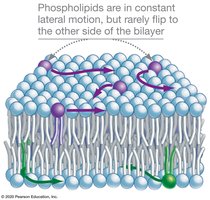
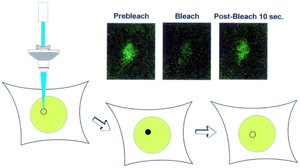
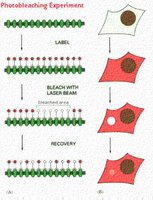
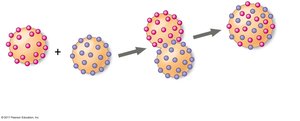
Membranes are held together by weak hydrophobic interactions, allowing lipids and some proteins to move laterally. Rarely, lipids flip-flop across the bilayer.
FRAP( Fluor
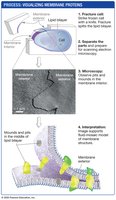
Studying Membrane Proteins
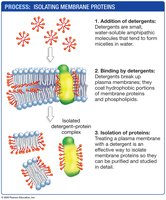
Detergents are used to isolate membrane proteins for study. Detergents are amphipathic molecules that break up membranes and solubilize proteins.
Channels, carriers, pumps: Types of membrane proteins affecting permeability.
Channel Proteins and Facilitated Diffusion
Ion Channels and Electrochemical Gradients
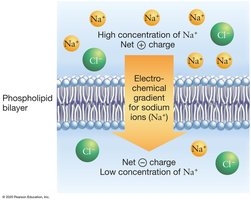
Ion channels are specialized proteins forming pores in membranes, allowing ions to cross. Electrochemical gradients combine concentration and charge differences, driving ion movement.
Electrochemical gradient: Combined concentration and electrical gradient for ions.
Channel Selectivity and Aquaporins
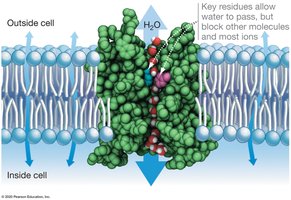
Channel proteins are highly selective, permitting only specific ions or molecules to pass. Aquaporins are channels that allow water to cross the membrane.
Hydrophilic residues: Line the channel interior, enabling selectivity.
Gated Channels
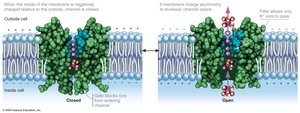
Gated channels open or close in response to signals such as molecule binding or changes in membrane voltage, regulating ion and molecule flow.
Regulation: Ensures controlled transport across membranes.
Cystic Fibrosis and Ion Channels
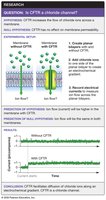
Cystic fibrosis is caused by defects in the CFTR protein, a chloride ion channel. Defective CFTR prevents chloride ions from leaving cells, leading to concentrated secretions.
CFTR: Cystic-fibrosis conductance transmembrane regulator; chloride channel.
Carrier Proteins and Active Transport
Carrier Proteins and Facilitated Diffusion
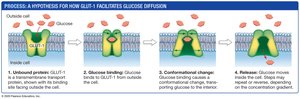
Carrier proteins facilitate diffusion by selectively binding solutes and undergoing conformational changes to transport them across membranes. The best-studied example is the glucose carrier GLUT-1.
GLUT-1: Increases membrane permeability to glucose.
Pumps and Active Transport
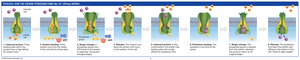
Pumps perform active transport, moving substances against their concentration gradients using energy, often from ATP. The sodium–potassium pump (Na+/K+–ATPase) is a key example.
Active transport: Requires energy input; moves substances against gradients.
Sodium–potassium pump: Uses ATP to transport Na+ and K+ ions.
Secondary Active Transport (Co-Transport)
Electrochemical gradients established by pumps enable secondary active transport, where the movement of one molecule down its gradient powers the transport of another molecule against its gradient.
Co-transport: ATP is not directly used; gradient energy powers transport.
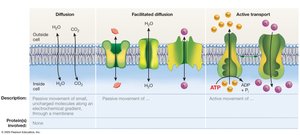
Summary Table: Passive and Active Membrane Transport Mechanisms
Transport Type | Description | Proteins Involved | Energy Requirement |
|---|---|---|---|
Diffusion | Passive movement of small, uncharged molecules along concentration gradient | None | No |
Facilitated Diffusion | Passive movement of ions and polar molecules via channel or carrier proteins | Channel, carrier proteins | No |
Active Transport | Movement of substances against concentration gradient | Pumps | Yes (ATP) |
Conclusion: Plasma Membranes and Cellular Evolution
Biological membranes are essential for defining the internal environment of cells, enabling selective permeability, compartmentalization, and the evolution of complex life. The interplay of lipids and proteins in membrane structure and function is fundamental to cellular biology.
