 Indietro
Lipids, Membranes, and the First Cells: Structure, Function, and Permeability
Guida di studio - Note intelligenti
 Appunti personalizzati basati sui tuoi materiali, ampliati con definizioni chiave, esempi e contesto.
Lipids, Membranes, and the First Cells
Plasma Membrane: The Boundary of Life
The plasma membrane (or cell membrane) is a fundamental structure that separates living cells from their environment. It acts as a selective barrier, allowing essential materials to enter while keeping harmful substances out, and facilitates the chemical reactions necessary for life by sequestering appropriate chemicals.
Selective permeability: Only certain molecules can cross the membrane freely.
Facilitation of reactions: The membrane environment enables efficient biochemical processes.
6.1 Lipid Structure and Function
Definition and Properties of Lipids
Lipids are carbon-containing compounds that are insoluble in water due to their high proportion of nonpolar bonds. The main structural component, hydrocarbons, are nonpolar molecules consisting only of carbon and hydrogen, making them hydrophobic.
Hydrophobicity: Lipids do not mix with water.
Hydrocarbons: Electrons are shared equally, resulting in nonpolarity.
Bond Saturation and Hydrocarbon Structure
The structure and function of lipids are influenced by the saturation of their hydrocarbon chains.
Isoprenoids: Hydrocarbon chains functioning as pigments, scents, vitamins, and hormone precursors.
Fatty acids: Hydrocarbon chains bonded to a carboxyl group, containing 14–20 carbon atoms. They can be saturated (only single bonds) or unsaturated (one or more double bonds).
Saturated fatty acids: Maximum hydrogen atoms, straight chains.
Unsaturated fatty acids: Double bonds create kinks, reducing packing density.
Polyunsaturated: Multiple double bonds, more kinks.
A Look at Three Types of Lipids Found in Cells
Major Lipid Types
Lipids have diverse structures and functions. The three most important types found in cells are:
Steroids: Bulky, four-ring structure; examples include hormones (estrogen, testosterone) and cholesterol.
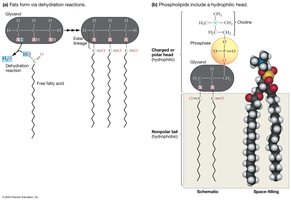
Fats: Composed of three fatty acids linked to glycerol (triacylglycerols/triglycerides); primary role is energy storage.
Phospholipids: Glycerol linked to a phosphate group and two hydrocarbon chains; primary role is forming cell membranes.
Fats and Phospholipids: Structure and Formation
Fats are formed by dehydration reactions between the hydroxyl group of glycerol and the carboxyl group of fatty acids, resulting in an ester linkage. Phospholipids consist of a glycerol backbone, a phosphate group, and two hydrocarbon tails. The presence or absence of a hydrophilic region distinguishes fats from phospholipids.
Fats: Not polymers; fatty acids are not linked into chains.
Phospholipids: Amphipathic, with hydrophilic heads and hydrophobic tails.
How Membrane Lipids Interact with Water
Amphipathic Nature of Membrane Lipids
Membrane lipids, especially phospholipids, are amphipathic, meaning they contain both hydrophilic (water-loving) and hydrophobic (water-fearing) regions. This property is crucial for membrane formation.
Hydrophilic head: Contains glycerol, phosphate group, and a charged or polar group.
Hydrophobic tail: Nonpolar hydrocarbon chains.
Amphipathic molecules: Responsible for plasma membrane formation.
6.2 Phospholipid Bilayers
Micelles and Bilayers
Amphipathic lipids do not dissolve in water. Instead, they form structures such as micelles (spherical aggregates) and lipid bilayers (paired sheets). Phospholipid bilayers form spontaneously in water, requiring no energy input.
Micelles: Formed by free fatty acids.
Lipid bilayers: Created by phospholipids aligning in paired sheets.
Artificial Membranes and Liposomes
Vesicles, or small bubble-like structures surrounded by phospholipids, can be formed in the lab. Artificial membrane-bound vesicles are called liposomes, which are used in drug delivery to encapsulate drugs and reduce toxicity.
Selective Permeability of Lipid Bilayers
Permeability and Membrane Structure
Phospholipid bilayers exhibit selective permeability. Small or nonpolar molecules move across quickly, while charged or large polar substances cross slowly, if at all.
Oxygen: Small, nonpolar; moves quickly.
Glucose: Large, polar; moves slowly.
Factors Affecting Membrane Permeability
Membrane permeability is influenced by:
Hydrocarbon tail length: Longer tails decrease permeability.
Saturation: Unsaturated tails (with kinks) increase permeability; saturated tails decrease permeability.
Cholesterol: Increases packing density, reduces permeability.
Temperature: Lower temperatures decrease fluidity and permeability.
6.3 How Substances Move Across Lipid Bilayers: Diffusion and Osmosis
Diffusion
Diffusion is the spontaneous movement of molecules and ions from regions of high concentration to low concentration, driven by thermal energy. Equilibrium is reached when molecules are randomly distributed, with no net movement.
Passive transport: Diffusion across membranes without energy input.
Osmosis
Osmosis is a special case of diffusion involving water movement across selectively permeable membranes, from regions of low solute concentration to high solute concentration.
Hypertonic solution: Water moves out; cell shrinks.
Hypotonic solution: Water moves in; cell swells.
Isotonic solution: No net water movement; cell size remains constant.
6.4 Proteins Alter Membrane Structure and Function
Role of Membrane Proteins
Membrane proteins are as abundant as phospholipids in the plasma membrane. They can insert into the membrane due to their amphipathic nature, forming openings and passageways for substances to cross the lipid bilayer.
Integral (transmembrane) proteins: Span the membrane, with segments facing both interior and exterior.
Peripheral proteins: Bind to membrane lipids without passing through; found on interior or exterior.
Fluid-Mosaic Model
The fluid-mosaic model describes the membrane as a dynamic mosaic of phospholipids and proteins, with some proteins spanning the membrane.
Channel Proteins and Carrier Proteins
Channel proteins form pores in the membrane, allowing ions to cross. They are selective, permitting only specific ions or molecules. Aquaporins are channel proteins that permit water to cross. Gated channels open or close in response to signals, regulating flow.
Facilitated diffusion: Passive transport assisted by transmembrane proteins.
Carrier proteins: Selectively pick up solute on one side and drop it on the other; best studied example is glucose transport.
Pumps and Active Transport
Active transport moves substances against their concentration gradient, requiring energy input (often from ATP). Pumps are proteins that facilitate this process by transferring phosphate groups.
Additional info: Liposomes are used in drug delivery to encapsulate drugs, allowing for targeted delivery and reduced toxicity. The amphipathic nature of phospholipids is essential for the formation of biological membranes, which are critical for cellular compartmentalization and function.
