 Indietro
Lipids, Membranes, and the First Cells: Structure, Function, and Transport Mechanisms
Guida di studio - Note intelligenti
 Appunti personalizzati basati sui tuoi materiali, ampliati con definizioni chiave, esempi e contesto.
Chapter 6: Lipids, Membranes, and the First Cells
Overview of the Plasma Membrane
The plasma membrane, also known as the cell membrane, is a fundamental structure that separates living cells from their external environment. It acts as a selective barrier, allowing essential materials to enter while keeping harmful substances out, and facilitates the chemical reactions necessary for life by sequestering appropriate chemicals.
Selective permeability: Only certain molecules can pass through the membrane.
Compartmentalization: Enables distinct internal environments for cellular processes.
Facilitation of reactions: Membrane structure allows for efficient chemical reactions.
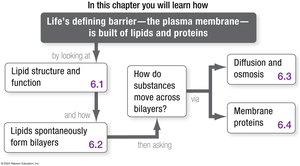
6.1 Lipid Structure and Function
Definition and Properties of Lipids
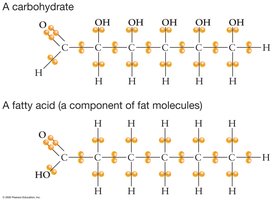
Lipids are carbon-containing compounds that are insoluble in water due to their high proportion of nonpolar bonds. Hydrocarbons, which are molecules containing only carbon and hydrogen, are hydrophobic because their electrons are shared equally, preventing interaction with water.
Hydrophobicity: Lipids do not dissolve in water.
Hydrocarbon chains: The backbone of most lipids, contributing to their nonpolarity.
Bond Saturation and Hydrocarbon Structure
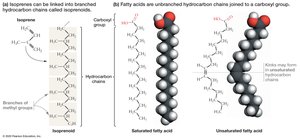
The saturation of hydrocarbon chains affects the physical and chemical properties of lipids. Fatty acids, which are hydrocarbon chains bonded to a carboxyl group, can be saturated (only single bonds) or unsaturated (one or more double bonds).
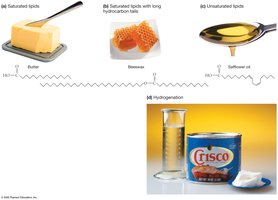
Saturated fatty acids: Maximum number of hydrogen atoms, straight chains, solid at room temperature.
Unsaturated fatty acids: One or more double bonds, kinked chains, liquid at room temperature.
Polyunsaturated: Multiple double bonds, even more fluid.
Types of Lipids in Cells
Lipids do not share a common chemical structure, but three major types are found in cells: steroids, fats, and phospholipids.
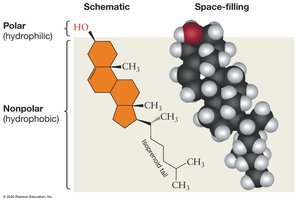
Steroids: Bulky, four-ring structure; includes hormones and cholesterol.
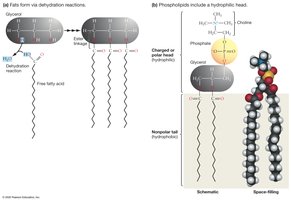
Fats (triglycerides): Three fatty acids linked to glycerol; primary role is energy storage.
Phospholipids: Glycerol linked to a phosphate group and two hydrocarbon chains; main component of cell membranes.
6.2 Phospholipid Bilayers
Amphipathic Nature of Membrane Lipids
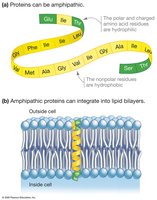
Phospholipids are amphipathic, meaning they contain both hydrophilic (water-loving) and hydrophobic (water-fearing) regions. This property is crucial for membrane formation.
Hydrophilic head: Contains glycerol, phosphate, and a charged or polar group.
Hydrophobic tail: Nonpolar hydrocarbon chains.
Micelles and Bilayers
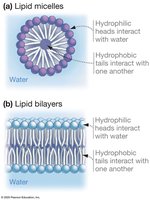
Amphipathic lipids form micelles (spherical aggregates) or bilayers (paired sheets) in water. Bilayers are the basis of biological membranes.
Micelles: Formed by free fatty acids.
Lipid bilayers: Formed spontaneously by phospholipids.
Artificial Membranes and Experimental Systems
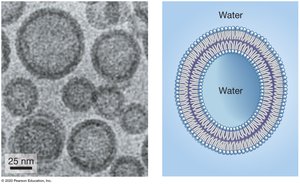
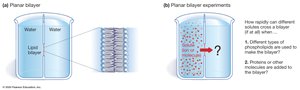
Vesicles and liposomes are artificial membrane-bound structures used to study membrane properties. Planar bilayers are constructed to measure permeability.
Vesicles: Small, bubble-like structures surrounded by phospholipids.
Liposomes: Artificial vesicles used in laboratory experiments.
Planar bilayers: Used to study permeability and transport.
Selective Permeability of Lipid Bilayers
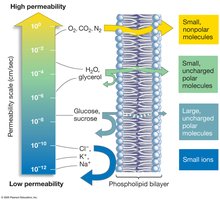
Phospholipid bilayers are selectively permeable, allowing small or nonpolar molecules to cross quickly, while large or charged molecules cross slowly or not at all.
Small, nonpolar molecules: Rapidly cross the membrane (e.g., O2).
Large, polar molecules: Cross slowly (e.g., glucose).
Charged ions: Rarely cross without assistance.
Factors Affecting Membrane Permeability
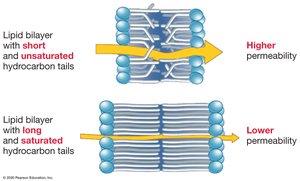
Membrane permeability is influenced by hydrocarbon tail length, saturation, and cholesterol content.
Short, unsaturated tails: Higher permeability.
Long, saturated tails: Lower permeability.
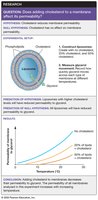
Cholesterol: Increases packing density, reduces permeability.
Temperature Effects on Membrane Fluidity
Membrane fluidity decreases as temperature drops, causing molecules to move more slowly and hydrophobic tails to pack tightly, which reduces permeability.
High temperature: Increased fluidity and permeability.
Low temperature: Decreased fluidity and permeability.
6.3 Diffusion and Osmosis Across Lipid Bilayers
Diffusion
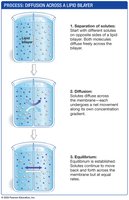
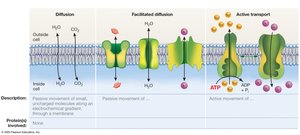
Diffusion is the spontaneous movement of molecules and ions from regions of high concentration to low concentration, driven by thermal energy. Equilibrium is reached when molecules are evenly distributed.
Passive transport: Diffusion across membranes without energy input.
Entropy: Diffusion increases disorder (entropy).
Osmosis
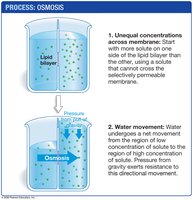
Osmosis is the diffusion of water across a selectively permeable membrane. Water moves from regions of low solute concentration to high solute concentration, diluting the solute and equalizing concentrations.
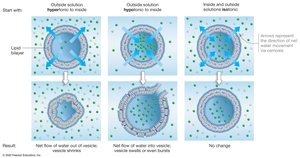
Hypertonic solution: Higher solute concentration outside; water leaves cell.
Hypotonic solution: Lower solute concentration outside; water enters cell.
Isotonic solution: Equal solute concentrations; no net water movement.
6.4 Proteins Alter Membrane Structure and Function
Role of Membrane Proteins
Membrane proteins are as abundant as phospholipids in the plasma membrane. They can be amphipathic, allowing them to integrate into the lipid bilayer and form passageways for molecules.
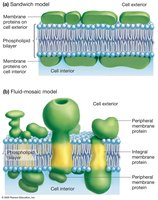
Integral (transmembrane) proteins: Span the membrane, with segments facing both sides.
Peripheral proteins: Bind to membrane lipids without passing through.
Fluid-Mosaic Model of Membrane Structure
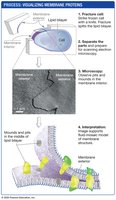
The fluid-mosaic model describes the membrane as a dynamic mosaic of phospholipids and proteins, with proteins able to move laterally within the membrane.
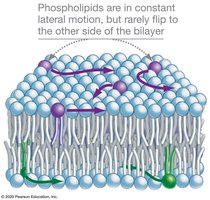
Membrane fluidity: Lipids and some proteins move sideways; rare flip-flop between layers.
Experimental evidence: Mixing of mouse and human membrane proteins demonstrates lateral movement.
Studying Membrane Proteins
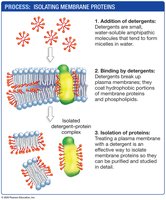
Detergents are used to isolate membrane proteins for study. Detergents are amphipathic molecules that break up membranes and solubilize proteins.
Channels: Form pores for ions.
Carriers: Transport specific molecules.
Pumps: Use energy to move substances against gradients.
Channel Proteins and Facilitated Diffusion
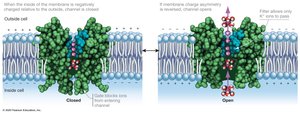
Channel proteins facilitate diffusion by forming selective pores for ions and small molecules. Movement is passive and regulated by signals (gated channels).
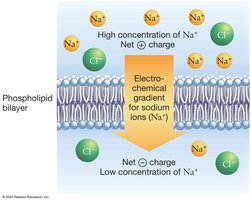
Ion channels: Allow ions to cross membranes down electrochemical gradients.
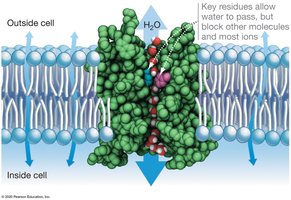
Aquaporins: Permit water to cross the membrane.
Gated channels: Open or close in response to signals.
Carrier Proteins and Glucose Transport
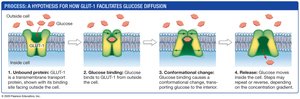
Carrier proteins facilitate diffusion by binding to specific molecules and undergoing conformational changes to transport them across the membrane. The GLUT-1 protein is a well-studied glucose carrier.
Mechanism: Carrier binds solute, changes shape, releases solute on other side.
Specificity: Each carrier is selective for particular molecules.
Active Transport and Pumps
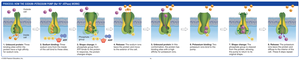
Active transport moves substances against their concentration gradients, requiring energy input, often from ATP. The sodium-potassium pump (Na+/K+-ATPase) is a classic example.
ATP: Provides energy for transport.
Na+/K+ pump: Maintains electrochemical gradients essential for cell function.
Secondary Active Transport (Co-Transport)
Secondary active transport uses electrochemical gradients established by primary pumps to move other molecules against their gradients, without direct ATP usage.
Potential energy: Stored in gradients powers transport.
Co-transport: Coupled movement of molecules.
Summary Table: Passive and Active Mechanisms of Membrane Transport
Mechanism | Description | Proteins Involved |
|---|---|---|
Diffusion | Passive movement of small, uncharged molecules along concentration gradient | None |
Facilitated Diffusion | Passive movement of ions and polar molecules via channel or carrier proteins | Channel, Carrier |
Active Transport | Movement against concentration gradient, requires energy (ATP) | Pump |
Membranes and Chemical Evolution
Origin of Cellular Life
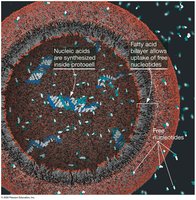
The first lipid bilayers likely provided containers for replicating molecules such as RNA. Protocells, simple vesicle-like structures, may have been intermediates in the evolution of cells.
Protocells: Simple membrane-bound structures harboring nucleic acids.
Permeability: Early membranes allowed uptake of nucleotides.
Key Terms and Concepts
Lipid: Hydrophobic molecule, insoluble in water.
Phospholipid: Amphipathic molecule forming cell membranes.
Diffusion: Passive movement of molecules from high to low concentration.
Osmosis: Diffusion of water across a membrane.
Channel protein: Forms selective pore for ions.
Carrier protein: Transports specific molecules via conformational change.
Pump: Uses energy to move substances against gradient.
Equations
Diffusion Rate:
Osmotic Pressure:
Where is osmotic pressure, is the van 't Hoff factor, is molarity, is the gas constant, and is temperature.
Additional info: Academic context was added to clarify mechanisms, definitions, and examples for self-contained study notes.
