 Indietro
Lipids, Membranes, and the First Cells: Structure and Function
Guida di studio - Note intelligenti
 Appunti personalizzati basati sui tuoi materiali, ampliati con definizioni chiave, esempi e contesto.
Lipids: Structure and Function
Definition and Characteristics
Lipids are a diverse group of carbon-containing compounds that are largely nonpolar and hydrophobic. Unlike polysaccharides, lipids are not composed of discrete subunits, but they are still considered macromolecules. Their structure is characterized by their hydrophobic nature, which is due to the predominance of hydrocarbon chains.
Hydrocarbons: Molecules containing only carbon and hydrogen; hydrophobic due to equal sharing of electrons in C–H bonds.
Functions: Energy storage, insulation in animals, and formation of cell membranes.
Types of Lipids
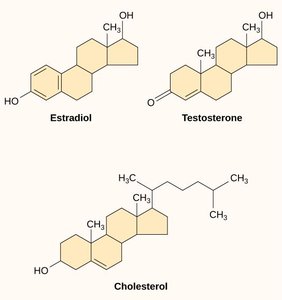
Lipids include fats and oils, steroid hormones, cholesterol, and phospholipids. Each type has distinct structural features and biological roles.
Fats and Oils: Energy storage molecules.
Steroids: Hormones and membrane components.
Phospholipids: Major constituents of cell membranes.
Isoprenoids and Fatty Acids
Isoprenoids: Hydrocarbon chains functioning as pigments, scents, vitamins, and hormone precursors; building blocks for complex lipids.
Fatty Acids: Hydrocarbon chains bonded to a carboxyl (–COOH) group; can be saturated (no double bonds) or unsaturated (one or more double bonds).
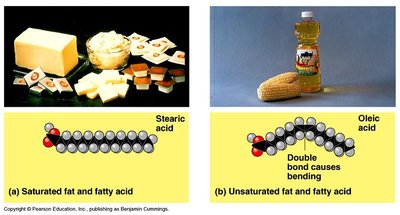
Saturated Fatty Acids: Straight chains, solid at room temperature.
Unsaturated Fatty Acids: Kinked chains due to double bonds, liquid at room temperature.
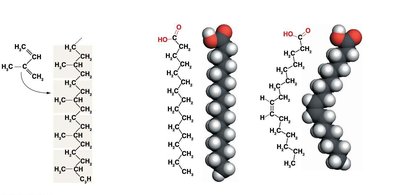
Examples of Saturated and Unsaturated Fats
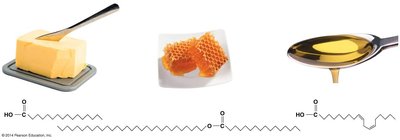
Animal Sources: Typically contain saturated fats (e.g., butter).
Plant Sources: Typically contain unsaturated fats (e.g., safflower oil).
Polyunsaturated Lipids: May prevent heart disease.
Fat Synthesis and Structure
Formation of Fats (Triacylglycerols)
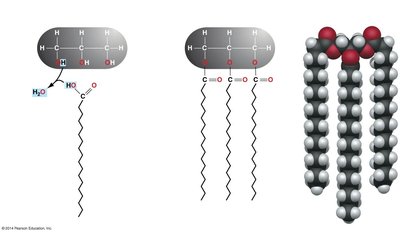
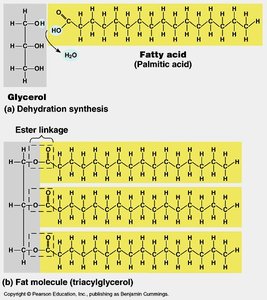
Fats are formed via dehydration reactions, linking glycerol to three fatty acids by ester linkages. This structure is known as triacylglycerol.
Glycerol Backbone: Three-carbon molecule.
Ester Linkages: Bonds formed between glycerol and fatty acids.
Function: Energy storage and insulation in animals.
Trans Fats
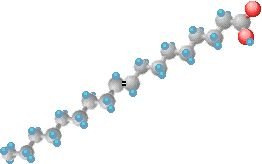
Trans fats are produced by hydrogenating unsaturated oils, breaking double bonds and adding hydrogen atoms. This process alters the configuration from cis to trans, impacting health.
Cis Configuration: Naturally occurring, healthier.
Trans Configuration: Artificially produced, associated with health risks.
Phospholipids and Membrane Structure
Phospholipids: Structure and Function
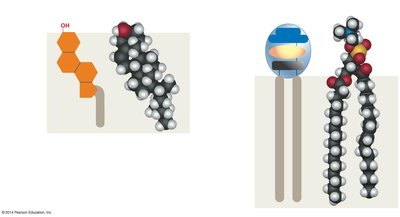
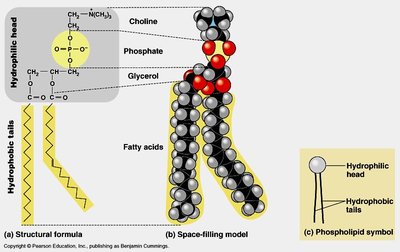
Phospholipids are essential for forming the plasma membrane, separating the cell's interior from the external environment. Their amphipathic nature (having both hydrophilic and hydrophobic regions) allows them to form bilayers.
Hydrophilic Head: Contains phosphate and is polar.
Hydrophobic Tails: Composed of fatty acids.
Function: Membrane formation, selective permeability, and compartmentalization.
Phospholipid Bilayers and Micelles
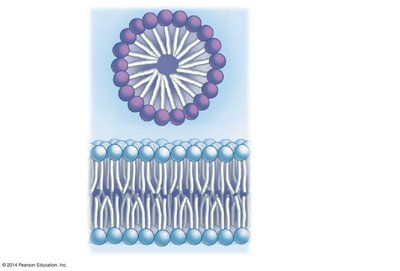
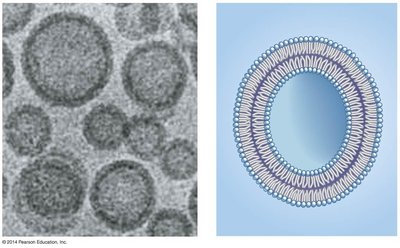
Phospholipids spontaneously form micelles or bilayers in aqueous environments, with hydrophilic heads facing water and hydrophobic tails facing inward.
Lipid Micelles: Spherical structures with tails inward.
Lipid Bilayers: Double-layered sheets forming cell membranes.
Membrane Permeability and Fluidity
Factors Affecting Membrane Permeability
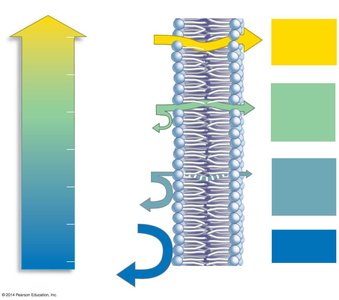
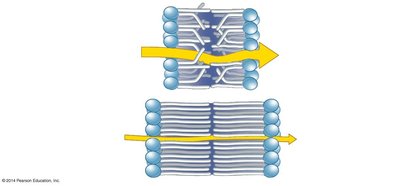
Membrane permeability is influenced by the structure of phospholipids, cholesterol content, and temperature.
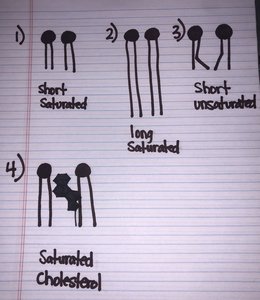
Double Bonds: Increase permeability by preventing close packing.
Tail Length: Longer tails decrease permeability.
Cholesterol: Decreases permeability by filling spaces in the bilayer.
Temperature: Higher temperatures increase permeability.
Summary Table: Factors Affecting Membrane Permeability
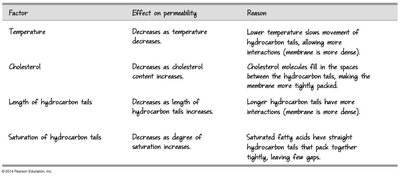
Factor | Effect on permeability | Reason |
|---|---|---|
Temperature | Decreases as temperature decreases | Lower temperature slows movement of hydrocarbon tails, allowing more interactions (membrane is more dense) |
Cholesterol | Decreases as cholesterol content increases | Cholesterol molecules fill in the spaces between the hydrocarbon tails, making the membrane more tightly packed |
Length of hydrocarbon tails | Decreases as length of hydrocarbon tails increases | Longer hydrocarbon tails have more interactions (membrane is more dense) |
Saturation of hydrocarbon tails | Decreases as degree of saturation increases | Saturated fatty acids have straight hydrocarbon tails that pack together tightly, leaving few gaps |
Membrane Proteins and Permeability
Role of Membrane Proteins
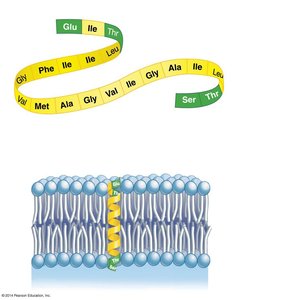
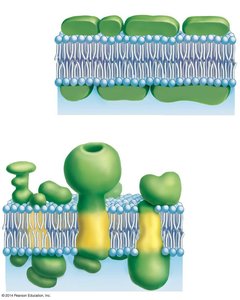
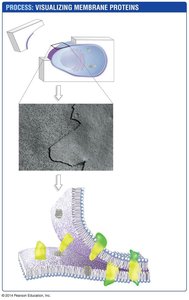
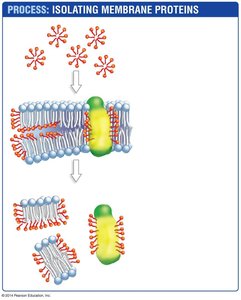
Membranes are not composed solely of phospholipids; proteins are essential for constructing an effective plasma membrane. Membrane proteins can be amphipathic, allowing them to integrate into lipid bilayers and affect permeability.
Integral Proteins: Span the membrane.
Peripheral Proteins: Attach to the membrane surface.
Functions: Transport, signaling, and maintaining internal environment.
Classes of Membrane Proteins Affecting Permeability
Experiments reveal three broad classes of proteins that affect membrane permeability:
Channels: Allow specific ions or molecules to pass.
Carriers: Facilitate transport by binding and moving substances.
Pumps: Use energy to move substances against gradients.
Case Study: Cystic Fibrosis and Channel Proteins
CFTR Protein and Membrane Permeability
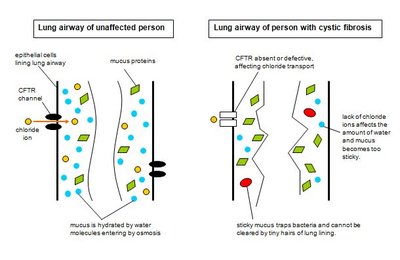
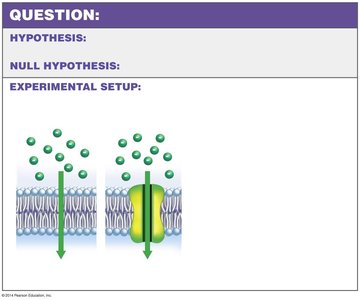
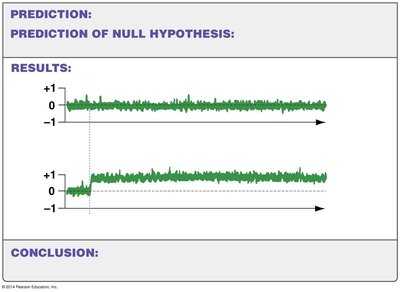
The CFTR protein is a chloride channel that facilitates diffusion of chloride ions along an electrochemical gradient. Its function is crucial for maintaining proper hydration and mucus consistency in lung airways.
Normal Function: CFTR increases the flow of chloride ions across membranes.
Cystic Fibrosis: Defective or absent CFTR leads to thick, sticky mucus and impaired lung function.
Conclusion
Lipids are fundamental to biological structure and function, particularly in the formation of cell membranes. The properties of lipids and their interactions with proteins determine membrane fluidity, permeability, and the ability to maintain cellular environments. Understanding these principles is essential for studying cell biology and related physiological processes.
