 Indietro
Lipids, Membranes, and the Structure of Cells
Guida di studio - Note intelligenti
 Appunti personalizzati basati sui tuoi materiali, ampliati con definizioni chiave, esempi e contesto.
Lipids, Membranes, and Cells
Introduction to Cell Membranes
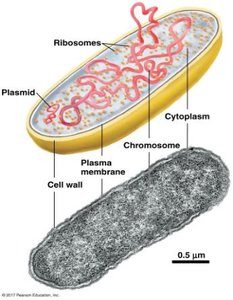
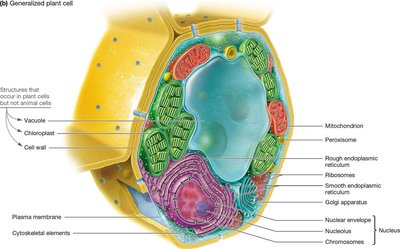
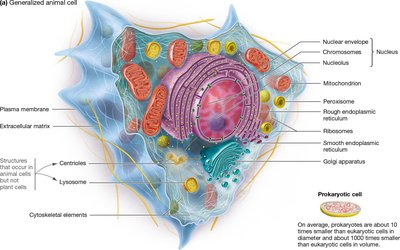
The plasma membrane is a fundamental structure that separates the cell’s interior from the external environment. In eukaryotic cells, membranes also create internal compartments, forming membrane-bound organelles that allow for specialized functions within the cell.
Plasma membrane: Defines the boundary of the cell and regulates the passage of substances.
Membrane-bound organelles: Present in eukaryotes, allowing compartmentalization of cellular processes.
Functions of Cell Membranes
Cell membranes are essential for maintaining cellular integrity and function. They:
Exclude damaging materials from the cell.
Permit entry of necessary nutrients and molecules.
Facilitate chemical reactions by providing a suitable environment and organizing cellular processes.
Membrane Lipids: Structure and Types
Definition and Properties of Lipids
Lipids are a diverse group of biological molecules that are largely nonpolar and hydrophobic. They are major components of cell membranes and serve various structural and functional roles.
Phospholipids
Glycolipids
Fats (Triglycerides)
Steroids
Phospholipids, glycolipids, and fats are all derived from fatty acids.
Fatty Acids: Structure and Saturation
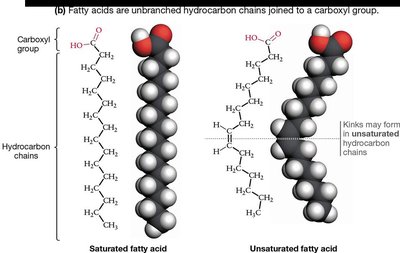
A fatty acid consists of a hydrocarbon chain bonded to a carboxyl group. Fatty acids are amphipathic, meaning they have both hydrophilic (water-attracting) and hydrophobic (water-repelling) regions.
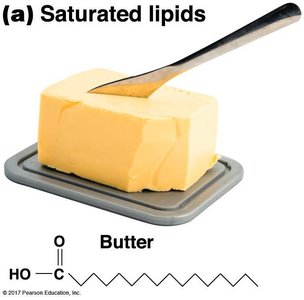
Saturated fatty acids: Only single bonds between carbons; straight chains; solid at room temperature (e.g., butter).
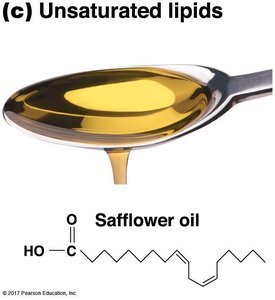
Unsaturated fatty acids: One or more double bonds; kinks in the chain; liquid at room temperature (e.g., vegetable oil).
Fats (Triglycerides)
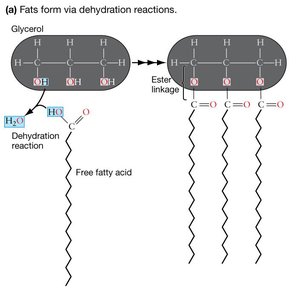
Fats are composed of three fatty acids linked to a glycerol molecule via ester linkages. Their primary role is energy storage.
Formed by dehydration reactions between glycerol and fatty acids.
Stored in adipose tissue in animals.
Phospholipids
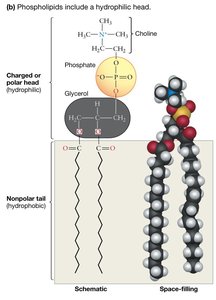
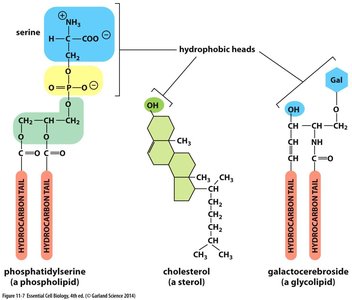
Phospholipids consist of a glycerol backbone, two fatty acid tails, and a phosphate-containing head group. They are amphipathic, with hydrophilic heads and hydrophobic tails, making them ideal for forming biological membranes.
Major component of cell membranes.
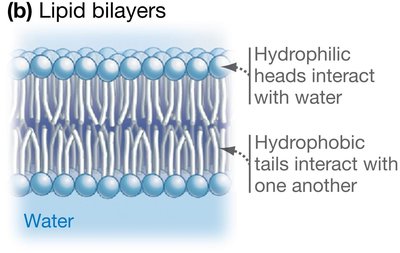
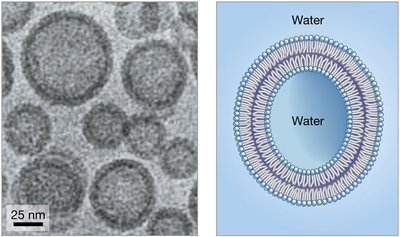
Self-assemble into bilayers in aqueous environments.
Glycolipids
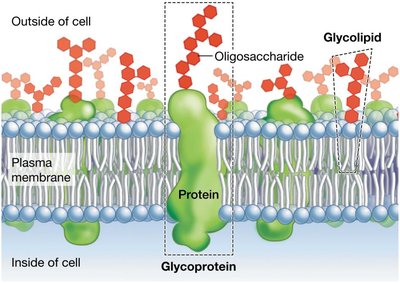
Glycolipids are lipids with two fatty acids and a sugar (oligosaccharide) head group. They may have a glycerol backbone but lack a phosphate group. Glycolipids are amphipathic and are found mainly on the extracellular surface of cell membranes.
Play roles in cell recognition and signaling.
Steroids
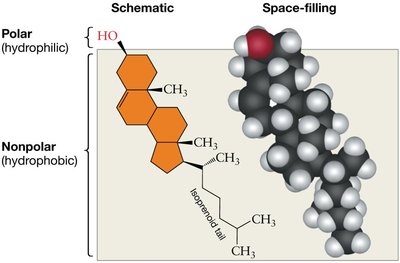
Steroids are characterized by a bulky, four-ring structure. Examples include hormones such as estrogen and testosterone, and cholesterol, which is a component of animal cell membranes and is amphipathic.
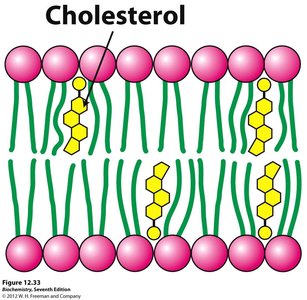
Cholesterol modulates membrane fluidity and permeability.
Lipid Bilayer Structure and Properties
Asymmetry of the Lipid Bilayer
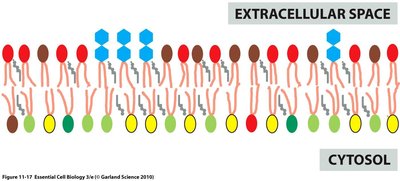
The lipid bilayer in cell membranes is asymmetrical. Some phospholipids are found only on one side of the bilayer, and glycolipids are typically present only on the extracellular side.
Amphipathic Nature and Bilayer Formation
Membrane lipids such as phospholipids, glycolipids, and cholesterol are amphipathic. In water, they spontaneously form bilayers, with hydrophilic heads facing outward and hydrophobic tails facing inward, minimizing free energy.
Membrane Permeability and Fluidity
Selective Permeability of Lipid Bilayers
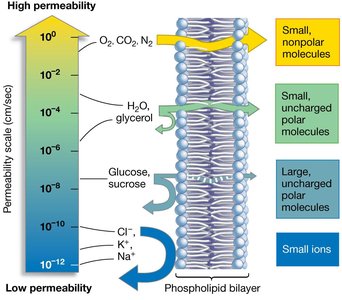
Lipid bilayers are selectively permeable, allowing some molecules to cross more easily than others. The permeability depends on the size, polarity, and charge of the molecules.
Small, nonpolar molecules (e.g., O2, CO2) cross easily.
Small, uncharged polar molecules (e.g., H2O, glycerol) cross less easily.
Large, uncharged polar molecules (e.g., glucose) and ions (e.g., Na+, Cl-) cross with difficulty.
Membrane Fluidity
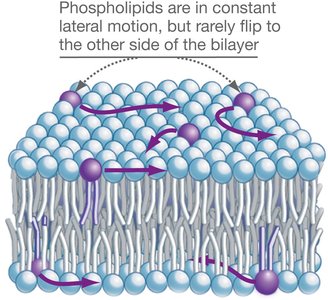
Membrane fluidity is determined by the movement of lipids within the bilayer. Phospholipids can move laterally, rotate, and flex their fatty acid tails. "Flip-flop" movement between leaflets is rare. Increased fluidity enhances permeability and is influenced by temperature and the degree of hydrocarbon saturation.
Higher temperature increases fluidity.
Unsaturated fatty acids increase fluidity; saturated fatty acids decrease it.
Effect of Cholesterol on Membrane Properties
Cholesterol is an amphipathic molecule that intercalates between phospholipids in animal cell membranes. It reduces membrane permeability and modulates fluidity, making the membrane less permeable to small molecules.
Summary Table: Major Membrane Lipids
Lipid Type | Structure | Key Features | Example/Function |
|---|---|---|---|
Phospholipid | Glycerol + 2 fatty acids + phosphate group | Amphipathic; forms bilayers | Main component of cell membranes |
Glycolipid | Glycerol + 2 fatty acids + sugar | Amphipathic; sugar head group | Cell recognition, signaling |
Steroid | Four-ring structure | Amphipathic; rigid | Cholesterol, hormones |
Fat (Triglyceride) | Glycerol + 3 fatty acids | Hydrophobic; energy storage | Adipose tissue in animals |
Additional info: The degree of saturation and length of fatty acid chains also influence membrane properties. Shorter and more unsaturated chains increase fluidity and permeability, while cholesterol acts as a buffer, stabilizing membrane fluidity across temperature changes.
