 Indietro
Macroevolution and Speciation: Life on Earth
Guida di studio - Note intelligenti
 Appunti personalizzati basati sui tuoi materiali, ampliati con definizioni chiave, esempi e contesto.
Macroevolution and Speciation
Introduction to Macroevolution
Macroevolution refers to large-scale evolutionary changes that occur over long periods of time, resulting in the emergence of new species and major changes in life on Earth. It encompasses processes such as speciation, extinction, and the diversification of life forms. - Macroevolution: Evolutionary changes above the species level, including the origin of new taxonomic groups, adaptive radiation, and mass extinctions. - Speciation: The process by which new species arise from existing ones. 
How New Species Originate
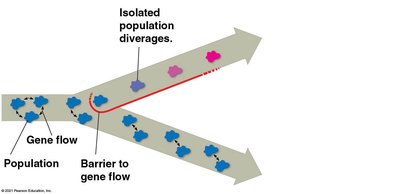
Speciation occurs when populations become reproductively isolated, preventing gene flow and allowing genetic divergence. - Gene flow: The transfer of genetic material between populations. - Reproductive isolation: The existence of biological barriers that prevent members of different species from interbreeding. - Divergence: Genetic differences accumulate, leading to the formation of new species. 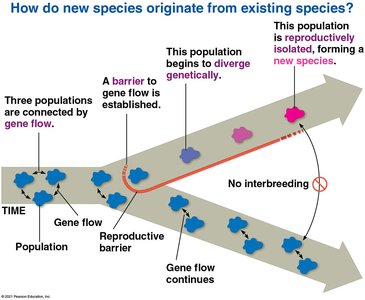
Biological and Ecological Species Concepts
The definition of a species can vary depending on the concept used. - Biological species concept: Defines a species as a group of interbreeding organisms that produce viable offspring and are reproductively isolated from other groups. - Ecological species concept: Defines a species based on its ecological niche, including interactions with the environment and other organisms.
Reproductive Barriers
Reproductive barriers prevent gene flow between species and are classified as prezygotic or postzygotic. - Prezygotic barriers: Prevent mating or fertilization between species (e.g., habitat, temporal, behavioral, mechanical, gametic isolation). - Postzygotic barriers: Prevent the development of viable, fertile offspring after fertilization (e.g., reduced hybrid viability, reduced hybrid fertility, hybrid breakdown). 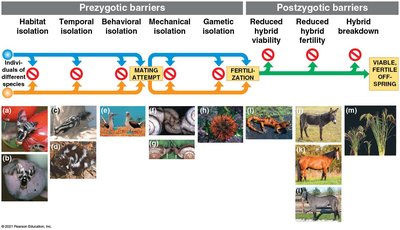
Hybridization and Speciation
Hybridization can occur between closely related species, sometimes resulting in hybrid offspring. - Hybrid: An organism resulting from the mating of two different species. - Example: The "grolar bear" is a hybrid between a grizzly bear (Ursus arctos) and a polar bear (Ursus maritimus). 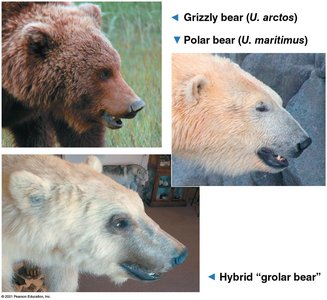
Experimental Evidence for Speciation
Laboratory experiments can demonstrate reproductive isolation and speciation. - Example: Fruit flies (Drosophila pseudoobscura) raised on different media (starch vs. maltose) show mating preferences after 40 generations, indicating reproductive isolation. 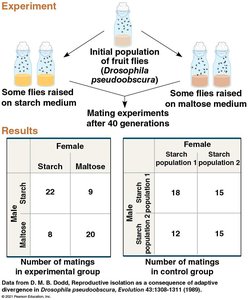
Female | Starch | Maltose |
|---|---|---|
Male Starch | 22 | 9 |
Male Maltose | 8 | 19 |
Behavioral Isolation in Speciation
Behavioral differences, such as mating rituals, can contribute to reproductive isolation. - Example: Fruit flies exhibit specific courtship behaviors that help maintain species boundaries. 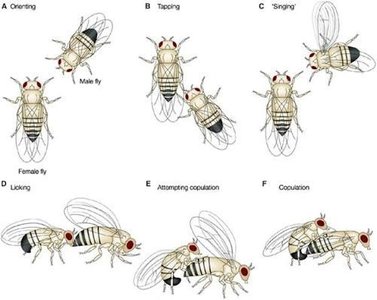
Hybrid Zones
Hybrid zones are regions where two species meet and interbreed, producing hybrid offspring. - Hybrid zone: Area where members of different species meet and mate, resulting in hybrids. - Example: Fire-bellied toad (Bombina bombina) and yellow-bellied toad (Bombina variegata) form a hybrid zone in Europe. 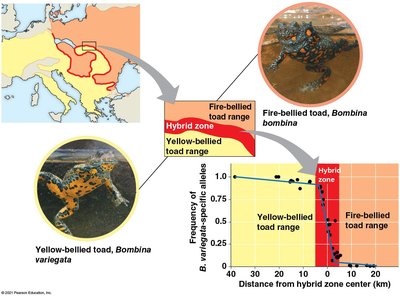
Species Recognition and Isolation
Closely related species may be distinguished by subtle differences in appearance or behavior. - Example: Black-capped chickadee (Poecile atricapillus) and Carolina chickadee (Poecile carolinensis) are similar but reproductively isolated. 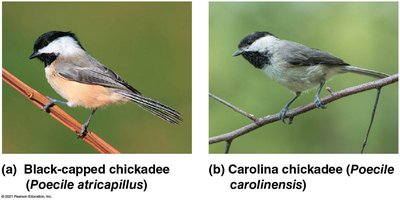
Barriers to Gene Flow and Divergence
Physical or ecological barriers can restrict gene flow, leading to divergence and speciation. 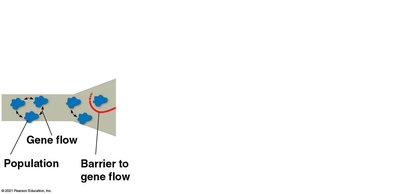
Hybrid Zones and Speciation Outcomes
Hybrid zones can have different outcomes: reinforcement, fusion, or stability. - Reinforcement: Strengthening of reproductive barriers. - Fusion: Two species merge into one. - Stability: Hybrid zone persists. 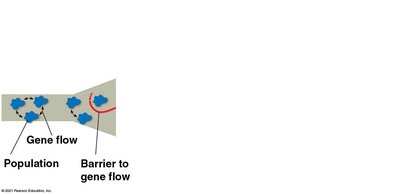
History of Life on Earth
How Life Has Changed Over Time
The fossil record provides evidence for the history of life, showing how groups of organisms arise, diversify, and go extinct. - Fossil record: Chronological collection of life's remains in sedimentary rock layers. - Large-scale processes: Continental drift, mass extinction, and adaptive radiation shape the diversity of life. 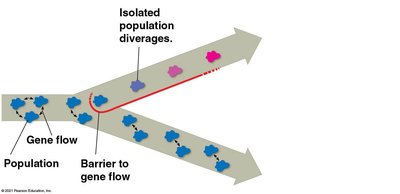
Fossil Evidence
Fossils provide direct evidence of ancient life forms and their ages. - Examples: Plant fossils, petrified trees, dinosaur tracks, frozen wolf pup, insect in amber. 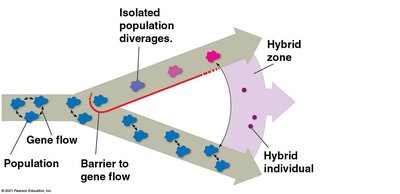
Dating Fossils: Radiometric Methods
Radiometric dating uses the decay of isotopes to estimate the age of fossils. - Isotopes: Variants of elements with different numbers of neutrons. - Carbon-14: Used for dating relatively recent fossils (half-life = 5,730 years). - Uranium-238: Used for dating much older fossils (half-life = 4.5 billion years). 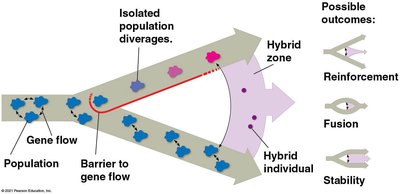
Half-Life and Radiometric Dating
The half-life is the time required for half of the parent isotope to decay into the daughter isotope. - Formula: , where is the remaining amount, is the initial amount, is time, and is the half-life. 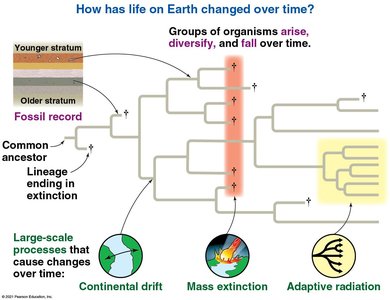
Macroevolutionary Patterns and Processes
Evolution by Natural Selection
Natural selection shapes organs and functions, but evolution is not goal-oriented. - Natural selection: Process by which organisms better adapted to their environment tend to survive and reproduce. - Evolution improves traits but does not work toward a specific goal.
Major Transitions in Evolution
Major evolutionary transitions involve the formation of larger entities from smaller ones, differentiation, and new ways of transmitting information. - Examples: Chromosomes, eukaryotes, multicellular colonies, DNA-protein complexes, organelles, tissues, castes. - Smaller entities often cannot replicate independently and may disrupt larger entities (e.g., selfish genes, cancers). - New information transmission methods include cell heredity and epigenesis. Additional info: These transitions are central to understanding the complexity and diversity of life. ----------------------------------------
