 Indietro
Macromolecules: Structure and Function in Biology
Guida di studio - Note intelligenti
 Appunti personalizzati basati sui tuoi materiali, ampliati con definizioni chiave, esempi e contesto.
Proteins
Amino Acids and Protein Structure
Proteins are essential biological macromolecules composed of amino acids, which serve as their monomers. The structure of proteins determines their function, and they exhibit four distinct levels of structural organization.
Amino Acids: Each amino acid contains an amino group (-NH2), a carboxyl group (-COOH), a hydrogen atom, and a variable R-group (side chain). There are 20 different amino acids.
Polypeptide Chain: Amino acids are linked by peptide bonds (covalent bonds) to form polypeptide chains.
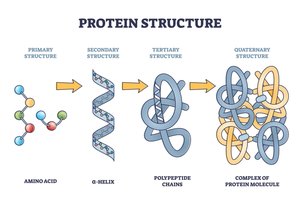
Primary Structure: The unique linear sequence of amino acids in a polypeptide.
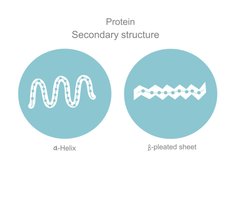
Secondary Structure: Local folding of the polypeptide chain stabilized by hydrogen bonds, forming α-helix (coils) and β-pleated sheet (folds).
Tertiary Structure: Further folding due to interactions among R-groups, including hydrogen bonds, disulfide bonds, ionic bonds, and hydrophobic interactions.
Quaternary Structure: Association of two or more polypeptide chains, stabilized by the same R-group interactions as tertiary structure. Not all proteins possess quaternary structure.
Denaturation: Loss of protein structure due to environmental changes (temperature, pH), resulting in loss of function.
Example: Hemoglobin is a protein with quaternary structure, consisting of four polypeptide subunits.
Carbohydrates
Types and Functions of Carbohydrates
Carbohydrates are sugars and their polymers, serving as energy sources and structural materials in cells.
Monosaccharides: Simple sugars (3-7 carbons), typically with the formula . Examples include glucose and glyceraldehyde. The location of the carbonyl group determines if the sugar is an aldose (aldehyde group) or ketose (ketone group).
Disaccharides: Formed by two monosaccharides joined by a glycosidic linkage (covalent bond). Examples:
Maltose: Glucose + Glucose
Sucrose: Glucose + Fructose
Lactose: Glucose + Galactose
Polysaccharides: Polymers of many sugar units, used for storage or structural support.
Storage: Starch (plants, amylose monomer), glycogen (animals)
Structure: Cellulose (plant cell walls, indigestible due to different glucose isomer), chitin (exoskeletons of arthropods, fungi cell walls)
Example: Cellulose provides structural support in plant cell walls, while starch stores energy in plants.
Disaccharide | Monosaccharides |
|---|---|
Maltose | Glucose + Glucose |
Sucrose | Glucose + Fructose |
Lactose | Glucose + Galactose |
Lipids
Structure and Types of Lipids
Lipids are hydrophobic molecules that mix poorly with water. They include fats, phospholipids, and steroids, and are constructed from glycerol and fatty acids.
Glycerol: A 3-carbon alcohol with a hydroxyl group attached to each carbon.
Fatty Acid: A carboxyl group attached to a long carbon skeleton. Three fatty acids connect to glycerol via ester linkages formed by dehydration reactions.
Saturated Fatty Acids: No double bonds, maximum hydrogen atoms, solid at room temperature (e.g., animal fats).
Unsaturated Fatty Acids: One or more double bonds, liquid at room temperature (e.g., plant and fish oils).
Hydrogenation: Converts unsaturated fats to saturated fats by adding hydrogen, producing trans fats with trans double bonds, which are associated with cardiovascular disease.
Functions: Energy storage (in adipose cells), insulation, and protection of organs.
Steroids: Lipids with a carbon skeleton of four fused rings. Cholesterol is a steroid used in cell membranes and as a precursor for hormones; excess cholesterol can contribute to cardiovascular disease.
Example: Adipose cells store fat for long-term energy reserves in animals.
Nucleic Acids
Structure and Function of Nucleic Acids
Nucleic acids (DNA and RNA) are polymers of nucleotides, which store and transmit genetic information.
Nucleotide: Consists of a nitrogenous base, a pentose (5-carbon) sugar, and a phosphate group.
Nitrogenous Bases:
Pyrimidines: Cytosine, Uracil, Thymine
Purines: Adenine, Guanine
Pentose Sugar: DNA contains deoxyribose; RNA contains ribose.
Phosphodiester Linkages: Covalent bonds joining adjacent nucleotides in a strand.
Base Pairing: Adenine pairs with Thymine (Uracil in RNA), Guanine pairs with Cytosine.
Antiparallel Strands: DNA strands run in opposite directions (one 5' to 3', the other 3' to 5'). RNA is read from 3' to 5'.
Example: The sequence of nucleotides in DNA encodes genetic information for protein synthesis.
Base Pairing | Mnemonic |
|---|---|
Adenine - Thymine (Uracil in RNA) | Apple in a Tree |
Guanine - Cytosine | Car in Garage |
Practice Questions and Concept Checks
Key Concepts and Review
Functional Groups in Amino Acids: Amino and carboxyl groups are always present.
Bond Linking Amino Acids: Peptide bond.
Primary Structure of Protein: Specific linear sequence of amino acids.
Secondary Structure Stabilization: Hydrogen bonds.
Tertiary Structure Covalent Bond: Disulfide bonds between sulfhydryl groups.
Monosaccharide Formula:
Sucrose Composition: Glucose + Fructose.
Structural Polysaccharide in Arthropods/Fungi: Chitin.
Cellulose Digestion: Humans cannot digest cellulose due to a different glucose isomer than starch.
Fat Formation: Ester linkages via dehydration reactions connect fatty acids to glycerol.
Saturated vs. Unsaturated Fats: Saturated fats have no double bonds and maximum hydrogen atoms; unsaturated fats have one or more double bonds.
Steroids: Lipids with four fused rings; example: cholesterol.
Purine Bases: Adenine and Guanine.
Nucleotide Components: Nitrogenous base, pentose sugar, phosphate group.
DNA/RNA Linkage: Phosphodiester linkages.
Protein Denaturation: Unfolding due to temperature or pH changes.
Carbonyl Group Location: Determines aldose or ketose classification.
Maltose: Glucose + Glucose; Lactose: Glucose + Galactose.
Fat Storage: Adipose cells.
Trans Fats: Created by hydrogenation, contain trans double bonds.
Pentose Sugar in DNA: Deoxyribose; RNA: Ribose.
DNA Strands: Run antiparallel (5' to 3' and 3' to 5').
Quaternary Structure: Not present in all proteins; only those with multiple polypeptide chains.
Additional info: The notes expand brief points into full academic explanations and provide context for exam preparation.
