 Indietro
Macromolecules: Structure, Formation, and Biological Roles
Guida di studio - Note intelligenti
 Appunti personalizzati basati sui tuoi materiali, ampliati con definizioni chiave, esempi e contesto.
Macromolecules
Definition and Importance
Macromolecules are large, complex molecules essential for life, composed of thousands or millions of smaller subunits. They are fundamental to biological structure and function, and their diversity among species is largely due to differences in proteins and nucleic acids.
Definition: Macromolecules are organic compounds made primarily of carbon, hydrogen, oxygen, and other elements, held together by covalent bonds.
Classes: The four main classes are carbohydrates, lipids, proteins, and nucleic acids.
Role of Carbon: Carbon's ability to form strong covalent bonds and unlimited combinations makes it the backbone of all organic molecules.
Formation and Breakdown of Macromolecules
Dehydration Synthesis (Condensation Reaction)
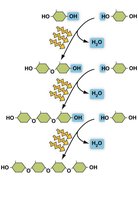
Macromolecules are formed by joining smaller molecules (subunits) through dehydration synthesis, a process that removes water and requires energy.
Process: Each time a subunit is added, a water molecule (H2O) is removed.
Energy: Energy is stored in the bonds formed between subunits.
Example: Formation of carbohydrates and triglycerides.
Hydrolysis Reaction
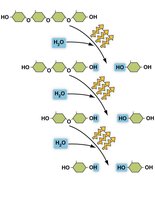
The breakdown of macromolecules occurs via hydrolysis, the reverse of dehydration synthesis, where water is added to break bonds and release energy.
Process: Water is added, breaking the bond between subunits.
Energy: Energy stored in the bonds is released for cellular processes.
Example: Breakdown of carbohydrates to release simple sugars.
Carbohydrates
Structure and Function
Carbohydrates are organic molecules with a carbon backbone, hydrogen, and oxygen in a 2:1 ratio. They serve as energy sources and structural components in organisms.
Structure: Carbon is "hydrated" (C:H:O ratio is 1:2:1).
Uses: Energy (in most organisms), structural support (plants and some animals).
Classification of Carbohydrates
Monosaccharides: Simplest sugars, usually five or six carbons in a ring. Examples: glucose, fructose, ribose, deoxyribose.
Disaccharides: Two monosaccharides joined by dehydration synthesis. Examples: sucrose (glucose + fructose), lactose (glucose + galactose), maltose (glucose + glucose).
Oligosaccharides: Short chains of monosaccharides. Often bind to proteins to form glycoproteins, important in cell recognition and communication.
Polysaccharides: Long chains of monosaccharides. Used for energy storage (glycogen in animals, starch in plants) and structural support (chitin in animals, cellulose in plants).
Lipids
Structure and Function
Lipids are hydrophobic molecules, insoluble in water, and serve as energy storage, structural components, and signaling molecules.
Sub-classes: Triglycerides, phospholipids, steroids.
Triglycerides
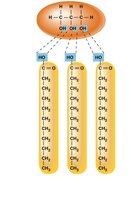
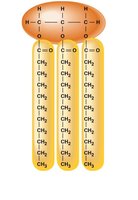
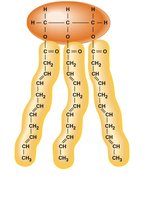
Triglycerides, also known as neutral fats, are formed by dehydration synthesis from glycerol and three fatty acids. They are stored in adipose tissue and are a major energy reserve.
Structure: One glycerol molecule (head) and three fatty acids (tails).
Types: Saturated and unsaturated fats.
Saturated Fats
Saturated fats have straight tails due to single bonds between carbons, allowing tight packing and making them solid at room temperature.
Examples: Animal fats like butter and bacon grease.
Health: High intake is linked to cardiovascular disease.
Unsaturated Fats
Unsaturated fats have kinked tails due to at least one double bond between carbons, preventing tight packing and making them liquid at room temperature (oils).
Examples: Vegetable oil.
Phospholipids
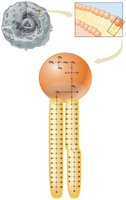
Phospholipids are modified lipids that form the primary structural component of cell membranes.
Structure: Two fatty acid tails (hydrophobic) attached to glycerol, with a negatively charged phosphate group (hydrophilic).
Properties: Amphipathic—polar head is water-soluble, nonpolar tail is water-insoluble.
Steroids
Steroids are lipids with a distinct structure: a backbone of three six-membered carbon rings and one five-membered ring. They are relatively insoluble in water and have various side groups.
Example: Cholesterol, which is a precursor for steroid hormones.
Summary Table: Carbohydrates and Lipids
Macromolecule | Subunit | Function | Example |
|---|---|---|---|
Carbohydrate | Monosaccharide | Energy, structure | Glucose, cellulose |
Lipid | Fatty acid, glycerol | Energy storage, membrane structure | Triglyceride, phospholipid |
Key Equations
Dehydration Synthesis
Hydrolysis
References
Johnson, M.D. (2017). Human biology: Concepts and current issues (8th ed). Pearson Education Inc.
Johnson, M.D. & Long, S (2021). Human biology: Concepts and current issues (9th ed). Pearson Education Inc.
