 Indietro
Meiosis and Sexual Life Cycles: Structured Study Notes
Guida di studio - Note intelligenti
 Appunti personalizzati basati sui tuoi materiali, ampliati con definizioni chiave, esempi e contesto.
Meiosis and Sexual Life Cycles
Overview of Meiosis and Its Role in Sexual Reproduction
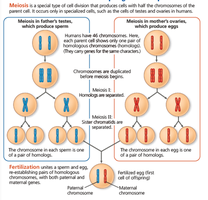
Meiosis is a specialized type of cell division that reduces the chromosome number by half, producing four genetically distinct gametes. This process is fundamental to sexual reproduction, ensuring genetic diversity and maintaining a stable chromosome number across generations.
Occurs in germ cells: Testes in males and ovaries in females.
Chromosome reduction: Diploid (2n) cells become haploid (n) gametes.
Result: Four non-identical haploid cells (gametes).
Genetic variation: Offspring resemble parents but are not identical due to meiosis.
Homologous Chromosomes
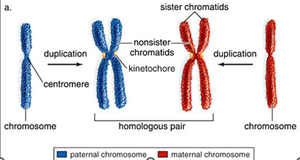
Homologous chromosomes are pairs found in diploid cells, each inherited from one parent. They have the same length, centromere position, and staining pattern, but may carry different alleles.
Somatic cells: Contain homologous pairs (2n).
Gene order: Identical, but alleles may differ.
Key terms: Sister chromatids, centromere, alleles.
Chromosome Sets and Karyotype
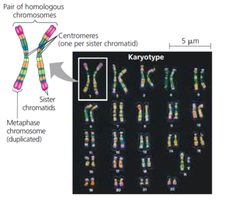
Human cells are diploid (2n = 46 chromosomes). A karyotype is an ordered display of homologous chromosomes, used to study chromosome structure and number.
Karyotype: Visual representation of chromosomes.
Chromosome features: Length, centromere position, staining properties.
Alternation of Meiosis and Fertilization in Sexual Life Cycles
Meiosis and fertilization alternate in sexual life cycles. Meiosis produces haploid gametes, and fertilization restores the diploid state, forming a zygote that undergoes mitosis to become a multicellular organism.
Meiosis: Produces gametes with half the chromosome number.
Fertilization: Fusion of gametes restores diploid number.
Life cycle: Alternates between haploid and diploid stages.
Stages of Meiosis
Meiosis consists of two sequential divisions: Meiosis I and Meiosis II. Each division has distinct phases, resulting in four genetically unique haploid cells.
Meiosis I: Separates homologous chromosomes.
Meiosis II: Separates sister chromatids (similar to mitosis).
Result: (four haploid cells).
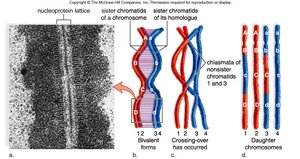
Meiosis I: Prophase I
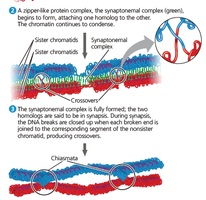
Prophase I is a critical phase where homologous chromosomes pair up (synapsis) and exchange genetic material (crossing over), increasing genetic variation.
Synapsis: Pairing of homologous chromosomes to form tetrads (bivalents).
Crossing over: Exchange of DNA between non-sister chromatids at chiasmata.
Genetic diversity: Reshuffling of genes.
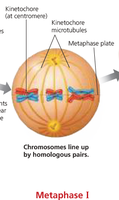
Metaphase I: Independent Assortment
During Metaphase I, homologous chromosomes align independently at the metaphase plate, leading to independent assortment and further genetic variation.
Alignment: Homologous pairs (tetrads) align at the equator.
Independent assortment: Each pair aligns independently, increasing genetic diversity.
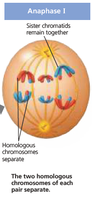
Anaphase I: Separation of Homologous Chromosomes
Homologous chromosomes are pulled to opposite poles, while sister chromatids remain together. This step reduces chromosome number.
Separation: Homologous chromosomes move to opposite poles.
Sister chromatids: Remain attached.
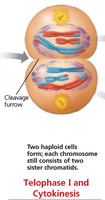
Telophase I and Cytokinesis
Telophase I and cytokinesis result in two haploid cells, each with duplicated chromosomes (two sister chromatids per chromosome).
Cleavage furrow: Plasma membrane pinches in animal cells.
Result: Two haploid cells.
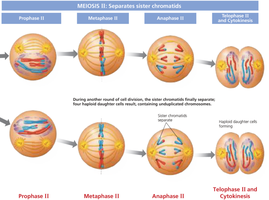
Meiosis II: Separation of Sister Chromatids
Meiosis II is similar to mitosis, but occurs in haploid cells. Sister chromatids are separated, resulting in four non-identical haploid gametes.
Phases: Prophase II, Metaphase II, Anaphase II, Telophase II, and Cytokinesis.
Result: Four haploid gametes.
Sources of Genetic Variation
Meiosis increases genetic variation through crossing over, independent assortment, and random fertilization.
Crossing over: Occurs in Prophase I.
Independent assortment: Occurs in Metaphase I.
Random fertilization: Fusion of gametes from different parents.
Sexual Reproduction and Maintenance of Chromosome Number
Sexual reproduction ensures genetic variation and prevents doubling of chromosome number each generation by producing haploid gametes.
Genetic variation: Essential for evolution and disease resistance.
Haploid gametes: Maintain diploid number after fertilization.
Spermatogenesis and Oogenesis
Spermatogenesis and oogenesis are processes that produce male and female gametes, respectively.
Spermatogenesis: Production of spermatids, followed by conversion to sperm cells (spermiogenesis).
Oogenesis: Production of egg cells; meiosis II is delayed until fertilization, and polar bodies are formed.
Comparison of Mitosis and Meiosis
Mitosis and meiosis are both forms of cell division, but differ in their outcomes and roles in the life cycle.
Feature | Mitosis | Meiosis |
|---|---|---|
Number of divisions | 1 | 2 |
Number of daughter cells | 2 | 4 |
Chromosome number | Diploid (2n) | Haploid (n) |
Genetic identity | Identical | Non-identical |
Function | Growth, repair | Gamete production |
Key Concepts
Meiosis I: Separation of homologous chromosomes.
Meiosis II: Separation of sister chromatids.
Crossing over: Occurs in Prophase I.
Independent assortment: Occurs in Metaphase I.
Genetic variation: Results from crossing over, independent assortment, and random fertilization.
Human chromosome number: 46 in somatic cells, 23 in gametes.
Synapsis and tetrads: Unique to meiosis.
One diploid cell (2n) → Four haploid cells (n): Non-identical gametes.
Additional info: The notes expand on the original content by providing definitions, examples, and a comparison table for mitosis and meiosis, ensuring completeness and academic quality.
