 Indietro
Meiosis and Sexual Reproduction: Structured Study Notes CH.10
Guida di studio - Note intelligenti
 Appunti personalizzati basati sui tuoi materiali, ampliati con definizioni chiave, esempi e contesto.
Meiosis and Sexual Reproduction
The Importance of Meiosis
Meiosis is a specialized type of cell division essential for sexual reproduction. It introduces significant genetic diversity, with over 70 trillion possible genetic combinations from the mating of two individuals. The process differs between males and females: sperm production begins at puberty in males, while egg production starts before birth and ends at menopause in females.
Overview of Meiosis
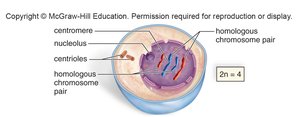
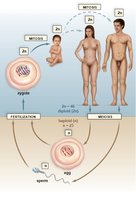
Meiosis is a reduction division that ensures the chromosome number is halved in gametes, preventing chromosome doubling in each generation. Parents are diploid (2n), and meiosis produces haploid (n) gametes. Fertilization restores the diploid state in the zygote. Errors in meiosis can result in gametes with abnormal chromosome numbers.
Diploid (2n): Two sets of chromosomes.
Haploid (n): One set of chromosomes.
Reduction division: Chromosome number is halved.
Homologous Pairs of Chromosomes
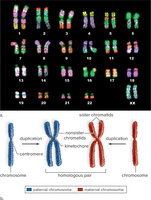
In diploid cells, chromosomes occur in pairs called homologous chromosomes. Humans have 23 types of chromosomes, and each type is present as a pair (one from each parent). Homologous chromosomes have the same length, centromere position, and banding pattern.
Homologous chromosomes: Chromosomes of the same type, one paternal and one maternal.
Alleles: Variant forms of a gene found at the same locus on homologous chromosomes.
Homozygous: Identical alleles for a gene.
Heterozygous: Different alleles for a gene.
Meiosis: Reduction Division
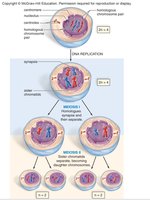
Meiosis consists of two nuclear divisions:
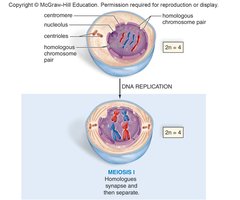
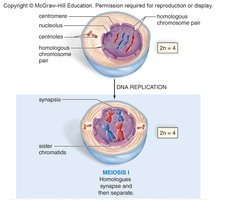
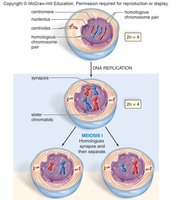
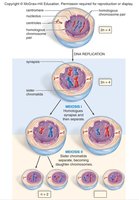
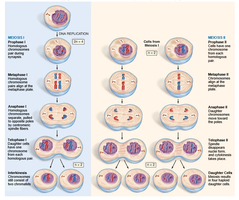
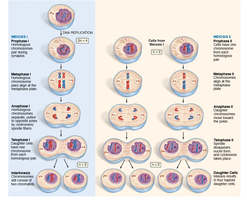
Meiosis I: Homologous chromosomes pair and separate, reducing chromosome number from 2n to n.
Meiosis II: Sister chromatids separate, resulting in four haploid cells.
Genetic Variation
Sources of Genetic Variation
Genetic variation is crucial for evolution and adaptation. Meiosis generates variation through:
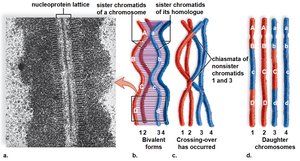
Crossing-over: Exchange of genetic material between nonsister chromatids during meiosis I.
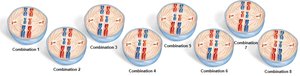
Independent assortment: Random orientation and separation of homologous chromosomes during meiosis I.
Significance of Genetic Variation
Sexual reproduction creates genetic recombinations, increasing the chances of survival in changing environments. In humans, with 23 pairs of chromosomes, the possible combinations are (without crossing-over).
The Phases of Meiosis
Meiosis I
Meiosis I includes:
Prophase I: Homologous chromosomes pair (synapsis), forming bivalents or tetrads.
Metaphase I: Bivalents align at the metaphase plate.
Anaphase I: Homologous chromosomes separate.
Telophase I: Daughter cells have one chromosome from each homologous pair.
Interkinesis: Short interphase without DNA replication.
Meiosis II
Meiosis II resembles mitosis:
Prophase II: Chromosomes condense.
Metaphase II: Chromosomes align at the metaphase plate.
Anaphase II: Sister chromatids separate.
Telophase II: Four haploid cells are produced.
Meiosis Compared to Mitosis
Comparison Table
Meiosis and mitosis differ in their purpose, process, and outcomes:
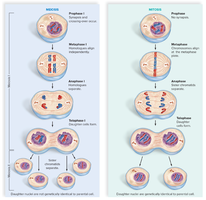
Meiosis: Two divisions, synapsis and crossing-over, halves chromosome number, produces four genetically unique haploid cells, used for sexual reproduction.
Mitosis: One division, no synapsis or crossing-over, preserves chromosome number, produces two genetically identical diploid cells, used for growth and asexual reproduction.
The Cycle of Life
Life Cycles in Plants, Animals, and Fungi
A life cycle includes all reproductive events from one generation to the next. In plants, alternation of generations occurs between haploid (gametophyte) and diploid (sporophyte) individuals. Animals are diploid except for gametes, and meiosis occurs only during gametogenesis.
Human Life Cycle
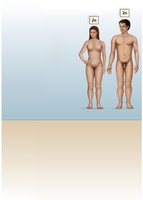
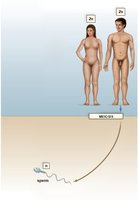
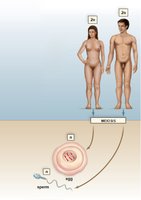
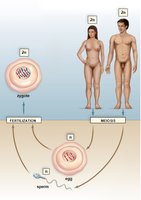
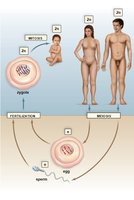
Humans produce sperm and eggs via meiosis. Fertilization forms a diploid zygote, which undergoes mitosis to become a multicellular embryo. All somatic cells have the same chromosome number and genetic makeup as the zygote.
Spermatogenesis and Oogenesis
In humans:
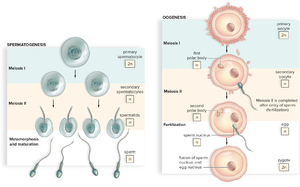
Spermatogenesis: Stem cells (spermatogonia) produce primary spermatocytes, which undergo meiosis to form four sperm.
Oogenesis: Stem cells (oogonia) produce primary oocytes, which undergo meiosis to form one egg and polar bodies.
Changes in Chromosome Number and Structure
Aneuploidy and Nondisjunction
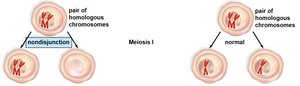
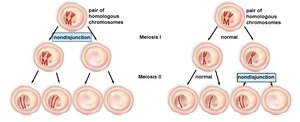
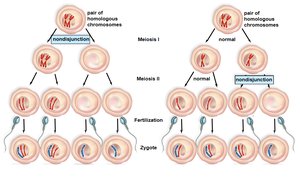
Meiosis usually produces gametes with the correct chromosome number (euploidy). Aneuploidy results from nondisjunction, leading to monosomy (one chromosome) or trisomy (three chromosomes). Karyotypes are used to detect these abnormalities.
Trisomies
Trisomy occurs when an individual has three of a particular chromosome. Trisomy 21 (Down syndrome) is the most common autosomal trisomy, characterized by distinct physical features and increased risk with maternal age.
Changes in Sex Chromosome Number
Abnormal numbers of sex chromosomes result from nondisjunction. Examples include Turner syndrome (XO) and Klinefelter syndrome (XXY). The presence of a Y chromosome determines maleness, and deletion of the SRY gene can result in XY females.
Changes in Chromosome Structure
Chromosome breakage can lead to mutations:
Deletion: Loss of a chromosome segment.
Duplication: Repetition of a segment.
Translocation: Segment moves to a nonhomologous chromosome.
Inversion: Segment is reversed within the chromosome.
Deletion and Translocation Syndromes
Examples include Williams syndrome (deletion of chromosome 7) and chronic myeloid leukemia (translocation between chromosomes 22 and 9).
Summary Table: Types of Chromosomal Mutations
Type | Description | Example |
|---|---|---|
Deletion | Loss of chromosome segment | Williams syndrome |
Duplication | Repeated segment | Charcot-Marie-Tooth disease |
Inversion | Segment reversed | Hemophilia A (sometimes) |
Translocation | Segment moved to another chromosome | Chronic myeloid leukemia |
Key Equations
Possible chromosome combinations: (where n = number of chromosome pairs)
Human combinations:
Conclusion
Meiosis is fundamental to sexual reproduction, genetic diversity, and the maintenance of chromosome number across generations. Understanding its phases, mechanisms of variation, and consequences of errors is essential for studying genetics and evolution.
