 Indietro
Meiosis and Sexual Reproduction: Study Notes for General Biology
Guida di studio - Note intelligenti
 Appunti personalizzati basati sui tuoi materiali, ampliati con definizioni chiave, esempi e contesto.
Meiosis and Sexual Reproduction
Heredity and Genetic Concepts
Heredity is the process by which traits are passed from one generation to the next, primarily through reproduction. Traits are genetically determined characteristics encoded by genes, which are segments of DNA located at specific positions (loci) on chromosomes.
Heredity: Transmission of traits from parents to offspring.
Trait: A characteristic determined by genes.
Gene: The basic unit of heredity, composed of DNA.
Locus: The specific location of a gene on a chromosome.
Asexual vs. Sexual Reproduction
Organisms reproduce either asexually or sexually. Asexual reproduction involves a single parent and produces genetically identical offspring (clones). Sexual reproduction involves two parents, resulting in offspring with genetic combinations from both.
Asexual reproduction: Offspring are clones of the parent.
Sexual reproduction: Offspring inherit a mix of genes from both parents.
Chromosome Sets: Diploid and Haploid States
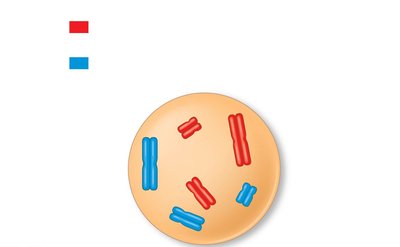
Sexually reproducing organisms alternate between diploid (2n) and haploid (n) states. Diploid cells contain two sets of chromosomes (one from each parent), while haploid cells (gametes) contain a single set.
Diploid (2n): Two sets of chromosomes.
Haploid (n): One set of chromosomes.
Gamete: A haploid cell (egg or sperm) involved in fertilization.
Human Life Cycle and Fertilization
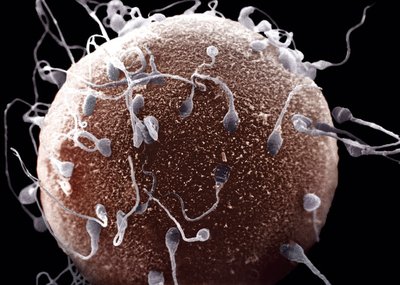
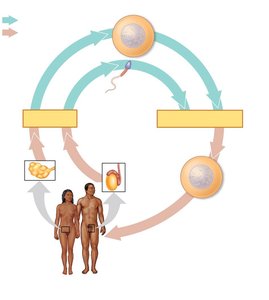
Humans undergo a life cycle involving meiosis and fertilization. Meiosis produces haploid gametes (egg and sperm), which fuse during fertilization to form a diploid zygote. The zygote undergoes mitosis to develop into a multicellular diploid adult.
Meiosis: Reduces chromosome number from diploid to haploid.
Fertilization: Fusion of haploid gametes to restore diploid state.
Zygote: The first diploid cell formed after fertilization.
Variety of Sexual Life Cycles
Different organisms exhibit diverse sexual life cycles, including those of animals, plants, fungi, and protists. These cycles involve alternation between haploid and diploid stages, with meiosis and fertilization as key events.
Animal life cycle: Diploid adults produce haploid gametes via meiosis.
Plant and algae life cycle: Alternation of generations between diploid sporophyte and haploid gametophyte.
Fungi and protist life cycle: Haploid adults produce gametes; zygote is the only diploid stage.
Meiosis: Process and Phases
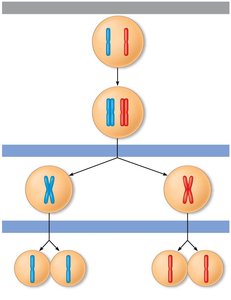
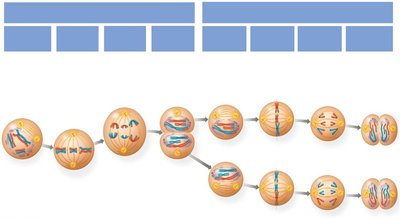
Meiosis is a two-part cell division process that reduces chromosome number from diploid to haploid. It consists of Meiosis I (separates homologous chromosomes) and Meiosis II (separates sister chromatids).
Meiosis I: Homologous chromosomes are separated.
Meiosis II: Sister chromatids are separated.
Interphase: Chromosomes duplicate before meiosis begins.
Phases of Meiosis I
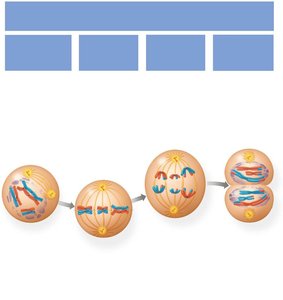
Meiosis I consists of four phases: Prophase I, Metaphase I, Anaphase I, and Telophase I (with cytokinesis). Unique events include crossing over and pairing of homologous chromosomes.
Prophase I: Homologous chromosomes pair and exchange genetic material (crossing over).
Metaphase I: Homologous pairs align at the metaphase plate.
Anaphase I: Homologous chromosomes separate.
Telophase I and cytokinesis: Cells divide, forming haploid cells with duplicated chromosomes.
Phases of Meiosis II
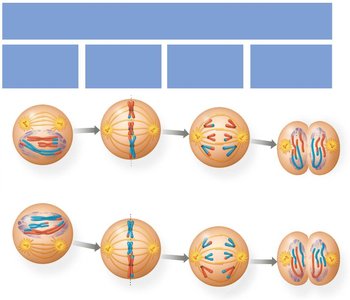
Meiosis II also consists of four phases: Prophase II, Metaphase II, Anaphase II, and Telophase II (with cytokinesis). This division separates sister chromatids, resulting in haploid cells with unduplicated chromosomes.
Prophase II: Chromosomes condense in haploid cells.
Metaphase II: Chromosomes align at the metaphase plate.
Anaphase II: Sister chromatids separate.
Telophase II and cytokinesis: Four haploid cells are formed.
Unique Events in Meiosis
Meiosis includes events not found in mitosis, such as crossing over, pairing of homologous chromosomes, and separation of homologs (not sister chromatids) in Meiosis I.
Crossing over: Exchange of genetic material between homologous chromosomes during Prophase I.
Homologous chromosome pairing: Homologs align at the metaphase plate in Metaphase I.
Homolog separation: Homologous chromosomes are separated in Anaphase I.
Genetic Variation in Sexual Reproduction
Sexual reproduction increases genetic variation among offspring through three mechanisms: independent assortment, crossing over, and random fertilization.
Independent assortment: Chromosome pairs are sorted independently during meiosis.
Crossing over: Recombinant chromosomes are formed by exchanging DNA between homologs.
Random fertilization: Any sperm can fuse with any egg, increasing genetic diversity.
Comparison of Mitosis and Meiosis
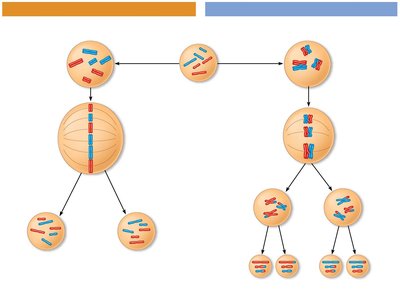
Mitosis and meiosis are distinct processes. Mitosis produces two genetically identical diploid cells, while meiosis produces four genetically unique haploid cells.
Mitosis: One division, produces identical cells.
Meiosis: Two divisions, produces genetically diverse cells.
Fungal Life Cycle: Sordaria fimicola
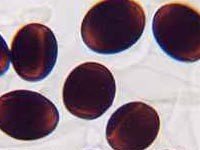
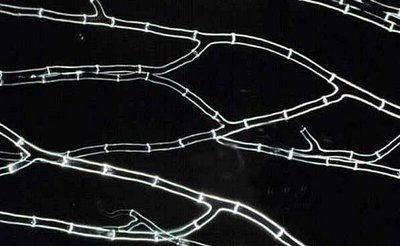
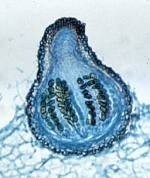
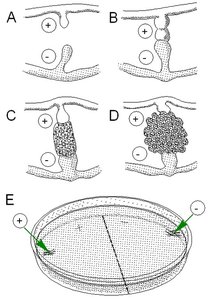
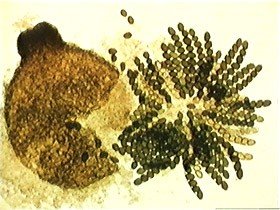
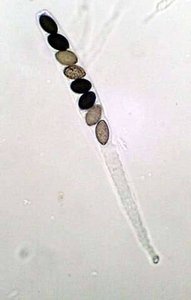
Sordaria fimicola, a fungus, demonstrates a life cycle involving haploid hyphae, mating to form diploid zygotes, and production of ascospores within asci.
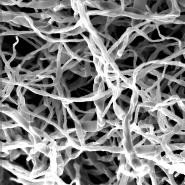
Hyphae/mycelium: Haploid structures.
Mating: Fusion of haploid cells to form diploid zygotes.
Ascospore: Haploid spores produced after meiosis.
Perithecium: Structure containing asci and ascospores.
Summary Table: Comparison of Asexual and Sexual Reproduction
Feature | Asexual Reproduction | Sexual Reproduction |
|---|---|---|
Number of Parents | One | Two |
Genetic Variation | None (clones) | High (mix of genes) |
Cell Division | Mitosis | Meiosis |
Offspring | Identical to parent | Genetically unique |
Summary Table: Phases of Meiosis
Phase | Meiosis I | Meiosis II |
|---|---|---|
Prophase | Homologs pair, crossing over | Chromosomes condense |
Metaphase | Homologs align at plate | Chromosomes align at plate |
Anaphase | Homologs separate | Sister chromatids separate |
Telophase & Cytokinesis | Two haploid cells form | Four haploid cells form |
Key Equations
Chromosome number reduction:
Genetic variation (independent assortment):
possible combinations, where n = number of chromosome pairs
*Additional info: Academic context was added to clarify the fungal life cycle and to expand on the mechanisms of genetic variation.*
----------------------------------------
