 Indietro
Chapter 13
Guida di studio - Note intelligenti
 Appunti personalizzati basati sui tuoi materiali, ampliati con definizioni chiave, esempi e contesto.
Meiosis and Chromosome Behavior
Heredity, Genes, and Chromosomes
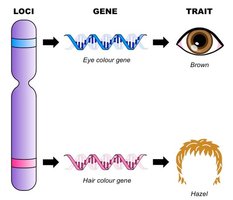
Heredity is the transmission of traits from one generation to the next, while variation refers to differences in appearance among offspring. Genes are units of heredity made up of DNA segments, located at specific positions called loci on chromosomes. Genes are passed to offspring via gametes (sperm and eggs), which contain a single set of chromosomes.
Gene: Segment of DNA coding for a specific trait.
Locus: Physical location of a gene on a chromosome.
Trait: Observable characteristic determined by gene expression.
Gametes: Reproductive cells (sperm and egg) with 23 chromosomes in humans.
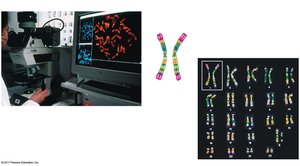
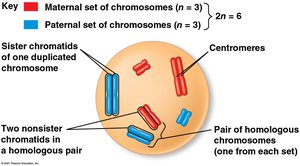
Chromosome Sets in Human Cells
Humans have 46 chromosomes in somatic cells, organized as 23 pairs of homologous chromosomes. Each pair consists of one chromosome from each parent. Chromosomes in a homologous pair have the same length, centromere position, and carry genes for the same traits.
Diploid (2n): Two sets of chromosomes (46 in humans).
Haploid (n): One set of chromosomes (23 in humans).
Autosomes: Non-sex chromosomes (22 pairs).
Sex chromosomes: X and Y chromosomes (1 pair).
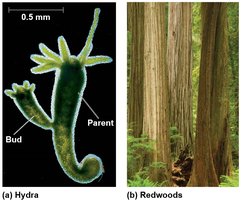
Comparison of Asexual and Sexual Reproduction
Asexual reproduction involves a single parent and produces genetically identical offspring (clones). Sexual reproduction involves two parents and results in offspring with unique gene combinations.
Asexual reproduction: No fusion of gametes; offspring are clones.
Sexual reproduction: Fusion of gametes; offspring have genetic variation.
Sexual Life Cycles and Alternation of Generations
Human Life Cycle
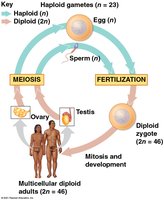
In humans, meiosis produces haploid gametes, which fuse during fertilization to form a diploid zygote. The zygote undergoes mitosis to develop into a multicellular adult.
Meiosis: Produces haploid gametes (n).
Fertilization: Fusion of gametes restores diploid state (2n).
Mitosis: Growth and development of multicellular diploid adults.
Alternation of Generations
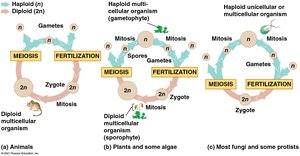
Some organisms, such as plants and algae, exhibit alternation of generations, with both diploid (sporophyte) and haploid (gametophyte) multicellular stages. Fungi and some protists have different life cycles, often with multicellular haploid stages.
Sporophyte: Diploid stage producing haploid spores by meiosis.
Gametophyte: Haploid stage producing gametes by mitosis.
Meiosis: Process and Phases
Overview of Meiosis
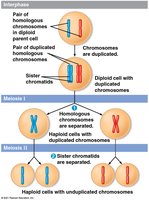
Meiosis consists of two consecutive divisions: meiosis I and meiosis II. It results in four haploid daughter cells, each genetically distinct from the parent cell.
Meiosis I: Homologous chromosomes separate.
Meiosis II: Sister chromatids separate.
Meiosis I: Separating Homologous Chromosomes
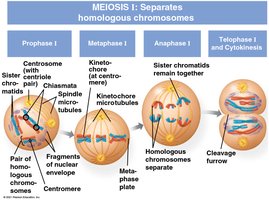
Meiosis I includes four phases: prophase I, metaphase I, anaphase I, and telophase I. Homologous chromosomes pair, undergo crossing over, align at the metaphase plate, and then separate.
Prophase I: Homologous chromosomes pair and crossing over occurs.
Metaphase I: Homologous pairs align at the metaphase plate.
Anaphase I: Homologous chromosomes separate.
Telophase I and Cytokinesis: Two haploid cells form.
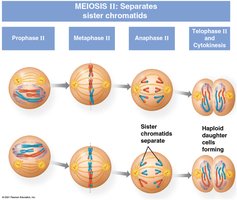
Meiosis II: Separating Sister Chromatids
Meiosis II also includes four phases: prophase II, metaphase II, anaphase II, and telophase II. Sister chromatids are separated, resulting in four haploid cells.
Prophase II: Spindle forms, chromatids move to metaphase plate.
Metaphase II: Chromatids align at metaphase plate.
Anaphase II: Sister chromatids separate.
Telophase II and Cytokinesis: Four haploid cells form.
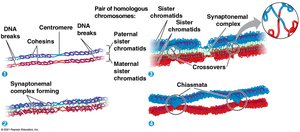
Crossing Over and Synapsis
During prophase I, homologous chromosomes undergo synapsis and crossing over, exchanging genetic material. This process increases genetic variation among offspring.
Synaptonemal complex: Structure holding homologs together.
Chiasmata: Sites of crossing over.
Cohesins: Proteins holding sister chromatids together.
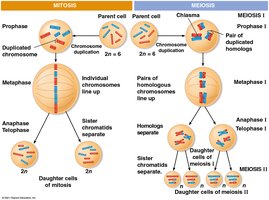
Comparison of Mitosis and Meiosis
Key Differences
Mitosis produces two genetically identical diploid cells, while meiosis produces four genetically distinct haploid cells. Meiosis involves unique events: synapsis and crossing over, alignment of homologous pairs, and separation of homologs.
Mitosis: Conserves chromosome number; produces identical cells.
Meiosis: Reduces chromosome number; produces genetically diverse cells.
Unique to meiosis: Synapsis/crossing over, homologous pair alignment, homolog separation.
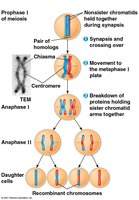
Genetic Variation in Sexual Life Cycles
Mechanisms of Genetic Variation
Genetic variation arises from mutations, independent assortment, crossing over, and random fertilization. These mechanisms ensure diversity among offspring and contribute to evolution.
Mutation: Original source of genetic diversity.
Independent assortment: Random orientation of homologous pairs during meiosis I.
Crossing over: Exchange of genetic material between homologs.
Random fertilization: Any sperm can fuse with any egg, increasing possible combinations.
Independent Assortment Formula
The number of possible chromosome combinations due to independent assortment is given by:
Where n is the haploid number. For humans, , so there are more than 8 million possible combinations.
Summary Table: Comparison of Mitosis and Meiosis
Feature | Mitosis | Meiosis |
|---|---|---|
Number of divisions | 1 | 2 |
Number of daughter cells | 2 | 4 |
Chromosome number in daughter cells | Diploid (2n) | Haploid (n) |
Genetic identity | Identical to parent | Genetically unique |
Role | Growth, repair | Gamete production |
Key Questions for Review
How many pairs of chromosomes are in a human cell?
What are the different alternation of generations?
What happens in each step of meiosis I and II?
What allows for genetic variation in meiosis?
What happens in meiosis I that doesn’t happen in meiosis II?
What are the major differences between mitosis and meiosis?
Additional info: These notes expand on brief points with academic context, definitions, and examples to ensure completeness and clarity for exam preparation.
