 Indietro
Meiosis: Mechanisms and Genetic Variation
Guida di studio - Note intelligenti
 Appunti personalizzati basati sui tuoi materiali, ampliati con definizioni chiave, esempi e contesto.
Meiosis: Mechanisms and Genetic Variation
Genes and Alleles
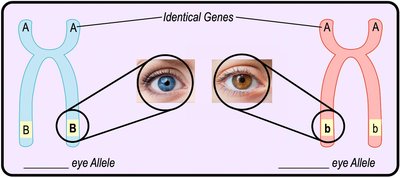
Genes are segments of DNA that encode proteins, which may result in the expression of specific traits. Alleles are alternative versions of a gene that can produce variations in a trait, such as eye color. Alleles are typically represented by capital and lowercase letters (e.g., B = blue eyes, b = brown eyes).
Gene: A sequence of DNA that codes for a protein or functional RNA.
Allele: A variant form of a gene at a particular locus on a chromosome.
Example: The gene for eye color may have a blue allele (B) and a brown allele (b).
Haploid vs. Diploid Cells
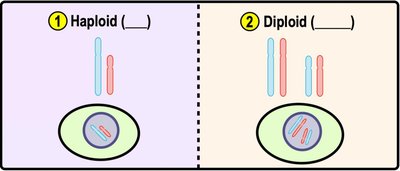
Cell ploidy refers to the number of sets of chromosomes in a cell. Organisms alternate between haploid (n) and diploid (2n) stages in their life cycles.
Haploid (n): One complete set of chromosomes (e.g., gametes such as sperm and egg).
Diploid (2n): Two complete sets of chromosomes, one from each parent (e.g., somatic cells).
Example: Human somatic cells are diploid (2n = 46), while gametes are haploid (n = 23).
Homologous Chromosomes and Karyotypes
Chromosome Structure and Karyotypes
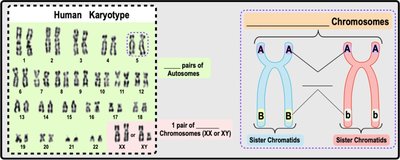
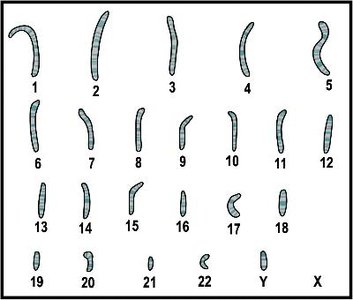
A karyotype is an ordered display of all chromosomes in a cell. Human somatic cells contain 23 pairs of chromosomes (46 total): 22 pairs of autosomes and 1 pair of sex chromosomes (XX or XY). Homologous chromosomes are similar in size and shape and carry the same genes, but may have different alleles.
Autosomes: Non-sex chromosomes found in both males and females.
Sex Chromosomes: X and Y chromosomes that determine the sex of the organism.
Homologous Chromosomes: Chromosome pairs with the same genes but possibly different alleles; one inherited from each parent.
Life Cycle of Sexual Reproducers
Overview of the Sexual Life Cycle
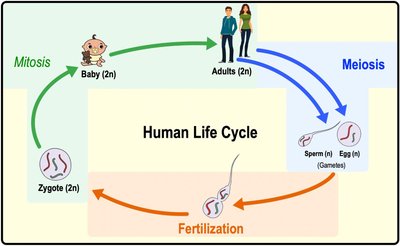
The life cycle of sexually reproducing organisms includes both mitosis and meiosis. Meiosis produces haploid gametes (sperm or egg), and fertilization merges these gametes to form a diploid zygote, which then grows by mitosis.
Gametes: Haploid reproductive cells (sperm and egg).
Fertilization: Fusion of gametes to form a diploid zygote.
Zygote: The first diploid cell of a new organism.
Introduction to Meiosis
Phases and Purpose of Meiosis
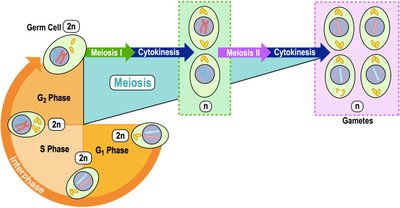
Before meiosis, a diploid cell replicates its DNA during interphase. Meiosis starts with a diploid germ cell and ends with four genetically diverse haploid gametes. Germ cells are the precursors to gametes.
Meiosis: Specialized cell division that reduces chromosome number by half, producing four haploid cells.
Germ Cells: Diploid cells that undergo meiosis to produce gametes.
Stages of Meiosis
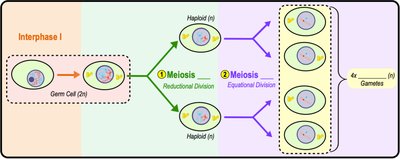
Meiosis consists of two sequential divisions:
Meiosis I (Reductional Division): Homologous chromosomes are separated, reducing the chromosome number by half.
Meiosis II (Equational Division): Sister chromatids are separated, similar to mitosis, resulting in four haploid gametes.
Detailed Steps of Meiosis
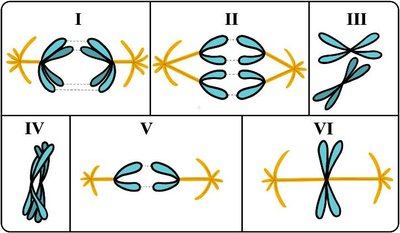
Meiosis I
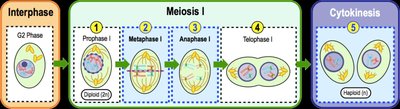
Meiosis I is similar to mitosis but differs in key ways:
Prophase I: Homologous chromosomes pair and exchange genetic material (crossing over).
Metaphase I: Homologous pairs align in two rows at the cell's equator.
Anaphase I: Homologous chromosomes are separated, but sister chromatids remain attached.
Telophase I and Cytokinesis: Two haploid cells are produced.
Meiosis II
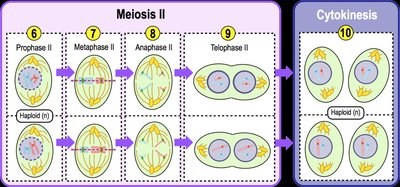
Meiosis II is similar to mitosis. Each haploid cell from Meiosis I divides again:
Metaphase II: Chromosomes align in a single row at the equator.
Anaphase II: Sister chromatids are separated.
Result: Four genetically diverse haploid gametes are produced.
Genetic Variation During Meiosis
Crossing Over
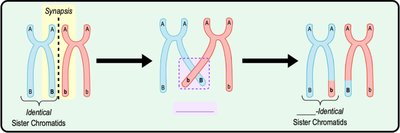
Genetic diversity is generated during meiosis by two main mechanisms. Crossing over occurs during Prophase I, where homologous chromosomes exchange genetic material at points called chiasmata. This results in new combinations of alleles on each chromosome.
Synapsis: Homologous chromosomes pair up and align gene by gene.
Chiasma: The site where crossing over occurs.
Independent Assortment
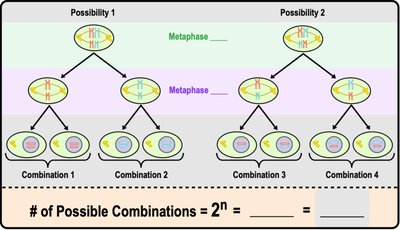
During Metaphase I, homologous chromosome pairs align independently at the metaphase plate. This independent assortment leads to a large number of possible genetic combinations in gametes. The number of possible combinations is given by:
(where n = haploid number of chromosomes)
Example: For humans (n = 23), the number of possible combinations is .
Nondisjunction
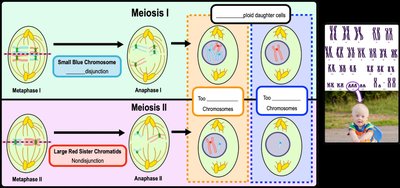
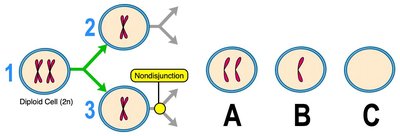
Nondisjunction is an error in meiosis when chromosomes fail to separate properly, resulting in gametes with abnormal numbers of chromosomes (aneuploidy). This can lead to genetic disorders such as Down syndrome (trisomy 21).
Aneuploid Cells: Cells with too many or too few chromosomes.
Example: Nondisjunction during Anaphase I or II can produce gametes with extra or missing chromosomes.
Mitosis vs. Meiosis
Comparison of Mitosis and Meiosis
Mitosis and meiosis share some similarities but have key differences:
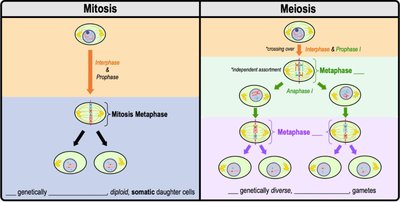
Mitosis: Produces two genetically identical diploid somatic cells for growth and repair.
Meiosis: Produces four genetically diverse haploid gametes for sexual reproduction.
Reductional Division: Meiosis I reduces chromosome number by half.
Equational Division: Mitosis and Meiosis II maintain chromosome number in daughter cells.
Additional info: Genetic variation produced by meiosis is essential for evolution and adaptation in sexually reproducing populations.
