 Indietro
Meiosis: Mechanisms, Genetic Variation, and Errors
Guida di studio - Note intelligenti
 Appunti personalizzati basati sui tuoi materiali, ampliati con definizioni chiave, esempi e contesto.
Meiosis: The Basis of Sexual Reproduction
Introduction to Meiosis
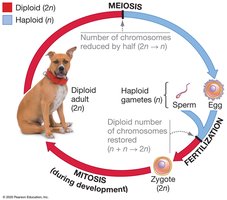
Meiosis is a specialized type of nuclear division that reduces the chromosome number by half, producing gametes (sperm and egg) for sexual reproduction. This ensures that upon fertilization, the offspring have the correct chromosome number.
Gametes are reproductive cells that unite during fertilization.
Meiosis halves the chromosome number, restoring it at fertilization.
Fertilization combines two haploid gametes to form a diploid zygote.
Chromosome Types and Structure
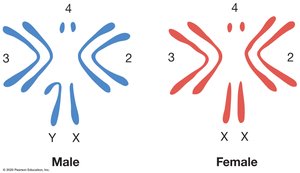
Chromosomes are thread-like structures carrying genetic information. They come in distinct sizes and shapes, and are classified as sex chromosomes or autosomes.
Sex chromosomes determine the sex of an individual (e.g., XX for females, XY for males).
Autosomes are non-sex chromosomes.
Homologous Chromosomes and Alleles
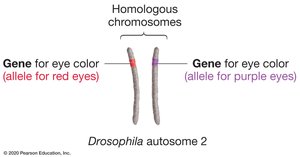
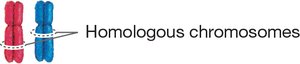
Homologous chromosomes are pairs of chromosomes containing the same genes at the same loci, but may carry different alleles (versions of a gene).
Homologs are chromosomes of the same type.
Alleles are different versions of a gene.
Homologs may contain different alleles, influencing traits.
The Concept of Ploidy
Ploidy refers to the number of sets of chromosomes in a cell. Organisms can be haploid, diploid, or polyploid.
Haploid (n): One set of chromosomes (e.g., gametes).
Diploid (2n): Two sets of chromosomes (e.g., somatic cells in humans).
Polyploid (3n, 4n, etc.): More than two sets of chromosomes.
Karyotype: The number and types of chromosomes present in a species.
Chromosome Replication and Structure
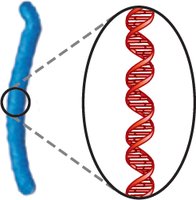
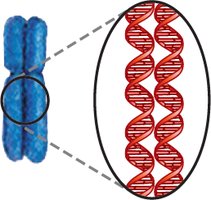
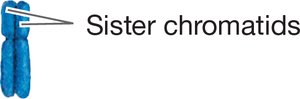
Before meiosis, chromosomes are replicated, forming sister chromatids. These chromatids remain attached until separated during cell division.
Sister chromatids: Identical copies of a chromosome, attached at the centromere.
Homologous chromosomes: Chromosome pairs, one from each parent.
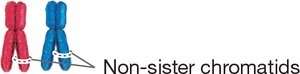
Non-sister chromatids: Chromatids from different homologs.
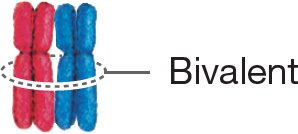
Bivalent: Structure formed by synapsis of homologous chromosomes.
An Overview of Meiosis
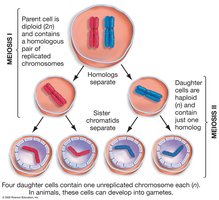
Meiosis consists of two consecutive cell divisions: Meiosis I and Meiosis II. Each division has distinct phases and outcomes.
Meiosis I: Homologous chromosomes separate, reducing chromosome number by half.
Meiosis II: Sister chromatids separate, producing four haploid cells.
Each diploid cell gives rise to four haploid cells.
Meiosis as a Reduction Division
Meiosis I is called a reduction division because it reduces the chromosome number from diploid to haploid. Fertilization restores the diploid state.
Gametes are haploid; zygote is diploid.
Each individual inherits one chromosome set from each parent.
The Phases of Meiosis I
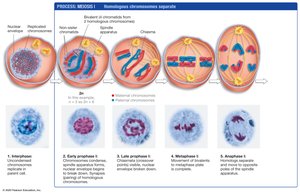
Meiosis I is a continuous process with five distinct phases:
Early Prophase I: Nuclear envelope breaks down, chromosomes condense, homologs pair (synapsis), forming bivalents.
Late Prophase I: Homologs attach to spindle microtubules, separate but remain joined at chiasmata (sites of crossing over).
Metaphase I: Paired homologs align at the metaphase plate, alignment is random.
Anaphase I: Homologs separate and migrate to opposite poles.
Telophase I: Homologs finish migrating, cell divides (cytokinesis).
The Phases of Meiosis II
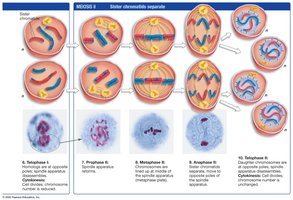
Meiosis II resembles mitosis and consists of four phases:
Prophase II: Chromosomes condense, spindle forms.
Metaphase II: Chromosomes align at the metaphase plate.
Anaphase II: Sister chromatids separate.
Telophase II: Chromatids reach poles, cell divides.
Meiosis vs. Mitosis
Meiosis and mitosis are distinct processes with different outcomes.
Meiosis: Homologs pair and separate, resulting in four genetically distinct haploid cells.
Mitosis: Produces two genetically identical diploid cells.
Meiosis introduces genetic diversity; mitosis maintains genetic stability.
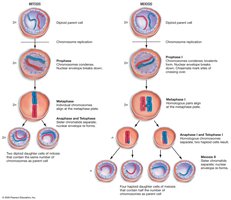
Feature | Mitosis | Meiosis |
|---|---|---|
Number of divisions | 1 | 2 |
Number of daughter cells | 2 | 4 |
Chromosome number | Diploid (2n) | Haploid (n) |
Genetic identity | Identical | Unique |
Homolog pairing | No | Yes |
Meiosis Promotes Genetic Variation
Sources of Genetic Variation
Meiosis and fertilization generate genetic diversity among offspring.
Independent assortment: Random alignment of homologs during metaphase I.
Crossing over: Exchange of genetic material between non-sister chromatids at chiasmata.
Fertilization: Combines unique haploid sets from each parent.
Asexual reproduction: Produces clones; sexual reproduction: Produces genetically unique offspring.
Errors in Meiosis
Nondisjunction and Chromosome Abnormalities
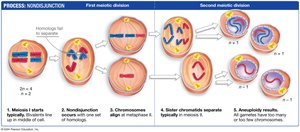
Errors during meiosis, such as nondisjunction, can lead to gametes with abnormal chromosome numbers. This is a common cause of genetic disorders.
Nondisjunction: Failure of homologs or sister chromatids to separate properly.
Aneuploidy: Gametes with too many or too few chromosomes.
Down syndrome: Caused by trisomy 21 (an extra copy of chromosome 21).
Summary Table: Key Terms for Chromosomes
Term | Definition |
|---|---|
Homologous chromosomes | Chromosome pairs with the same genes, one from each parent |
Sister chromatids | Identical copies of a chromosome, attached at the centromere |
Bivalent | Structure formed by synapsis of homologs during meiosis I |
Allele | Different version of a gene |
Ploidy | Number of chromosome sets in a cell (n, 2n, 3n, etc.) |
Nondisjunction | Failure of chromosomes to separate properly during meiosis |
Equations and Formulas
Diploid chromosome number:
Haploid chromosome number:
Restoration of chromosome number at fertilization:
Conclusion
Meiosis is essential for sexual reproduction, ensuring genetic diversity and proper chromosome number in offspring. Errors in meiosis can lead to genetic disorders, highlighting its biological significance.
