 Indietro
Membrane Potential and Action Potential in Neurons
Guida di studio - Note intelligenti
 Appunti personalizzati basati sui tuoi materiali, ampliati con definizioni chiave, esempi e contesto.
Membrane Potential and Ion Movement
Establishing Membrane Potential
The membrane potential is the electrical potential difference across the cell membrane, primarily established by the distribution of ions such as potassium (K+) and sodium (Na+). This potential is crucial for the function of excitable cells like neurons.
Resting Membrane Potential: Typically around -70 mV, maintained by selective permeability to K+ and the activity of the sodium-potassium pump.
Ion Distribution: High concentration of K+ inside the cell and high concentration of Na+ outside the cell.
Selective Permeability: The membrane is more permeable to K+ than to Na+ or Cl-, allowing K+ to move out, making the inside more negative.
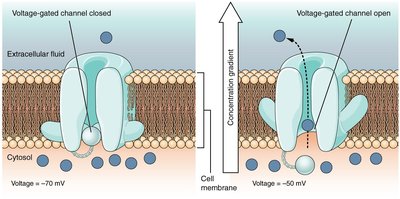
Voltage-Gated Channels
Voltage-Gated K+ Channels
Voltage-gated potassium channels are essential for repolarizing the membrane after an action potential. They exist in two states: open and closed.
Open State: Allows K+ to flow out of the cell, restoring negative membrane potential.
Closed State: Prevents K+ movement, maintaining resting potential.
Voltage-Gated Na+ Channels
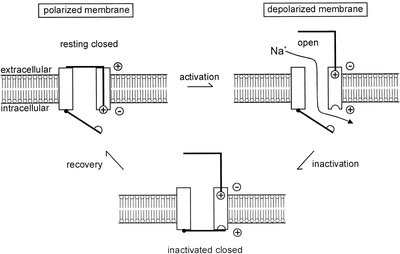
Sodium channels have three states: closed, open, and inactivated. Their transitions are critical for the initiation and propagation of action potentials.
Closed (Resting): Channel is not allowing Na+ to pass.
Open (Activated): Channel opens in response to depolarization, allowing Na+ influx.
Inactivated: Channel temporarily cannot open, ensuring unidirectional propagation of the action potential.
Action Potential
Initiation and Propagation
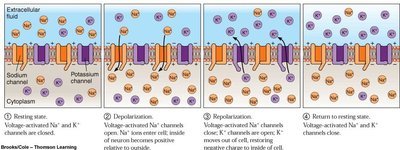
The action potential is a rapid change in membrane potential that travels along the neuron. It is initiated by depolarization, which opens voltage-gated Na+ channels.
Depolarization: Na+ channels open, Na+ enters, membrane potential becomes positive.
Repolarization: K+ channels open, K+ exits, membrane potential returns to negative.
Refractory Period: Na+ channels inactivate, preventing immediate reactivation.
Transmission Across Synapse
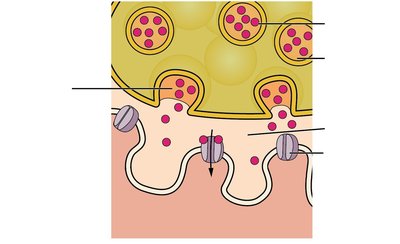
Neurotransmitters are released from synaptic vesicles into the synaptic cleft, binding to ligand-gated channels on the postsynaptic membrane, triggering a new action potential.
Synaptic Vesicle: Contains neurotransmitter molecules.
Exocytosis: Vesicles fuse with membrane, releasing contents.
Ligand-Gated Channels: Open in response to neurotransmitter binding, allowing ion flow.
Conduction of Action Potential
Propagation Along the Axon
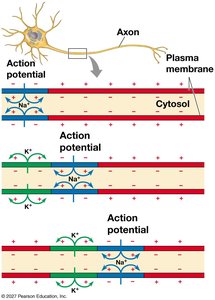
The action potential moves as a wave of depolarization along the axon, with Na+ and K+ channels opening sequentially.
Unidirectional Propagation: Due to refractory period, action potential moves in one direction.
Local Current: Depolarization at one segment triggers the next.
Myelination and Saltatory Conduction
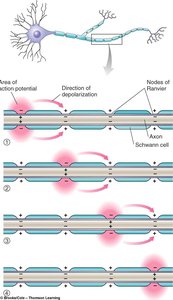
Myelination increases the speed of action potential propagation by insulating the axon and forcing the action potential to jump between nodes of Ranvier (saltatory conduction).
Schwann Cells: Form myelin sheath around axons.
Nodes of Ranvier: Gaps in myelin where ion channels are concentrated.
Saltatory Conduction: Action potential jumps from node to node, increasing velocity.
Summary Table: States of Voltage-Gated Channels
Channel Type | States | Function |
|---|---|---|
Na+ Channel | Closed, Open, Inactivated | Initiates and propagates action potential |
K+ Channel | Open, Closed | Restores resting potential |
Key Equations
Nernst Equation
The Nernst equation calculates the equilibrium potential for a particular ion: Where:
E: Equilibrium potential
R: Gas constant
T: Temperature (Kelvin)
z: Ion charge
F: Faraday's constant
Resting Membrane Potential
The Goldman-Hodgkin-Katz equation considers multiple ions: Where:
Vm: Membrane potential
P: Permeability of each ion
Additional info:
These notes expand on the original content by providing definitions, context, and equations relevant to membrane potential and action potential.
Images included are directly relevant to the explanation of voltage-gated channels, synaptic transmission, action potential propagation, and myelination.
