 Indietro
Membrane Structure and Function: Study Guide for General Biology
Guida di studio - Note intelligenti
 Appunti personalizzati basati sui tuoi materiali, ampliati con definizioni chiave, esempi e contesto.
Membrane Structure and Function
Overview of Cellular Membranes
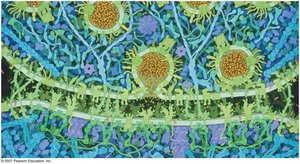
Cellular membranes are essential structures that separate the internal environment of the cell from the external surroundings. They are composed primarily of lipids and proteins, forming a dynamic and selectively permeable barrier.
Fluid Mosaic Model: Describes the membrane as a mosaic of protein molecules bobbing in a fluid bilayer of phospholipids.
Selective Permeability: Membranes allow certain substances to cross more easily than others, regulating molecular traffic.
Phospholipids and Amphipathic Nature
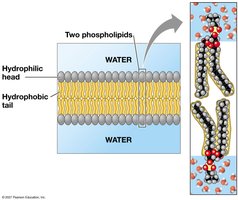
Phospholipids are the main constituents of cell membranes and are amphipathic molecules, meaning they have both hydrophilic (water-loving) and hydrophobic (water-fearing) regions.
Hydrophilic Head: Faces outward toward water.
Hydrophobic Tail: Faces inward, away from water.
Bilayer Formation: In water, phospholipids spontaneously form a bilayer with tails inside and heads outside.
Fluidity of Membranes
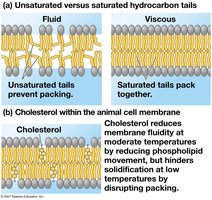
The fluidity of the cell membrane is crucial for its function and is influenced by temperature and lipid composition.
Unsaturated Hydrocarbon Tails: Prevent packing, increasing fluidity.
Saturated Hydrocarbon Tails: Pack together, making the membrane more viscous.
Cholesterol: Reduces membrane fluidity at moderate temperatures by restricting phospholipid movement, but prevents solidification at low temperatures by disrupting packing.
Adaptive Differences in Membrane Lipid Composition
Organisms adapt their membrane lipid composition to environmental conditions.
Cold Environments: High proportion of unsaturated hydrocarbon tails (e.g., fish in extreme cold).
Variable Temperatures: Plants like winter wheat increase unsaturated phospholipids in autumn to prevent membrane solidification.
Membrane Proteins: Types and Functions
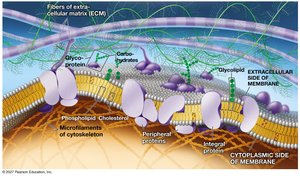
Membrane proteins are embedded within the lipid bilayer and perform a variety of functions.
Peripheral Proteins: Bound to the surface of the membrane.
Integral Proteins: Penetrate the hydrophobic core; transmembrane proteins span the membrane.
Attachment: Some proteins are held in place by the cytoskeleton or extracellular matrix (ECM).
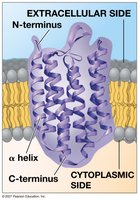
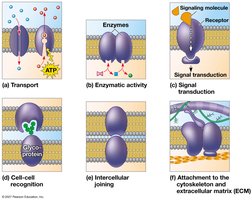
Six Major Functions of Membrane Proteins:
Transport
Enzymatic activity
Signal transduction
Cell-cell recognition
Intercellular joining
Attachment to cytoskeleton and ECM
Membrane Carbohydrates and Cell-Cell Recognition
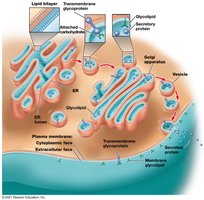
Cells recognize each other by binding to molecules on the membrane surface, many of which are carbohydrates bonded to lipids (glycolipids) or proteins (glycoproteins).
Glycoproteins: Carbohydrates bonded to proteins.
Glycolipids: Carbohydrates bonded to lipids.
Role: Important in cell-cell recognition and immune response.
Membrane Sidedness
Membranes have distinct inside and outside faces, which arise during their assembly in the endoplasmic reticulum (ER) and Golgi apparatus.
Assembly: Carbohydrates are added to proteins and lipids in the ER and Golgi, determining membrane sidedness.
Traffic Across Membranes
Permeability of the Lipid Bilayer
The lipid bilayer is selectively permeable, allowing hydrophobic molecules to pass rapidly while impeding hydrophilic molecules.
Hydrophobic Molecules: (e.g., hydrocarbons) dissolve in the bilayer and cross easily.
Hydrophilic Molecules: (e.g., sugars, water, ions) pass slowly or require transport proteins.
Transport Proteins
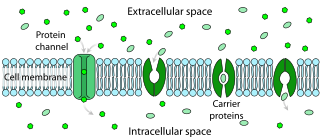
Transport proteins facilitate the movement of hydrophilic substances across the membrane.
Channel Proteins: Provide hydrophilic channels for molecules or ions.
Carrier Proteins: Bind to molecules and change shape to shuttle them across.
Diffusion and Passive Transport
Diffusion is the movement of particles so they spread out evenly into available space, moving down their concentration gradient.
Passive Transport: Diffusion across a membrane without energy investment.
Potential Energy: The concentration gradient represents potential energy that drives diffusion.
Osmosis and Water Balance
Osmosis is the diffusion of free water across a selectively permeable membrane. Tonicity describes the ability of a solution to cause a cell to gain or lose water.
Isotonic Solution: Solute concentration is equal inside and outside the cell; no net water movement.
Hypertonic Solution: Solute concentration is higher outside; cell loses water.
Hypotonic Solution: Solute concentration is lower outside; cell gains water.
Facilitated Diffusion
Facilitated diffusion is passive transport aided by proteins, allowing molecules to move down their concentration gradient without energy input.
Channel Proteins: Provide corridors for specific molecules or ions.
Aquaporins: Facilitate water diffusion.
Ion Channels: Facilitate ion transport; some are gated and respond to stimuli.
Carrier Proteins: Undergo shape changes to move solutes across the membrane.
Active Transport
Active transport uses energy, usually from ATP hydrolysis, to move substances against their concentration gradients.
Carrier Proteins: All proteins involved in active transport are carrier proteins.
Example: Sodium-potassium pump moves Na+ out and K+ in, maintaining membrane potential.
Electrochemical Gradient and Electrogenic Pumps
The electrochemical gradient drives ion diffusion across membranes, combining chemical and electrical forces.
Electrogenic Pump: Generates voltage across a membrane, storing energy for cellular work.
Examples: Sodium-potassium pump (animals), proton pump (plants, fungi, bacteria).
Cotransport
Cotransport is the coupled transport of two substances by a membrane protein, where the downhill diffusion of one solute drives the uphill transport of another.
Example: Na+/K+ pump cotransports glucose into animal cells.
Bulk Transport: Exocytosis and Endocytosis
Large molecules cross the membrane in bulk via vesicles.
Exocytosis: Transport vesicles fuse with the membrane and release contents outside the cell.
Endocytosis: Macromolecules are taken into the cell in vesicles.
Phagocytosis: Cell engulfs particles by extending pseudopodia.
Pinocytosis: Cell "gulps" extracellular fluid into vesicles.
Receptor-Mediated Endocytosis: Vesicle formation triggered by solute binding to receptors.
Summary Table: Types of Membrane Transport
Transport Type | Energy Required | Direction | Protein Involved | Example |
|---|---|---|---|---|
Simple Diffusion | No | Down gradient | No | O2 diffusion |
Facilitated Diffusion | No | Down gradient | Yes (channel/carrier) | Glucose transport |
Active Transport | Yes (ATP) | Against gradient | Yes (carrier) | Na+/K+ pump |
Bulk Transport | Yes | Variable | Vesicle | Exocytosis, endocytosis |
Key Equations
Membrane Potential: (where V is voltage, Q is charge, C is capacitance)
Diffusion Rate: (where J is flux, D is diffusion coefficient, C is concentration, x is distance)
Review Questions
Explain why phospholipids are classified as amphipathic molecules and how this property drives bilayer formation.
Describe how membrane fluidity changes with temperature and lipid composition.
Distinguish between integral and peripheral membrane proteins.
Define diffusion and explain its role in passive transport.
Describe the forces that create an electrochemical gradient and the function of electrogenic pumps.
Compare exocytosis and receptor-mediated endocytosis for handling large molecules.
Additional info: Academic context was added to clarify the functions of membrane proteins, the role of cholesterol, and the mechanisms of transport across membranes. The summary table and equations were inferred for completeness and exam preparation.
