 Indietro
Membrane Structure and Function: Study Guide for General Biology
Guida di studio - Note intelligenti
 Appunti personalizzati basati sui tuoi materiali, ampliati con definizioni chiave, esempi e contesto.
The Membrane
Membrane Structure and Function
The plasma membrane is a fundamental structure that separates the cell from its surroundings and regulates the movement of substances in and out of the cell. Its selective permeability is essential for maintaining cellular homeostasis.
Plasma membrane: A boundary that is selectively permeable, allowing some substances to cross more easily than others.
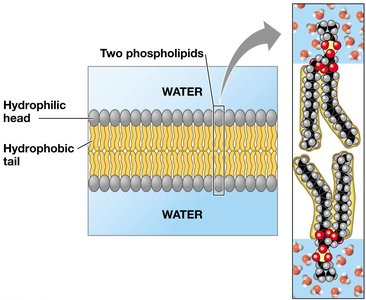
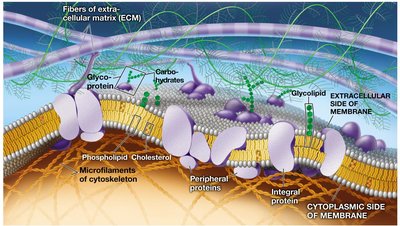
Membrane composition: Mainly composed of lipids (primarily phospholipids) and proteins.
Phospholipids: Amphipathic molecules with hydrophilic heads and hydrophobic tails, forming a bilayer.
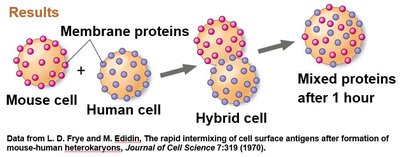
Fluid Mosaic Model: Describes the membrane as a fluid bilayer with proteins embedded throughout.
Membrane Proteins and Their Functions
Membrane proteins are crucial for the diverse functions of the plasma membrane. They are classified based on their association with the membrane.
Peripheral proteins: Attached to the membrane surface.
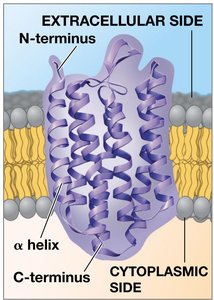
Integral proteins: Embedded within the membrane; transmembrane proteins span the entire membrane.
Functions include transport, enzymatic activity, signal transduction, cell-cell recognition, intercellular joining, and attachment to the cytoskeleton and extracellular matrix.
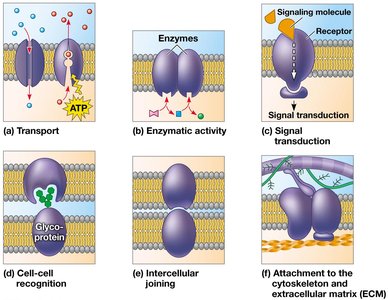
Membrane Carbohydrates and Cell-Cell Recognition
Membrane carbohydrates play a key role in cell identification and communication.
Glycolipids: Carbohydrates bonded to lipids.
Glycoproteins: Carbohydrates bonded to proteins.
Example: ABO blood groups are determined by specific glycoproteins.
Selective Permeability of the Membrane
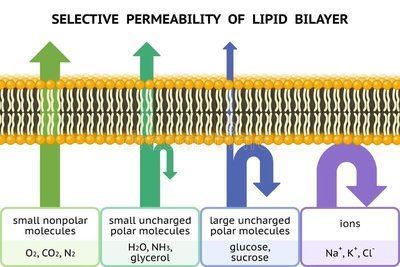
The structure of the membrane determines which substances can cross easily.
Hydrophobic (nonpolar) molecules: Can dissolve in the lipid bilayer and pass through rapidly.
Hydrophilic (polar) molecules and ions: Do not cross the membrane easily and require transport proteins.
Transport Proteins
Transport proteins facilitate the movement of hydrophilic substances across the membrane.
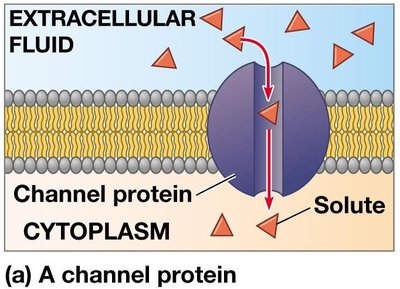
Channel proteins: Provide hydrophilic passageways for specific molecules or ions.
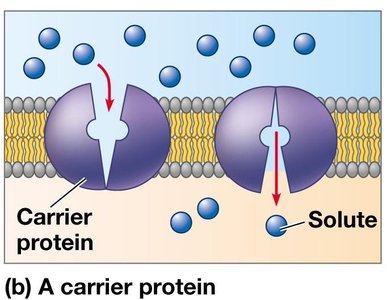
Carrier proteins: Bind specific molecules and change shape to move them across the membrane.
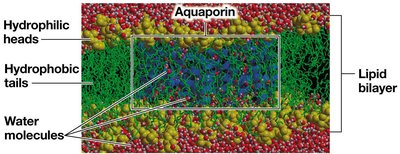
Example: Aquaporins transport water.
Passive Transport: Diffusion and Osmosis
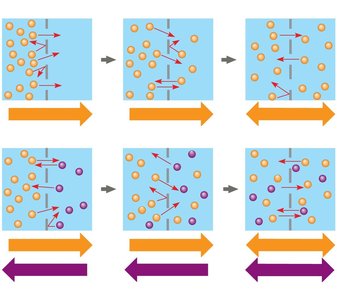
Passive transport involves the movement of substances down their concentration gradient without energy input.
Diffusion: Movement from high to low concentration.
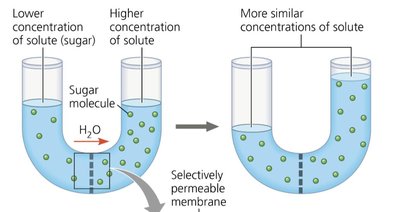
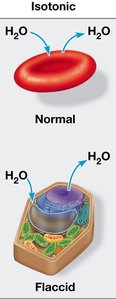
Osmosis: Diffusion of water across a selectively permeable membrane; water moves toward higher solute concentration.
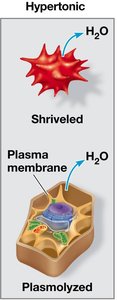
Facilitated Diffusion
Facilitated diffusion is a type of passive transport aided by proteins, moving substances down their concentration gradient.
Channel proteins: Allow specific molecules or ions to cross.
Carrier proteins: Bind and transport specific molecules.
No energy required.
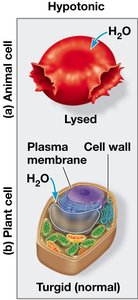
Active Transport
Active transport moves solutes against their concentration gradients (low to high), requiring energy, usually from ATP hydrolysis.
Carrier proteins: Used in active transport.
Sodium-potassium pump: Moves 3 Na+ out and 2 K+ in per ATP hydrolyzed.
Proton pump: Creates an electrochemical gradient by pumping H+ ions.
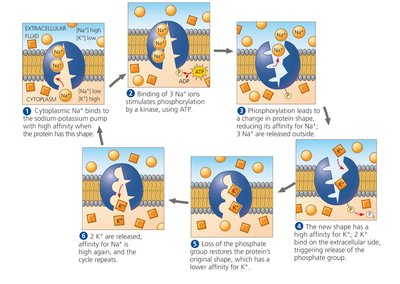
Membrane Potential and Electrochemical Gradients
Membrane potential is the voltage across a membrane, created by differences in ion distribution. Ion movement is influenced by both chemical and electrical forces, together forming the electrochemical gradient.
Ion pumps maintain membrane potential.
Ions diffuse down their electrochemical gradient.
Cotransport
Cotransport uses the energy stored in one gradient (such as H+) to drive the transport of another molecule (such as sucrose).
Proton pump builds H+ gradient.
H+ flows back down its gradient, powering sucrose transport.
Bulk Transport: Exocytosis and Endocytosis
Bulk transport moves large molecules across the membrane via vesicles and requires energy.
Exocytosis: Vesicles fuse with the plasma membrane to release contents outside the cell (e.g., insulin secretion).
Endocytosis: Plasma membrane folds inward to form a vesicle, bringing substances into the cell.
Types of endocytosis: Phagocytosis (cell eating), Pinocytosis (cell drinking), Receptor-mediated endocytosis (selective uptake).
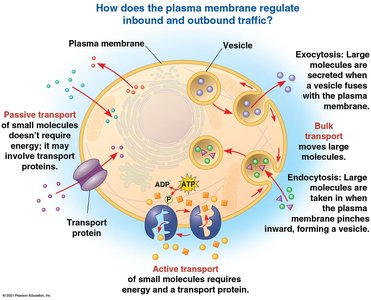
Summary Table: Types of Membrane Transport
Transport Type | Energy Required? | Direction | Key Proteins | Examples |
|---|---|---|---|---|
Simple Diffusion | No | High → Low | None | O2, CO2 |
Facilitated Diffusion | No | High → Low | Channel/Carrier Proteins | Glucose, ions |
Osmosis | No | High → Low (water) | Aquaporins | Water |
Active Transport | Yes (ATP) | Low → High | Carrier Proteins/Pumps | Na+/K+ pump |
Bulk Transport | Yes | Varies | Vesicles | Exocytosis, Endocytosis |
Additional info: The notes above expand on the original slides by providing definitions, examples, and a summary table for clarity. All images included are directly relevant to the explanation of the adjacent paragraphs, visually reinforcing key concepts in membrane structure and function.
