 Indietro
Membrane Structure and Function: Study Guide for General Biology
Guida di studio - Note intelligenti
 Appunti personalizzati basati sui tuoi materiali, ampliati con definizioni chiave, esempi e contesto.
Membrane Structure and Function
Introduction to the Plasma Membrane
The plasma membrane is a fundamental structure that separates the living cell from its external environment. It is selectively permeable, allowing certain substances to pass while restricting others, thus maintaining cellular homeostasis.
Selective permeability: The membrane controls the movement of molecules in and out of the cell.
Boundary function: It defines the cell's limits and protects internal components.
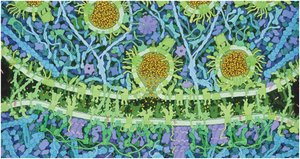
Fluid Mosaic Model of Membrane Structure
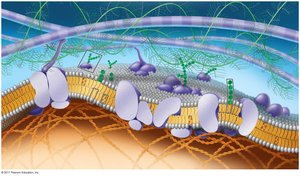
The fluid mosaic model describes the plasma membrane as a dynamic structure composed of a phospholipid bilayer with embedded proteins. Lipids and proteins can move laterally, contributing to membrane fluidity.
Phospholipid bilayer: Provides the basic structural framework.
Proteins: Integral and peripheral proteins serve various functions.
Cholesterol: Modulates membrane fluidity.
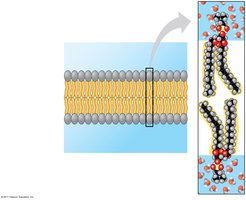
Phospholipid Structure and Arrangement
Phospholipids are amphipathic molecules with hydrophilic heads and hydrophobic tails. In aqueous environments, they form a bilayer, with heads facing outward and tails inward, creating a semi-permeable barrier.
Hydrophilic head: Attracts water.
Hydrophobic tail: Repels water.
Bilayer formation: Essential for membrane function.
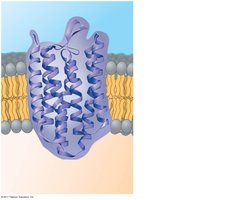
Membrane Proteins: Types and Functions
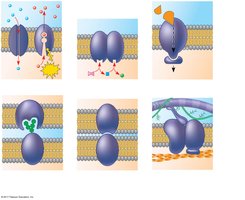
Membrane proteins are crucial for various cellular processes. They are classified as integral (spanning the membrane) or peripheral (attached to the membrane surface). Integral proteins that span the membrane are called transmembrane proteins.
Transport: Move substances across the membrane.
Enzymatic activity: Catalyze reactions.
Signal transduction: Relay signals from outside to inside the cell.
Cell-cell recognition: Identify other cells.
Intercellular joining: Connect cells together.
Attachment: Anchor the membrane to cytoskeleton and extracellular matrix.
Membrane Fluidity
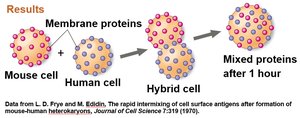
Membrane fluidity is essential for proper function. Lipids and some proteins move laterally within the membrane, and fluidity is influenced by temperature, lipid composition, and cholesterol content.
Experimental evidence: Fusion of mouse and human cells shows mixing of membrane proteins.
Membrane Permeability and Transport
Selective Permeability of the Lipid Bilayer
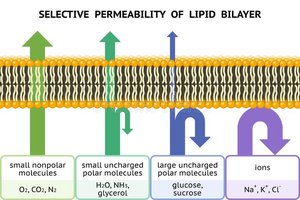
The lipid bilayer allows certain molecules to pass while blocking others. Hydrophobic (nonpolar) molecules pass easily, while hydrophilic (polar) molecules and ions require specialized transport proteins.
Hydrophobic molecules: Pass rapidly (e.g., O2, CO2).
Hydrophilic molecules: Require transport proteins (e.g., ions, glucose).
Transport Proteins
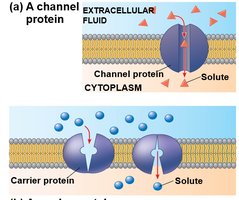
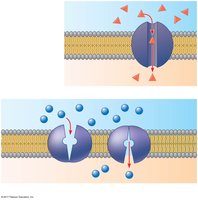
Transport proteins facilitate the movement of hydrophilic substances across the membrane. They include channel proteins and carrier proteins, each specific to the substance they transport.
Channel proteins: Form pores for ions and small molecules.
Carrier proteins: Bind and shuttle molecules across the membrane.
Passive Transport: Diffusion and Facilitated Diffusion
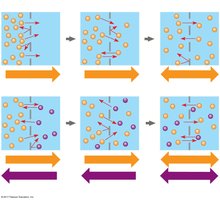
Passive transport involves the movement of substances down their concentration gradient without energy expenditure. Diffusion is the random movement of molecules, while facilitated diffusion uses transport proteins.
Diffusion: Movement from high to low concentration.
Facilitated diffusion: Uses proteins for hydrophilic molecules.
Osmosis and Water Balance
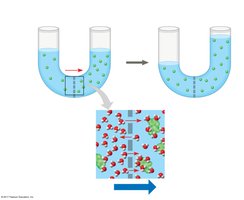
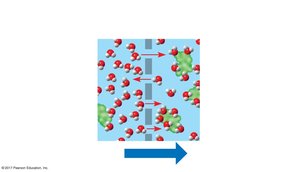
Osmosis is the diffusion of water across a selectively permeable membrane. Water moves from areas of lower solute concentration to higher solute concentration until equilibrium is reached.
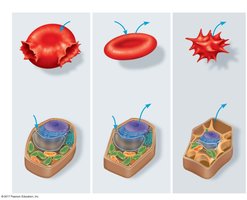
Hypertonic solution: Higher solute concentration outside the cell.
Hypotonic solution: Lower solute concentration outside the cell.
Isotonic solution: Equal solute concentration.
Facilitated Diffusion: Channel and Carrier Proteins
Facilitated diffusion is aided by channel and carrier proteins. Ion channels may be gated, opening in response to stimuli.
Channel proteins: Allow ions to pass through.
Carrier proteins: Change shape to move molecules.
Active Transport and Bulk Transport
Active Transport
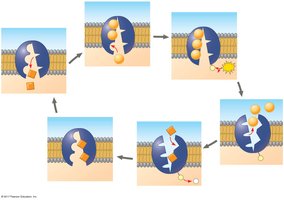
Active transport moves substances against their concentration gradient, requiring energy from ATP. This process is essential for maintaining cellular ion balances.
ATP hydrolysis: Provides energy for transport.
Example: Sodium-potassium pump ( per ATP).
Cotransport
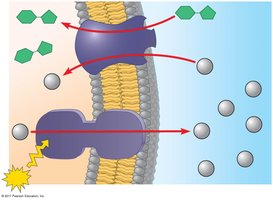
Cotransport involves the coupled movement of two substances across the membrane, often using the energy from one gradient to drive the transport of another molecule.
Proton pump: Establishes a gradient used for sucrose transport.
Bulk Transport: Exocytosis and Endocytosis
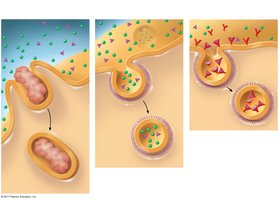
Bulk transport moves large molecules and particles across the membrane via vesicles. Exocytosis releases substances outside the cell, while endocytosis brings substances in.
Exocytosis: Vesicles fuse with the membrane to release contents.
Endocytosis: Membrane engulfs material, forming a vesicle.
Types of endocytosis: Phagocytosis (solid particles), pinocytosis (liquids), receptor-mediated endocytosis (specific molecules).
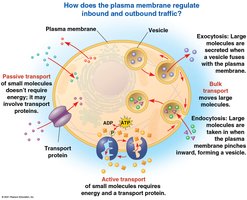
Summary Table: Membrane Transport Mechanisms
Transport Type | Energy Required | Direction | Example |
|---|---|---|---|
Passive Transport (Diffusion) | No | Down gradient | O2 diffusion |
Facilitated Diffusion | No | Down gradient | Glucose via carrier protein |
Active Transport | Yes (ATP) | Against gradient | Sodium-potassium pump |
Bulk Transport | Yes | Variable | Exocytosis, endocytosis |
Key Equations:
Osmosis: (Water potential = solute potential + pressure potential)
Sodium-potassium pump: per ATP
Example: The sodium-potassium pump maintains electrochemical gradients essential for nerve impulse transmission.
Additional info: Membrane transport is critical for nutrient uptake, waste removal, and signal transduction in all living cells.
