 Indietro
Membrane Structure and Function: Study Guide for General Biology
Guida di studio - Note intelligenti
 Appunti personalizzati basati sui tuoi materiali, ampliati con definizioni chiave, esempi e contesto.
Membrane Structure and Function
Overview of the Plasma Membrane
The plasma membrane is a fundamental structure in all living cells, separating the internal environment from the external surroundings. It is selectively permeable, allowing certain substances to cross more easily than others, and is primarily composed of a phospholipid bilayer with embedded proteins. The fluid mosaic model best describes its dynamic nature.
Phospholipids: Amphipathic molecules with hydrophilic heads and hydrophobic tails.
Membrane Proteins: Carry out diverse functions including transport, enzyme activity, and cell communication.
Fluid Mosaic Model: Describes the membrane as a flexible layer with proteins floating in a sea of lipids.
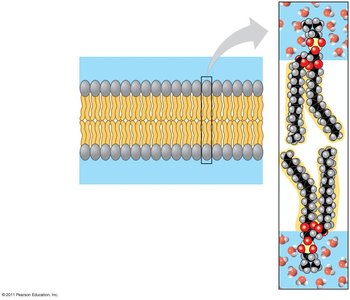
Phospholipid Bilayer Structure
The phospholipid bilayer forms the basic framework of the membrane. Each phospholipid has a hydrophilic (water-loving) head and two hydrophobic (water-fearing) tails, creating a double layer that acts as a barrier to most molecules.
Hydrophilic Heads: Face outward toward aqueous environments.
Hydrophobic Tails: Face inward, away from water.
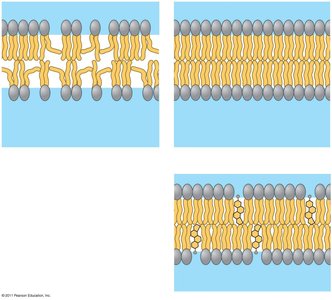
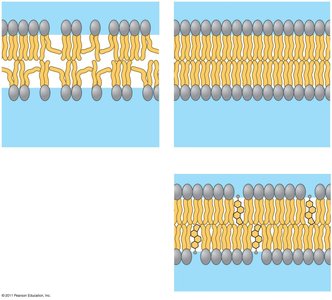
Membrane Fluidity
Membrane fluidity is influenced by temperature, fatty acid composition, and cholesterol content.
Temperature: Lower temperatures decrease fluidity, making membranes more rigid.
Fatty Acid Composition: Unsaturated fatty acids increase fluidity; saturated fatty acids decrease fluidity.
Cholesterol: Acts as a fluidity buffer, increasing fluidity at low temperatures and decreasing it at high temperatures.
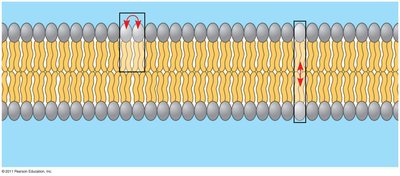
Movement of Phospholipids
Phospholipids move laterally within the membrane frequently, but flip-flop between layers is rare.
Lateral Movement: Occurs rapidly and contributes to membrane fluidity.
Flip-Flop: Rare event where a phospholipid switches sides of the bilayer.
Fluid Mosaic Model and Membrane Complexity
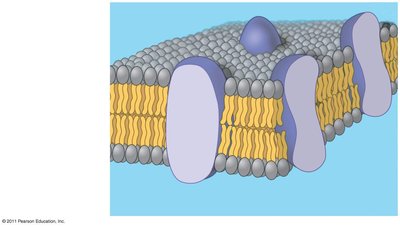
The fluid mosaic model highlights the complexity of membranes, with proteins and other molecules embedded in or attached to the bilayer.
Integral Proteins: Span the membrane and are involved in transport and signaling.
Peripheral Proteins: Attach to the membrane surface and assist in cell communication and structure.
Carbohydrates: Often attached to proteins (glycoproteins) or lipids (glycolipids) for cell recognition.
Transmembrane Proteins
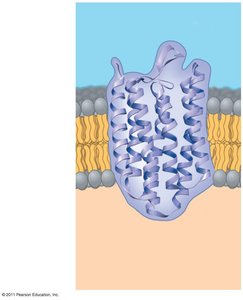
Transmembrane proteins typically have hydrophobic regions that interact with the membrane's interior and hydrophilic regions exposed to aqueous environments.
Structure: Often contain alpha helices that span the membrane.
Amino Acid Composition: Hydrophobic amino acids are most common in the transmembrane domain.
Functions of Membrane Proteins
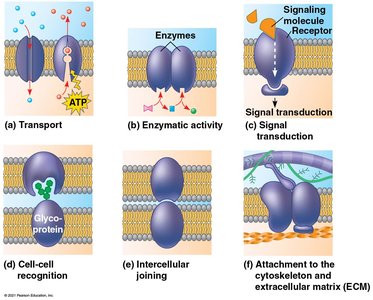
Membrane-associated proteins perform a variety of essential functions:
Transport: Move substances across the membrane.
Enzymatic Activity: Catalyze reactions at the membrane surface.
Signal Transduction: Relay signals from outside to inside the cell.
Cell Recognition: Allow cells to identify each other.
Intercellular Joining: Connect cells together.
Attachment: Anchor the membrane to the cytoskeleton and extracellular matrix.
Selective Permeability of the Cell Membrane
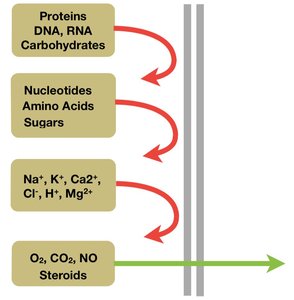
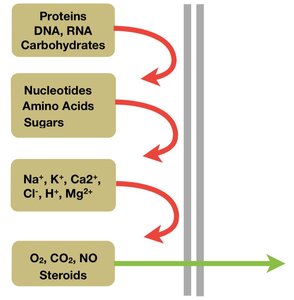
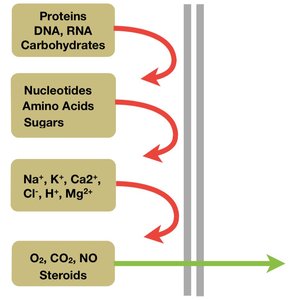
The cell membrane is semipermeable, restricting passage based on size, charge, and hydrophobicity.
Small, nonpolar molecules: Pass easily (e.g., O2, CO2).
Large or charged molecules: Require transport proteins.
Diffusion and Osmosis
Diffusion
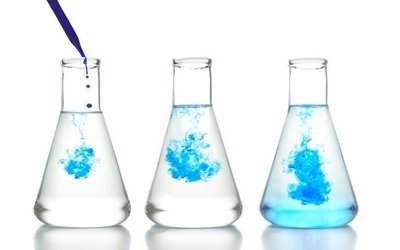
Diffusion is the movement of molecules from an area of high concentration to low concentration, driven by the concentration gradient.
Equilibrium: Achieved when concentrations are equal across the membrane.
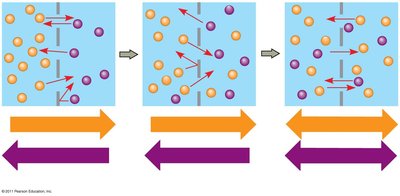
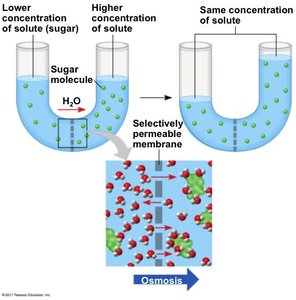
Osmosis
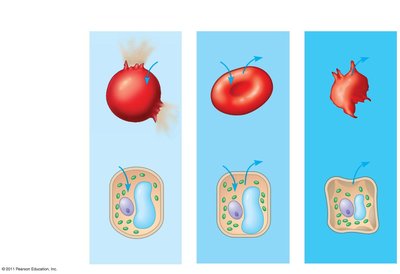
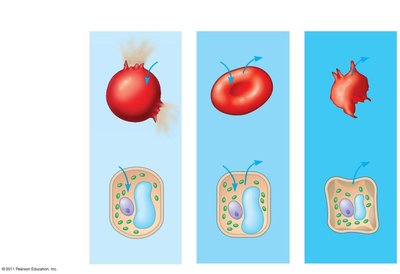
Osmosis is the diffusion of water across a selectively permeable membrane, moving from low solute concentration to high solute concentration.
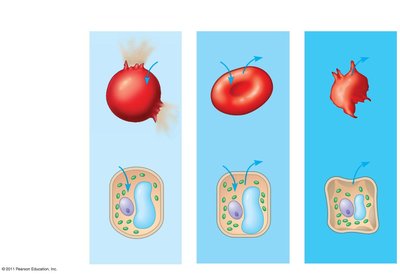
Tonicity: Describes the effect of a solution on cell volume.
Isotonic: No net water movement.
Hypertonic: Cell loses water.
Hypotonic: Cell gains water.
Transport Proteins and Facilitated Diffusion
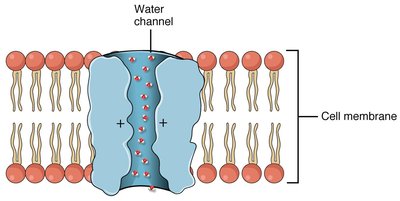
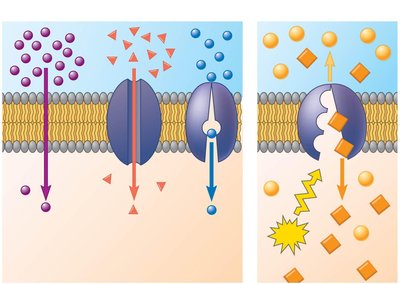
Channel Proteins: Provide hydrophilic tunnels for molecules or ions.
Carrier Proteins: Bind and change shape to move molecules across the membrane.
Facilitated Diffusion: Passive movement of molecules down their concentration gradient, assisted by transport proteins.
Active Transport and Ion Pumps
Active transport moves molecules against their concentration gradient and requires energy, often in the form of ATP.
Sodium-Potassium Pump: Maintains membrane potential by moving Na+ and K+ ions.
Ion Pumps: Create voltage differences across membranes, contributing to the electrochemical gradient.
Equation for Membrane Potential:
where = membrane potential (voltage), = charge difference, = capacitance of the membrane.
Cotransport and Bulk Transport
Cotransport: Active transport of one solute drives the transport of another.
Bulk Transport: Includes exocytosis (exporting large molecules) and endocytosis (importing large molecules).
Cell-Cell Recognition and Intercellular Joining
Membrane carbohydrates and proteins are involved in cell-cell recognition and joining, forming junctions that connect cells and facilitate communication.
Tight Junctions: Prevent fluid movement between cells.
Desmosomes: Provide mechanical strength.
Gap Junctions: Allow passage of ions and small molecules.
Attachment to Cytoskeleton and Extracellular Matrix (ECM)
The cytoskeleton provides structural support, while the ECM is a diverse array of macromolecules involved in cell adhesion, communication, and support.
Membrane Proteins: Anchor the membrane to the cytoskeleton and ECM.
Example: Duchenne Muscular Dystrophy (DMD) is caused by defects in membrane attachment proteins.
Summary Table: Membrane Transport Mechanisms
Transport Type | Energy Required | Direction | Example |
|---|---|---|---|
Simple Diffusion | No | Down gradient | O2, CO2 |
Facilitated Diffusion | No | Down gradient | Glucose, ions |
Active Transport | Yes (ATP) | Against gradient | Na+/K+ pump |
Cotransport | Indirect | Coupled | Sucrose-H+ cotransporter |
Bulk Transport | Yes | Vesicle-mediated | Exocytosis, endocytosis |
Key Terms and Definitions
Phospholipid: Amphipathic molecule forming the bilayer of cell membranes.
Fluid Mosaic Model: Describes the dynamic arrangement of lipids and proteins in the membrane.
Diffusion: Passive movement of molecules from high to low concentration.
Osmosis: Diffusion of water across a membrane.
Tonicity: Effect of a solution on cell volume.
Transport Protein: Protein that facilitates movement of substances across the membrane.
Active Transport: Movement of molecules against their gradient, requiring energy.
Cotransport: Coupled transport of two substances.
Bulk Transport: Movement of large molecules via vesicles.
Additional info:
Membrane fluidity is crucial for cell function and adaptation to environmental changes.
Defects in membrane proteins can lead to diseases such as Duchenne Muscular Dystrophy.
