 Indietro
Membrane Structure and Function: Study Guide for General Biology
Guida di studio - Note intelligenti
 Appunti personalizzati basati sui tuoi materiali, ampliati con definizioni chiave, esempi e contesto.
Membrane Structure and Function
Fluid Mosaic Model of Membranes
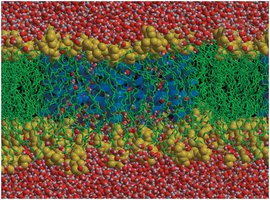
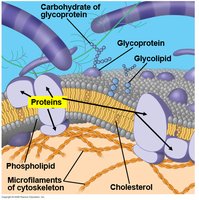
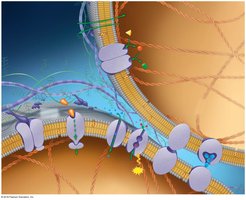
The cell membrane is a dynamic structure described by the fluid mosaic model, which highlights its composition of lipids and proteins. This model explains how membranes are flexible, allowing proteins and lipids to move within the bilayer, and how diverse proteins are embedded within the phospholipid matrix.
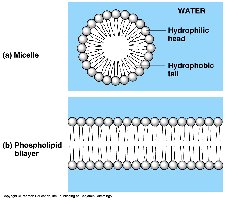
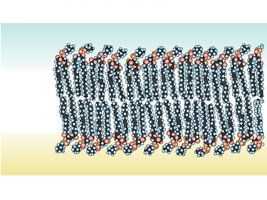
Phospholipids form the basic structure, creating a bilayer with hydrophilic heads facing outward and hydrophobic tails inward.
Proteins are interspersed throughout the membrane, serving various functions such as transport, signaling, and structural support.
Cholesterol is embedded within the bilayer, contributing to membrane fluidity and stability.
The membrane is selectively permeable, allowing certain substances to cross more easily than others.
Membrane Fluidity
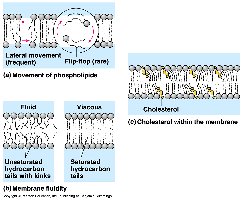
Membrane fluidity is essential for cell function and is influenced by the types of fatty acids in phospholipids and the presence of cholesterol.
Unsaturated fatty acids have kinks that prevent tight packing, increasing fluidity.
Saturated fatty acids allow tighter packing, making the membrane more viscous.
Cholesterol acts as a buffer, maintaining fluidity at low temperatures and stability at high temperatures.
Phospholipid Bilayer Structure
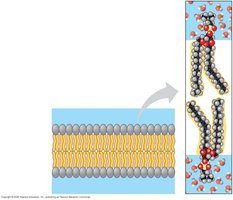
The phospholipid bilayer is arranged with polar, hydrophilic heads facing the aqueous environment and nonpolar, hydrophobic tails facing inward. This arrangement creates a barrier to most polar molecules and ions.
Serves as a cellular barrier and border.
Impermeable to most polar molecules and large substances.
Membrane Proteins and Their Functions
Membrane proteins are crucial for the diverse functions of the cell membrane. They are classified based on their roles:
Transport proteins: Facilitate the movement of specific molecules across the membrane.
Enzymes: Catalyze chemical reactions at the membrane surface.
Receptor proteins: Receive and transmit signals from the environment.
Glycoproteins: Serve as identification tags for cell recognition.
Junction proteins: Form connections between adjacent cells.
Attachment proteins: Anchor the membrane to the cytoskeleton and extracellular matrix.
Selective Permeability
The cell membrane's selective permeability allows only certain molecules to pass through directly. Small, nonpolar molecules such as oxygen (O2) and carbon dioxide (CO2) can diffuse freely, while polar molecules and ions require transport proteins.
Small, nonpolar molecules (e.g., O2, CO2, lipids) can cross directly.
Polar molecules (e.g., glucose, ions) cannot cross without assistance.
Formation and Evolution of Membranes
Phospholipids spontaneously assemble into bilayers, forming the basic structure of biological membranes. This self-assembly was a critical step in the origin of life, creating a distinct internal environment for cells.
Phospholipids form micelles or bilayers in water due to their amphipathic nature.
Membrane formation separates the cell's interior from its exterior, enabling cellular processes.
Passive Transport: Diffusion and Osmosis
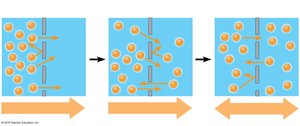
Passive transport involves the movement of substances across the membrane without energy input. Diffusion and osmosis are key examples:
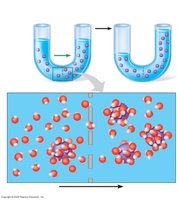
Diffusion: Movement of particles from high to low concentration until equilibrium is reached.
Osmosis: Diffusion of water across a selectively permeable membrane, driven by solute concentration differences.
Water Balance and Tonicity
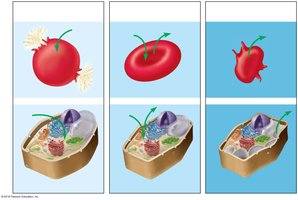
Water balance is crucial for cell survival. Tonicity describes the effect of a solution on cell volume:
Isotonic: Equal solute concentration; no net water movement.
Hypotonic: Lower solute concentration outside; water enters the cell.
Hypertonic: Higher solute concentration outside; water leaves the cell.
Osmoregulation: Mechanisms to maintain water balance, such as contractile vacuoles in protists.
Facilitated Diffusion
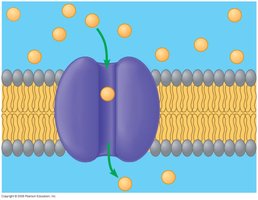
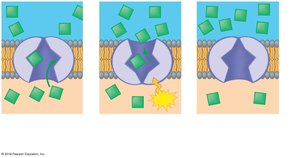
Facilitated diffusion is a type of passive transport that requires specific transport proteins to move substances across the membrane. It is essential for molecules that cannot diffuse directly, such as sugars, amino acids, ions, and water.
Transport proteins provide channels or carriers for these molecules.
Movement is still from high to low concentration and does not require energy.

Active Transport
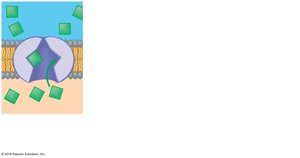
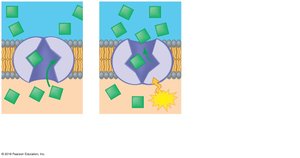
Active transport moves substances against their concentration gradient, requiring energy in the form of ATP. This process involves transport proteins that change shape to move solutes across the membrane.
ATP phosphorylates the transport protein, causing a conformational change.
Solutes are moved from low to high concentration.
Equation:
Bulk Transport: Exocytosis and Endocytosis
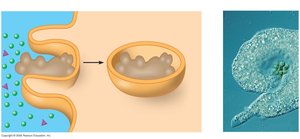
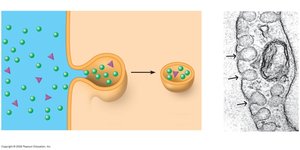
Cells use exocytosis and endocytosis to move large molecules across the membrane. These processes involve vesicles that fuse with or bud from the membrane.
Exocytosis: Exports bulky molecules (e.g., proteins, polysaccharides).
Endocytosis: Imports substances via three mechanisms: phagocytosis (engulfing particles), pinocytosis (engulfing fluids), and receptor-mediated endocytosis (specific uptake).
Summary Table: Membrane Transport Mechanisms
Transport Type | Energy Required | Direction | Example |
|---|---|---|---|
Simple Diffusion | No | High to Low | O2, CO2 |
Facilitated Diffusion | No | High to Low | Glucose, ions |
Osmosis | No | High to Low (water) | Water movement |
Active Transport | Yes (ATP) | Low to High | Na+/K+ pump |
Exocytosis | Yes | Bulk export | Protein secretion |
Endocytosis | Yes | Bulk import | Phagocytosis |
Key Terms and Definitions
Phospholipid: Amphipathic molecule forming the bilayer of membranes.
Selective permeability: Property allowing some substances to cross more easily than others.
Osmosis: Diffusion of water across a membrane.
Tonicity: Effect of a solution on cell volume.
Facilitated diffusion: Passive transport using proteins.
Active transport: Energy-requiring movement against gradient.
Exocytosis/Endocytosis: Bulk transport mechanisms.
Example: The sodium-potassium pump is an example of active transport, moving Na+ out and K+ into the cell against their concentration gradients.
Additional info: Membrane structure and transport are foundational concepts for understanding cell physiology, signaling, and homeostasis.
