 Indietro
Membrane Structure and Function: Study Guide for General Biology
Guida di studio - Note intelligenti
 Appunti personalizzati basati sui tuoi materiali, ampliati con definizioni chiave, esempi e contesto.
Membrane Structure and Function
Overview
The plasma membrane is a fundamental cellular structure that enables cells to maintain a distinct internal environment. Its unique composition and dynamic properties allow selective exchange of substances, regulate cellular homeostasis, and support essential biological processes.
Membrane Structure
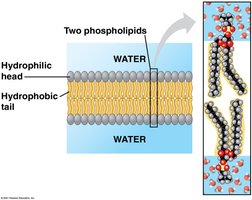
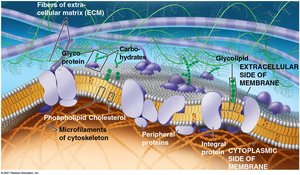
The plasma membrane is primarily composed of a phospholipid bilayer with embedded proteins, carbohydrates, and cholesterol. This arrangement is described by the fluid mosaic model, which highlights the flexibility and diversity of membrane components.
Phospholipids: Amphipathic molecules with hydrophilic heads and hydrophobic tails, forming a bilayer that acts as a barrier to most substances.
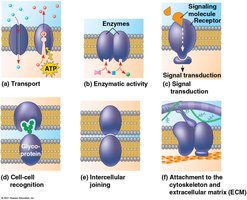
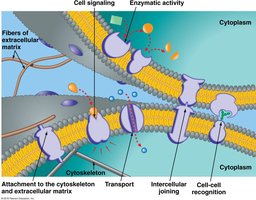
Proteins: Integral, peripheral, and transmembrane proteins serve various functions including transport, signaling, and structural support.
Carbohydrates: Attached to proteins (glycoproteins) or lipids (glycolipids), important for cell recognition and signaling.
Cholesterol: Modulates membrane fluidity and stability.
Membrane Fluidity
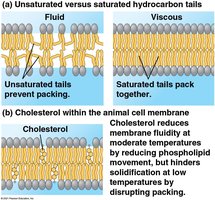
Membrane fluidity is essential for permeability and protein function. It is influenced by the types of fatty acids in phospholipids and the presence of cholesterol.
Unsaturated fatty acids: Create kinks, prevent tight packing, and increase fluidity.
Saturated fatty acids: Allow tight packing, decrease fluidity.
Cholesterol: At high temperatures, restrains phospholipid movement; at low temperatures, prevents solidification.
Synthesis and Sidedness of Membranes
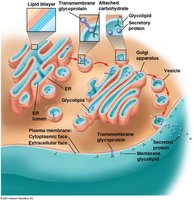
Membranes have distinct inner and outer faces due to the asymmetrical distribution of proteins, lipids, and carbohydrates. This asymmetry is established and maintained by the endomembrane system (ER, Golgi apparatus, vesicles).
Endoplasmic Reticulum (ER): Site of membrane synthesis.
Golgi Apparatus: Modifies and sorts membrane components.
Vesicles: Transport membrane segments to the plasma membrane.
Membrane Proteins
Proteins embedded in the membrane perform diverse functions. They are classified based on their association with the membrane:
Peripheral proteins: Bound to the membrane surface.
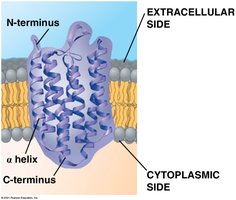
Integral proteins: Penetrate the hydrophobic core.
Transmembrane proteins: Span the entire membrane, often forming channels or receptors.
Selective Permeability
The plasma membrane regulates the movement of substances, allowing some molecules to cross freely while others require assistance.
Nonpolar molecules: (e.g., CO2, O2) cross easily.
Polar molecules: (e.g., glucose) require transport proteins.
Transport proteins: Channel proteins form tunnels; carrier proteins bind and change shape to move molecules.
Membrane Transport Mechanisms
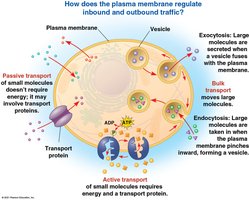
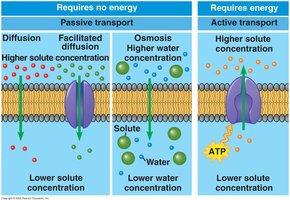
Transport across the membrane is categorized as passive or active, depending on energy requirements.
Passive Transport: No energy required; includes diffusion, osmosis, and facilitated diffusion.
Active Transport: Requires energy (usually ATP) to move substances against their concentration gradients.
Passive Transport
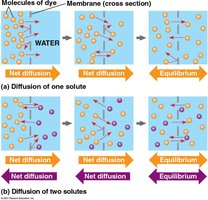
Diffusion: Movement of molecules from high to low concentration until equilibrium is reached.
Facilitated Diffusion: Transport proteins speed passive movement across the membrane.
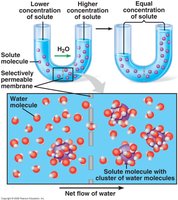
Osmosis: Diffusion of water across a selectively permeable membrane.
Dynamic equilibrium: Equal movement of molecules, no net change.
Tonicity: Describes the relative solute concentration:
Hypotonic: Lower solute concentration.
Hypertonic: Higher solute concentration.
Isotonic: Equal solute concentration.
Water Balance in Walled Cells
Plant, prokaryote, fungi, and some protist cells have cell walls that affect water balance.
Turgor pressure: Water uptake in hypotonic solution pushes membrane against cell wall.
Turgid: Firm, healthy state for most plant cells.
Flaccid: Limp, occurs in isotonic environments.
Plasmolysis: Water loss in hypertonic environments causes membrane to pull away from wall.
Facilitated Diffusion
Aquaporins: Channel proteins that allow rapid water passage.
Ion channels: Move ions across membrane.
Gated channels: Open/close in response to stimuli.
Carrier proteins: Change shape to move molecules.
Active Transport
Active transport uses energy to move solutes against their concentration gradients, maintaining cellular homeostasis.
Sodium-potassium pump: Moves Na+ out and K+ into the cell, using ATP.
Equation for sodium-potassium pump:
Membrane Potential and Pumps
The membrane potential is the voltage across the membrane, storing energy for cellular work. It is generated by electrogenic pumps that move ions against their gradients.
Electrochemical gradient: Combined effect of ion concentration and electrical charge.
Electrogenic pumps: Generate voltage by moving ions.
Cotransport
Cotransport occurs when the transport of one solute drives the transport of another. The "downhill" diffusion of one substance powers the "uphill" movement of another against its gradient.
Plants: H+ gradient drives sucrose uptake.
Animals: Na+ diffusion drives glucose absorption in intestinal cells.
Bulk Transport
Bulk transport moves large molecules (proteins, polysaccharides) via vesicles. It includes exocytosis and endocytosis.
Exocytosis: Vesicles fuse with plasma membrane to release contents outside the cell.
Endocytosis: Cell takes in macromolecules by forming vesicles from the plasma membrane.
Summary Table: Membrane Transport Mechanisms
Transport Type | Energy Required? | Direction | Example |
|---|---|---|---|
Diffusion | No | Down gradient | O2 movement |
Facilitated Diffusion | No | Down gradient | Glucose via carrier protein |
Osmosis | No | Down water gradient | Water via aquaporins |
Active Transport | Yes (ATP) | Against gradient | Sodium-potassium pump |
Bulk Transport | Yes (vesicle formation) | Variable | Exocytosis, endocytosis |
Example: Pancreatic cells use exocytosis to secrete insulin, while intestinal cells use cotransport to absorb glucose.
Additional info: The notes expand on brief points by providing definitions, examples, and context for each transport mechanism, ensuring a comprehensive understanding suitable for exam preparation.
