 Indietro
Membrane Structure and Function: Study Guide for General Biology
Guida di studio - Note intelligenti
 Appunti personalizzati basati sui tuoi materiali, ampliati con definizioni chiave, esempi e contesto.
Membrane Structure and Function
Overview
The plasma membrane is a fundamental cellular structure that enables cells to maintain a distinct internal environment. Its unique composition and properties allow for selective permeability, regulating the exchange of nutrients, wastes, and signals. Membrane structure directly determines its function, supporting processes such as transport, signaling, and homeostasis.
Membrane Structure
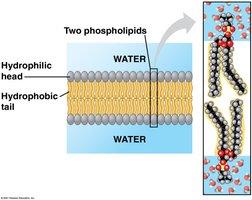
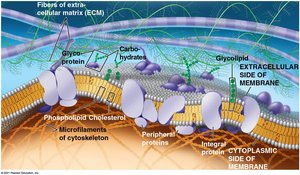
The plasma membrane is primarily composed of a phospholipid bilayer with embedded proteins, carbohydrates, and cholesterol. The amphipathic nature of phospholipids (hydrophilic head and hydrophobic tail) creates a flexible, selectively permeable barrier.
Phospholipid Bilayer: Two layers of phospholipids with hydrophobic tails facing inward and hydrophilic heads facing outward.
Fluid Mosaic Model: Membranes are dynamic, with lipids and proteins moving laterally within the bilayer.
Membrane Proteins: Integral, peripheral, and transmembrane proteins serve various functions including transport, signaling, and cell recognition.
Synthesis and Sidedness of Membranes
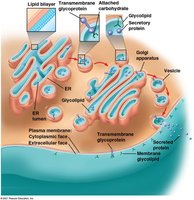
Membranes have distinct inner and outer faces, with asymmetrical distribution of proteins, lipids, and carbohydrates. This asymmetry is established and maintained by the endomembrane system (ER → Golgi → vesicles → plasma membrane).
Endomembrane System: Organelles work together to synthesize, modify, and transport membrane components.
Membrane Sidedness: Ensures proper orientation and function of membrane proteins and lipids.
Membrane Fluidity
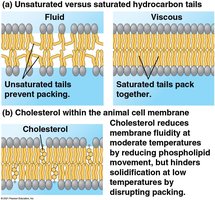
Fluidity is essential for membrane permeability and protein function. It is influenced by the composition of fatty acids and cholesterol.
Unsaturated Fatty Acids: Create kinks, prevent tight packing, and increase fluidity.
Saturated Fatty Acids: Allow tight packing, decrease fluidity.
Cholesterol: Modulates fluidity; restrains movement at high temperatures, prevents solidification at low temperatures.
Membrane Proteins and Their Functions
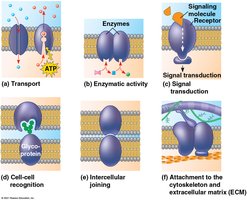
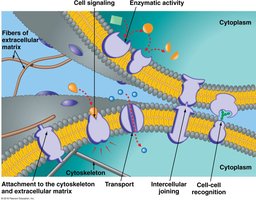
Proteins embedded in the membrane perform diverse functions, including transport, enzymatic activity, signal transduction, cell-cell recognition, intercellular joining, and attachment to the cytoskeleton and extracellular matrix.
Peripheral Proteins: Bound to membrane surface.
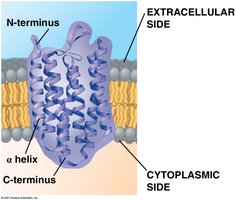
Integral Proteins: Penetrate hydrophobic core.
Transmembrane Proteins: Span the entire membrane.
Selective Permeability
The membrane regulates movement of substances based on their properties:
Nonpolar Molecules: (e.g., CO2, O2) cross easily.
Polar Molecules: (e.g., glucose) require transport proteins.
Transport Proteins: Channel proteins form tunnels; carrier proteins bind and change shape to move molecules.
 s
Membrane Transport Mechanisms
Transport across the membrane is essential for cellular homeostasis and occurs via passive and active mechanisms.
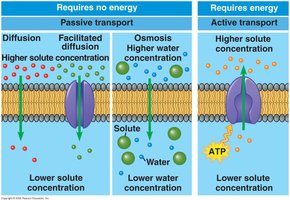
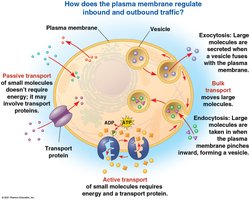
Passive Transport: Moves substances down their concentration gradient without energy input.
Active Transport: Moves substances against their gradient, requiring energy (often ATP).
Osmosis: Diffusion of water across a selectively permeable membrane.
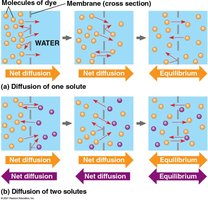
Passive Transport
Diffusion: Random movement of molecules down their concentration gradient.
Dynamic Equilibrium: Equal movement, no net change.
Facilitated Diffusion: Transport proteins speed passive movement.
Aquaporins: Allow rapid water passage.
Ion Channels: Move ions across membrane.
Gated Channels: Open/close in response to stimuli.
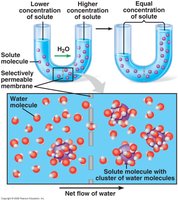
Osmosis and Water Balance
Osmosis: Water moves until solute concentrations are equal on both sides.
Tonicity: Describes relative solute concentration:
Hypotonic: Lower solute concentration.
Hypertonic: Higher solute concentration.
Isotonic: Equal solute concentration.
Water Balance in Walled Cells
Turgor Pressure: Water uptake in hypotonic solution pushes cell membrane against cell wall.
Turgid: Firm, healthy state for most plant cells.
Flaccid: Limp, isotonic environment causes wilting.
Plasmolysis: Hypertonic environment causes water loss and membrane pulls away from wall.
Active Transport
Requires energy (ATP): Moves solutes against their concentration gradient.
Sodium-Potassium Pump: Energizes transport of K+ into cell and Na+ out of cell.
Equation for sodium-potassium pump:
Membrane Potential and Pumps
Membrane potential is the voltage across the membrane, storing energy for cellular work. The electrochemical gradient combines ion concentration and electrical charge, driving ion diffusion.
Electrogenic Pumps: Generate voltage by moving ions against the gradient.
Cotransport
Cotransport involves the transport of one solute driving the transport of another. The "downhill" diffusion of one substance powers the "uphill" movement of another against its gradient.
Example in Plants: H+ gradient drives sucrose uptake.
Example in Animals: Na+ diffusion drives glucose absorption in intestinal cells.
Bulk Transport
Bulk transport moves large molecules (proteins, polysaccharides) via vesicles. Exocytosis and endocytosis are the main mechanisms.
Exocytosis: Vesicles fuse with plasma membrane to release contents outside the cell.
Endocytosis: Cell takes in macromolecules by forming vesicles from the plasma membrane.
Summary Table: Membrane Transport Mechanisms
Transport Type | Energy Required? | Direction | Example |
|---|---|---|---|
Diffusion | No | Down gradient | O2, CO2 |
Facilitated Diffusion | No | Down gradient | Glucose, ions |
Osmosis | No | Down water gradient | Water |
Active Transport | Yes (ATP) | Against gradient | Na+/K+ pump |
Bulk Transport | Yes (vesicles) | Varies | Exocytosis, endocytosis |
Example: Pancreatic cells use exocytosis to secrete insulin, while intestinal cells use cotransport to absorb glucose.
Additional info: The notes have been expanded to include definitions, examples, and academic context for clarity and completeness.
