 Indietro
Membrane Structure and Function: Study Notes (Campbell Biology, Ch. 7)
Guida di studio - Note intelligenti
 Appunti personalizzati basati sui tuoi materiali, ampliati con definizioni chiave, esempi e contesto.
Membrane Structure and Function
Introduction
The plasma membrane is a fundamental cellular structure that regulates the movement of substances into and out of the cell. Its unique composition and organization enable selective permeability, communication, and interaction with the environment.
Membrane Composition and the Fluid Mosaic Model
Phospholipids and Membrane Structure
Phospholipids are amphipathic molecules, meaning they have both hydrophobic (water-fearing) tails and hydrophilic (water-loving) heads.
They arrange themselves into a bilayer, with hydrophobic tails facing inward and hydrophilic heads facing outward toward water.
This bilayer forms the basic structure of all biological membranes.
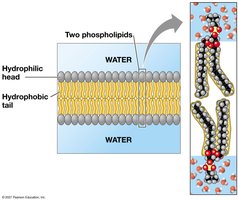
The Fluid Mosaic Model
The fluid mosaic model describes the membrane as a dynamic structure with proteins embedded in or attached to a fluid lipid bilayer.
Proteins are not randomly distributed; they often form functional groups.
Carbohydrates are also present, usually attached to proteins (glycoproteins) or lipids (glycolipids).
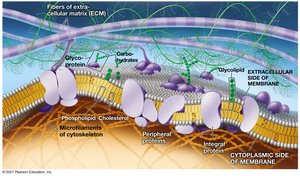
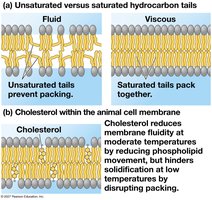
Membrane Fluidity
Membranes are held together by weak hydrophobic interactions, allowing lipids and some proteins to move laterally.
Rarely, lipids may flip-flop between layers.
Fluidity is essential for membrane function, affecting permeability and protein movement.
Organisms adapt membrane lipid composition to environmental temperatures.
Membrane Proteins and Their Functions
Types of Membrane Proteins
Peripheral proteins: Bound to the membrane surface.
Integral proteins: Penetrate the hydrophobic core; those spanning the membrane are called transmembrane proteins.
Hydrophobic regions of integral proteins often form α helices.
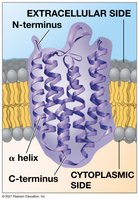
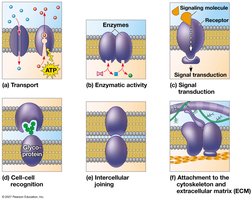
Functions of Membrane Proteins
Transport: Move substances across the membrane.
Enzymatic activity: Catalyze reactions at the membrane surface.
Signal transduction: Relay signals from outside to inside the cell.
Cell-cell recognition: Identify and interact with other cells.
Intercellular joining: Connect adjacent cells.
Attachment to cytoskeleton and ECM: Maintain cell shape and stabilize membrane proteins.
Membrane Carbohydrates and Cell-Cell Recognition
Carbohydrates on the cell surface are usually short, branched chains attached to lipids (glycolipids) or proteins (glycoproteins).
These molecules serve as markers for cell identification and are crucial for immune response and tissue organization.
Selective Permeability of Membranes
Lipid Bilayer Permeability
Hydrophobic (nonpolar) molecules, such as hydrocarbons, pass through the membrane easily.
Hydrophilic (polar) molecules, such as sugars, water, and ions, cross slowly or require transport proteins.
Transport Proteins
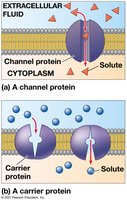
Channel proteins: Provide hydrophilic tunnels for specific molecules or ions.
Carrier proteins: Bind to molecules and change shape to shuttle them across the membrane.
Passive Transport: Diffusion and Osmosis
Diffusion
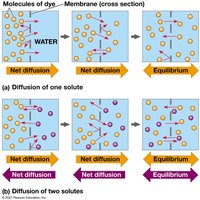
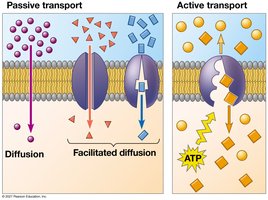
Diffusion is the movement of particles from an area of higher concentration to lower concentration, driven by the concentration gradient.
At dynamic equilibrium, movement continues but there is no net change in concentration.
Osmosis
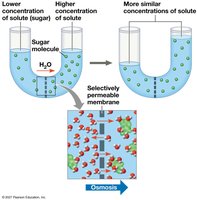
Osmosis is the diffusion of free water across a selectively permeable membrane.
Water moves from regions of lower solute concentration to higher solute concentration until equilibrium is reached.
Tonicity and Water Balance
Tonicity describes the ability of a solution to cause a cell to gain or lose water, depending on solute concentration.
In animal cells, water balance is crucial for survival; in plant cells, turgor pressure maintains structure.
In hypertonic environments, plant cells undergo plasmolysis (membrane pulls away from cell wall), leading to wilting.
Facilitated Diffusion
Transport proteins assist the passive movement of molecules across the membrane.
Includes both channel and carrier proteins.
Active Transport
Mechanism and Importance
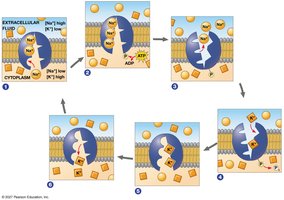
Active transport moves solutes against their concentration gradients, requiring energy (usually from ATP).
Essential for maintaining concentration differences of ions across the membrane.
Ion Pumps and Membrane Potential
Membrane potential is the voltage across a membrane, created by differences in ion distribution.
The electrochemical gradient combines the chemical and electrical forces driving ion movement.
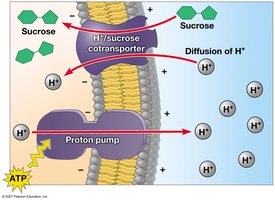
Electrogenic pumps generate membrane potential; the sodium-potassium pump is key in animals, while the proton pump is important in plants, fungi, and bacteria.
Cotransport
Cotransport occurs when active transport of one solute indirectly drives transport of another.
For example, the proton gradient created by a proton pump can drive the uptake of sucrose in plants.
Bulk Transport: Exocytosis and Endocytosis
Exocytosis
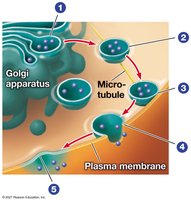
In exocytosis, vesicles fuse with the plasma membrane to release large molecules outside the cell.
Example: Pancreatic cells secrete insulin via exocytosis.
Endocytosis
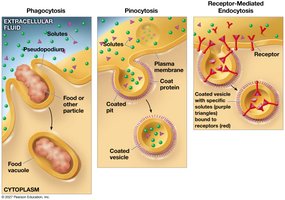
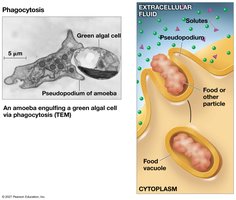
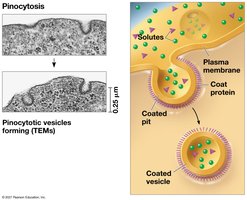
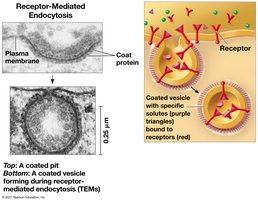
In endocytosis, the cell takes in large molecules by forming vesicles from the plasma membrane.
Three types: Phagocytosis (cellular eating), Pinocytosis (cellular drinking), and Receptor-mediated endocytosis (specific uptake).
Summary Table: Types of Membrane Transport
Transport Type | Energy Required? | Direction | Example |
|---|---|---|---|
Simple Diffusion | No | Down gradient | O2, CO2 |
Facilitated Diffusion | No | Down gradient | Glucose, ions |
Active Transport | Yes (ATP) | Against gradient | Na+/K+ pump |
Bulk Transport (Exocytosis/Endocytosis) | Yes | Bulk movement | Secretion of proteins, uptake of large particles |
Key Equations
Osmotic movement of water:
Where J is the flux, Lp is the hydraulic conductivity, ΔP is the pressure difference, σ is the reflection coefficient, and Δπ is the osmotic pressure difference.
Additional info: The above equation is a general form for water movement across membranes, included for academic completeness.
