 Indietro
Membrane Structure and Function: Study Notes for General Biology: lecture 10
Guida di studio - Note intelligenti
 Appunti personalizzati basati sui tuoi materiali, ampliati con definizioni chiave, esempi e contesto.
Membrane Structure and Function
Introduction to Membrane Structure
The plasma membrane is a fundamental structure that separates the living cell from its environment. It is essential for maintaining cellular integrity and regulating the movement of substances in and out of the cell. The membrane's selective permeability is crucial for cellular function and homeostasis.
Plasma membrane: Boundary between cell and surroundings; exhibits selective permeability.
Selective permeability: Allows some substances to cross more easily than others.
Phospholipids: Structure and Properties
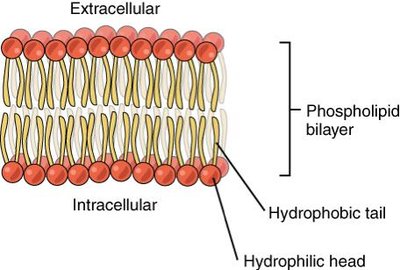
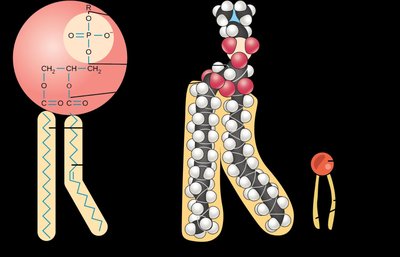
Phospholipids are the most abundant lipids in the plasma membrane. They are amphipathic molecules, meaning they contain both hydrophobic (water-repelling) and hydrophilic (water-attracting) regions. This property enables the formation of a stable bilayer in aqueous environments.
Hydrophilic head: Attracts water; faces outward toward aqueous environments.
Hydrophobic tail: Repels water; faces inward, away from water.
Phospholipid bilayer: Double layer of phospholipids forms the basic structure of the membrane.
The Fluid Mosaic Model
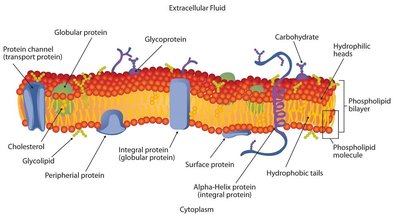
The fluid mosaic model describes the membrane as a dynamic structure with a mosaic of proteins embedded within the phospholipid bilayer. Proteins are not randomly distributed; they serve specific functions and can move laterally within the membrane.
Integral proteins: Penetrate the hydrophobic core; some span the membrane (transmembrane proteins).
Peripheral proteins: Bound to the membrane surface.
Fluidity: Phospholipids and proteins can move laterally; membrane must be fluid to function properly.
Membrane Fluidity and Composition
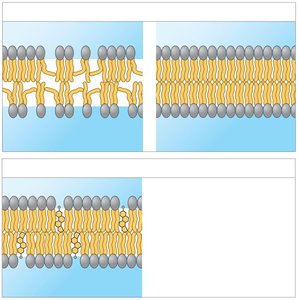
Membrane fluidity is influenced by temperature, the saturation of fatty acid tails, and the presence of cholesterol.
Unsaturated fatty acids: Increase fluidity by preventing tight packing.
Saturated fatty acids: Decrease fluidity by allowing tight packing.
Cholesterol: Modulates fluidity; restrains movement at high temperatures, prevents solidification at low temperatures.
Membrane Function: Selective Permeability
The plasma membrane regulates the cell’s molecular traffic through selective permeability.
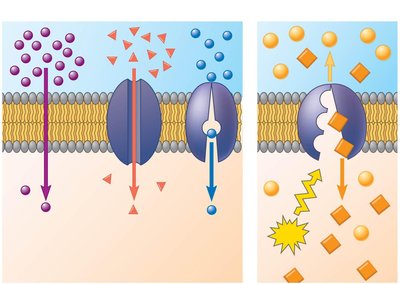
Hydrophobic (nonpolar) molecules: Pass through the membrane rapidly.
Hydrophilic (polar) molecules and ions: Do not cross easily; require transport proteins.

Passive Transport: Diffusion and Osmosis
Passive transport involves the movement of substances across the membrane without energy expenditure.
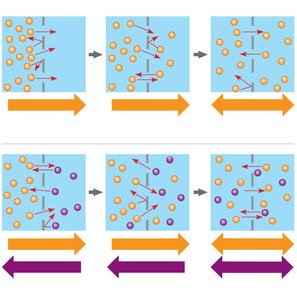
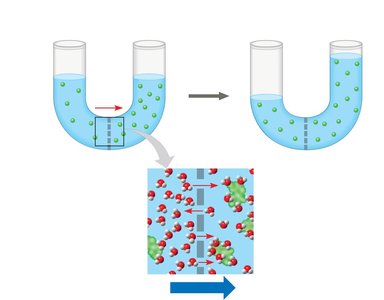
Diffusion: Movement of molecules from high to low concentration (down the concentration gradient).
Dynamic equilibrium: Equal movement in both directions; no net change.
Osmosis: Diffusion of water across a selectively permeable membrane.

Water Balance: Tonicity and Cell Response
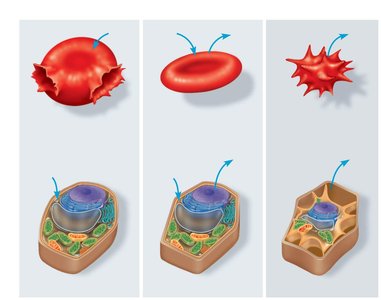
Tonicity describes how a solution affects cell water balance.
Isotonic: Equal solute concentration; no net water movement.
Hypertonic: Higher solute concentration outside; cell loses water.
Hypotonic: Lower solute concentration outside; cell gains water.
Water moves toward hypertonic solutions.
Facilitated Diffusion
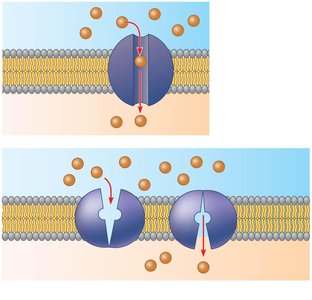
Facilitated diffusion is passive transport aided by proteins.
Channel proteins: Provide corridors for specific molecules or ions.
Carrier proteins: Change shape to move substances across the membrane.
Ion channels: Some are gated, opening or closing in response to stimuli.

Active Transport
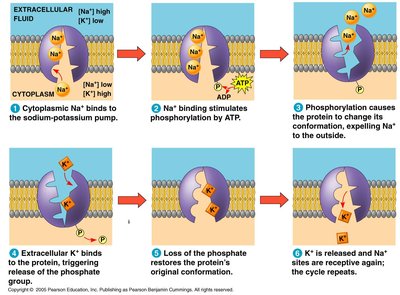
Active transport moves substances against their concentration gradients, requiring energy (usually ATP).
Sodium-potassium pump: Maintains concentration gradients of Na+ and K+ across the membrane.
Membrane potential: Voltage difference across the membrane due to ion distribution.
Electrochemical gradient: Combination of chemical and electrical forces driving ion movement.
Bulk Transport: Exocytosis and Endocytosis
Bulk transport moves large molecules across the membrane using vesicles.
Exocytosis: Vesicles fuse with the membrane to release contents outside the cell.
Endocytosis: Cell takes in macromolecules by forming vesicles from the membrane.
Types of endocytosis: Phagocytosis (cellular eating), pinocytosis (cellular drinking), receptor-mediated endocytosis.
Summary Table: Types of Membrane Transport
Type | Energy Required? | Direction | Example |
|---|---|---|---|
Simple Diffusion | No | Down gradient | O2 movement |
Facilitated Diffusion | No | Down gradient | Glucose transport |
Active Transport | Yes (ATP) | Against gradient | Na+/K+ pump |
Bulk Transport | Yes | Variable | Exocytosis, endocytosis |
Clinical Connection: Antiphospholipid Syndrome (APS)
APS is an autoimmune disorder where antibodies attack phospholipids in cell membranes, leading to blood clotting, thrombosis, stroke, and miscarriage. Treatments include heparin, aspirin, and corticosteroids. 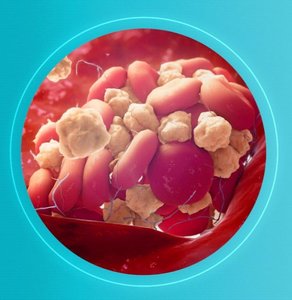
Key Terms and Concepts
Amphipathic: Molecule with both hydrophilic and hydrophobic regions.
Concentration gradient: Difference in concentration across a space.
Electrochemical gradient: Combined effect of concentration and charge differences.
Osmosis: Diffusion of water across a membrane.
Tonicity: Effect of solution on cell water balance.
Equations
Osmosis: Water moves from low solute concentration to high solute concentration.
Membrane potential: (where V = voltage, Q = charge, C = capacitance)
Test Yourself
What is the makeup of the membrane and how does each component contribute to its function?
Distinguish hypertonic and hypotonic solutions.
Distinguish diffusion, facilitated diffusion (gated and channel), and active transport.
What’s the role of the electrochemical gradient?
Additional info:
Membrane structure and function are central to understanding cell biology and physiology.
Clinical examples, such as APS, illustrate the importance of membrane integrity in health.
