 Indietro
Membrane Structure and Function: Study Notes for General Biology
Guida di studio - Note intelligenti
 Appunti personalizzati basati sui tuoi materiali, ampliati con definizioni chiave, esempi e contesto.
Membrane Structure and Function
Overview
The plasma membrane is a fundamental cellular structure that regulates the movement of substances into and out of the cell. It is composed primarily of lipids, proteins, and carbohydrates, and its dynamic nature is essential for cell survival and function.
Cellular Membranes: Fluid Mosaics of Lipids and Proteins
Phospholipids and Amphipathic Molecules
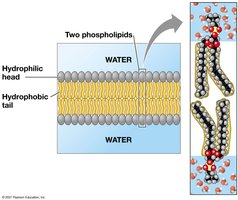
Phospholipids are the main component of cell membranes. They are amphipathic, meaning they have both hydrophilic (water-loving) heads and hydrophobic (water-fearing) tails.
In aqueous environments, phospholipids spontaneously form a bilayer with hydrophobic tails facing inward and hydrophilic heads facing outward.
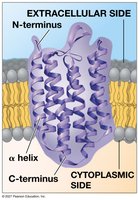
Most membrane proteins are also amphipathic, with hydrophilic regions exposed to the aqueous environment and hydrophobic regions embedded in the bilayer.
The Fluid Mosaic Model
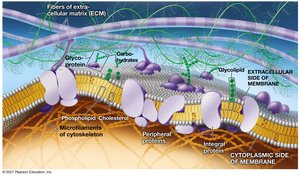
The fluid mosaic model describes the membrane as a mosaic of protein molecules bobbing in a fluid bilayer of phospholipids.
Proteins are not randomly distributed; they often form groups that carry out related functions.
Membrane Fluidity
Membranes are held together by weak hydrophobic interactions, allowing lipids and some proteins to move laterally within the layer.
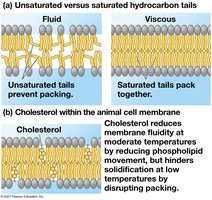
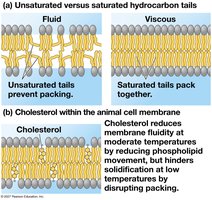
Membrane fluidity is affected by temperature and lipid composition:
Membranes rich in unsaturated fatty acids are more fluid than those with saturated fatty acids.
Cholesterol acts as a fluidity buffer, restraining movement at high temperatures and preventing tight packing at low temperatures.
Membrane Proteins
Membrane proteins determine most of the membrane’s functions and vary among cell types and organelles.
There are two main types:
Peripheral proteins: Bound to the membrane surface.
Integral proteins: Penetrate the hydrophobic core; transmembrane proteins span the membrane.
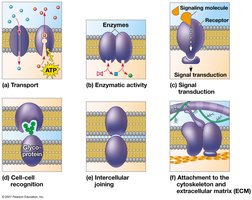
Functions of Membrane Proteins
Transport
Enzymatic activity
Signal transduction
Cell-cell recognition
Intercellular joining
Attachment to the cytoskeleton and extracellular matrix (ECM)
Membrane Carbohydrates and Cell-Cell Recognition
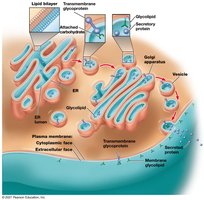
Carbohydrates on the membrane surface are attached to lipids (glycolipids) or proteins (glycoproteins).
These carbohydrates function as markers for cell identification and are important in immune response and tissue organization.
Synthesis and Sidedness of Membranes
Membranes have distinct inside and outside faces due to the asymmetric distribution of proteins, lipids, and carbohydrates.
This sidedness arises during membrane synthesis in the endoplasmic reticulum and Golgi apparatus.
Membrane Structure and Selective Permeability
Selective Permeability
The plasma membrane allows some substances to cross more easily than others, maintaining the internal environment of the cell.
Hydrophobic (nonpolar) molecules pass through rapidly, while hydrophilic (polar) molecules and ions require transport proteins.
Transport Proteins
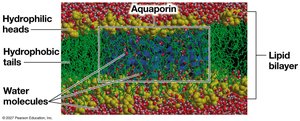
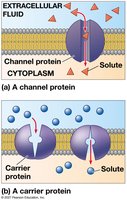
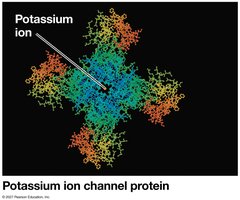
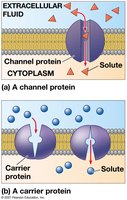
Channel proteins provide hydrophilic tunnels for specific molecules or ions.
Carrier proteins bind to molecules and change shape to shuttle them across the membrane.
Aquaporins are channel proteins that facilitate rapid water transport.
Passive Transport: Diffusion and Osmosis
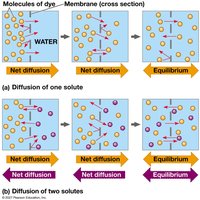
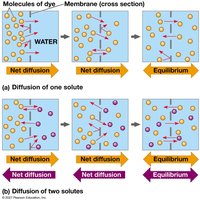
Diffusion
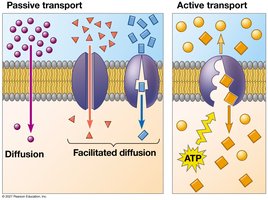
Diffusion is the movement of particles from an area of higher concentration to an area of lower concentration, down their concentration gradient.
It is a passive process, requiring no energy input from the cell.
At equilibrium, molecules move equally in both directions.
Osmosis
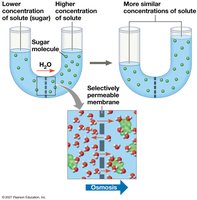
Osmosis is the diffusion of free water across a selectively permeable membrane.
Water moves from regions of lower solute concentration to regions of higher solute concentration until equilibrium is reached.
Tonicity and Water Balance
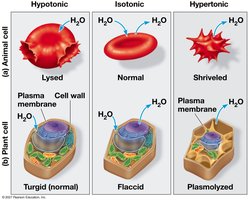
Tonicity describes the ability of a solution to cause a cell to gain or lose water.
Isotonic: Solute concentration is equal inside and outside the cell; no net water movement.
Hypertonic: Higher solute concentration outside the cell; cell loses water and shrivels.
Hypotonic: Lower solute concentration outside the cell; cell gains water and may burst (animal cells) or become turgid (plant cells).
Facilitated Diffusion
Transport proteins assist the passive movement of molecules across the membrane.
Channel proteins provide corridors; carrier proteins change shape to move substances.
Facilitated diffusion does not require energy and moves substances down their concentration gradients.
Active Transport
Mechanism and Importance
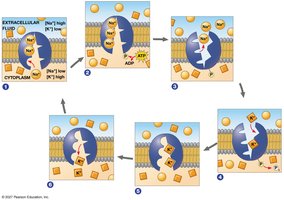
Active transport moves substances against their concentration gradients, requiring energy (usually from ATP).
All active transport proteins are carrier proteins.
Active transport maintains essential differences in ion concentrations across the membrane.
Electrochemical Gradients and Ion Pumps
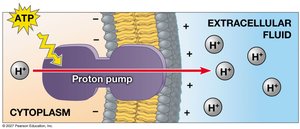
The membrane potential is the voltage across a membrane, created by differences in ion distribution.
The electrochemical gradient combines the chemical gradient (ion concentration) and electrical gradient (charge difference).
Electrogenic pumps generate voltage across membranes (e.g., sodium-potassium pump in animals, proton pump in plants, fungi, and bacteria).
Cotransport
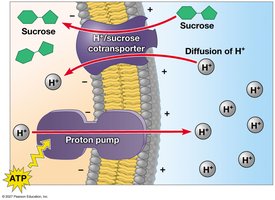
Cotransport occurs when the active transport of one solute drives the transport of another solute.
For example, in plants, a proton pump creates a gradient used to transport sucrose into cells.
Bulk Transport: Exocytosis and Endocytosis
Exocytosis
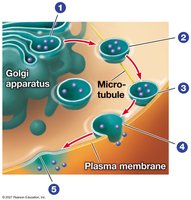
Exocytosis is the process by which cells export large molecules by fusing vesicles with the plasma membrane.
Secretory cells, such as those in the pancreas, use exocytosis to release hormones like insulin.
Endocytosis
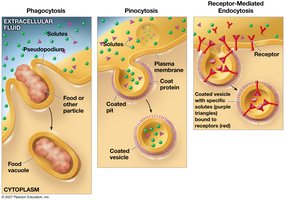
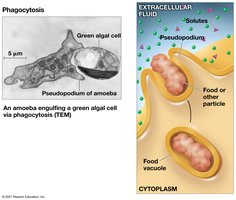
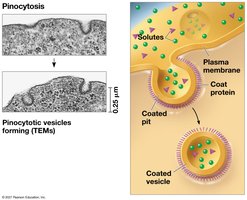
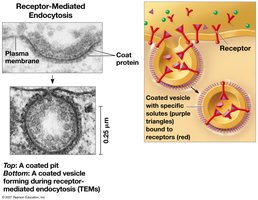
Endocytosis is the process by which cells import large molecules by engulfing them in vesicles formed from the plasma membrane.
There are three types:
Phagocytosis ("cellular eating"): Cell engulfs particles into food vacuoles.
Pinocytosis ("cellular drinking"): Cell engulfs extracellular fluid and dissolved solutes.
Receptor-mediated endocytosis: Specific molecules are taken in after binding to receptors.
Medical Relevance
Receptor-mediated endocytosis is used by cells to take in cholesterol via low-density lipoproteins (LDLs).
Genetic defects in LDL receptors can lead to high blood cholesterol and increased risk of heart disease.
